




Abd Fht 🟥 retweeted

Make sure to join us later today - your chance to ask us any burning questions you have!
nitter.cf/i/spaces/1RJZzjbykkXJB…

By popular demand, our upcoming Community Call will be an AMA- our first in quite some time!
This Monday at 4PM UTC, join @Dr_JohnFletcher and @0xAsuka as they answer all your burning questions about TIG.
We hope to see you there!

Abd Fht 🟥 retweeted

So I was doing some $TIG research today and came across this recent AI IP and Licensing Market Revenue article:
precedenceresearch.com/press…
If you add the algorithm segment ($10.7B by 2035) to a meaningful expansion driven by optimization IP coming online ($5–15B), and the addressable opportunity TIG is building toward is easily $15B–$25B a year in the next decade.
What makes the thesis interesting isn't the TAM number. It's that @tigfoundation is the only project trying to apply ARM's proven licensing machinery to the algorithm segment.
The deal volume in this space is already explosive (Dec 2025, NVIDIA and Groq finalized $20B tech licensing deal), but the standardized licensing infrastructure to capture algorithm-specific value at scale doesn't exist.
That's the gap @tigfoundation is built to fill, with the one person on Earth (Philip David) who has actually done something similar with ARM before. Algorithm licensing today looks like chip IP in 1990. Early.
If TIG can become THE place to attract global talent on algorithmic innovation, and David gets the licensing flowing, $TIG ends up a top 20 token by 2030ish.
What's standing between $TIG and the top 100 right now?
Pudgy Penguins.
That's not a typo. That's the actual market structure of crypto in 2026.
Up to you how you play this one.

Abd Fht 🟥 retweeted

Some days I wish the first @tigfoundation licensing TWAP would just hit. Right now. At $25M market cap.
Not for the price. So that everyone who believed early who read the papers, studied the challenges, understood why algorithms matter more than narratives finally gets rewarded. And everyone who had two years to look and chose not to has to live with it.
SOTA algorithms beating peer-reviewed methods. ARM's former General Counsel building patent-backed licensing. A live demo of decentralized AlphaEvolve shown to the biggest names in AI. A thesis on why tacit knowledge wins the algorithm race tagged to Satya Nadella.
All public. For two years. And you chose dog coins and AI agent tokens that went to zero in two weeks.
When the first commercial license is signed and real corporate treasuries start buying $TIG because they need the algorithms to save millions it doesn't dip. It reprices. Permanently. No second entry.
And that license can drop any day. No warning. No "coming soon" tweet. One announcement and the entire price structure changes forever.
Is it really worth spending your time rotating between memecoins and AI slop for a 2x while ignoring this?
You'd rather bet against Phil David the man who built ARM's entire licensing strategy that extracts billions per year from Apple, Qualcomm, and Samsung because CT isn't talking about it yet?
The cope will be unbearable.
"i DiDn'T kNoW aLgOrItHmS wErE wHaT aCtuAlLy MaDe Ai eFfiCiEnT, i ThOuGhT iT wAs JuSt MoRe GpUs"
"i WaS gOnNa BuY aFtEr ThE fIrSt LiCeNsE"
"nObOdY oN cT wAs TaLkInG aBoUt It"
"i DiDn'T tHiNk OpTiMiZiNg A rOuTiNg AlGoRiThM cOuLd SaVe AmAzOn $600m A yEaR"
But I'm not writing this to gloat. I'm writing this because that window is still open. Barely. The licensing hasn't started. CT hasn't caught on yet. You still have time to read, verify everything I've said, and make your own decision.
Nobody was talking about it. That was the alpha.

Abd Fht 🟥 retweeted
Some long thoughts on John's talk and more broadly about $TIG:
It's taken me a while to really ingest John's articles and get to the heart of what he means. Mainly because he went to the University of Cambridge and I'm a brainlet, but it all comes down to showing that @tigfoundation is the answer to algorithmic advancement right now. If that sounds lofty, that's because it is. It's a big deal.
Overall John's talk was why TIG needs to exist rather than a technical deep dive. It's the right approach right now because people need to know synthetic markets for algorithms are now a thing thanks to TIG.
John mentions Google quite a bit in this talk and shows a slide about the Google CTO stating that "failures don't go into the training data". Ok. So why does that really matter? Because TIG actually solves this by benchmarkers iterating on the best piece of work they've previously witnessed. This way you're building on every "failure". In reality through TIG, failures are just building blocks.
Basically TIG is the first time in history anyone can monetize algorithms that they've improved upon openly. Think about that for a second and where we are right at this moment with AI exploding in front of us. The chance of a smaller collective of theorists or even a genius NEET in his mom's basement coming up with a new algo has never been higher in history. @tigfoundation has now created a home for these types of creators to monitize their work. It's unprecedented and the timing is perfect.
Around 20:30 John goes into this aspect and how open source has struggled with this. The problem that has existed is that when something through open source makes money that "money went to a central vendor and they were responsible for distributing it" and maybe "this guy got twice as much as a contribution than me but why?...some guy at the top decided". Obviously you can see what issues this causes. @tigfoundation solves this.
John also went into Karpathy describing TIG's exact architecture on No Priors without ever having heard of it. Which just shows you the path they're on right now is the right one. Dig up those tweets if you haven't read them.
And finally someone in the crowd asked about the defensibility of the dual licensing system TIG is going with. John likens it to "stealing sweets from a child". And to paraphrase some more points: "You're just not going to do it in this type of community. These are some of the smartest people in the world and no one can afford to take that reputational hit. Because TIG has a revenue stream, they can afford to file patents and rely upon community enforcement."
Ultimately, Philip David has this on lock. If the most successful man in this field of IP thinks it will work, it will work.
When they commercially license an algo, the bull case for $TIG is considerably higher than you can imagine. There's not even 10 challenges on mainnet yet. Stacked emissions kick in over 100 to fuel the protocol but they're targeting 1000+ challenges.
Early.

This is the talk I gave last week at @agihouse_org in SF youtu.be/DGTbBp_48XE?si=_UcJ…
The talk covers
- Why AI-algorithm discovery pushes algorithms closed, and why this is so serious
- How to prevent it
- How and why TIG works
- TIGs unique IP, licensing and revenue model
For those curious about TIGs licensing and IP (and you should be!) This talk covers it in more depth that I've gone into before. Don't miss the question at the end :)



Abd Fht 🟥 retweeted
Community Call Summary
Something important happened at @agihouse_org SF over the weekend.
A swarm of 16 agents produced an algorithm 3% off the global state of the art.
The full story👇
Abd Fht 🟥 retweeted

We demonstrated our AI-agent framework for massively collaborative algorithm discovery for the first time yesterday
Using the TIG Vehicle Routing Challenge (collaboration with @StevenDiam77921)
The TIG team had the pleasure of presenting to some of the biggest players in the AI-algorithm discovery space
They learned they can mine for algorithms, monetise the outputs through TIG, while keeping the algorithms open for others to build on and improve
Minds were blown
Details to follow

Abd Fht 🟥 retweeted
I bought more $TIG after reading John's post the other day. It was fantastic. But I want to take a second to highlight his co-founder Philip David.
The guy who built ARM's licensing strategy now runs IP at $TIG.
Philip was General Council at ARM for 15 years. SVP of IP during the SoftBank acquisition. He designed the framework that lets ARM collect royalties on 95% of the world's smartphones without manufacturing a single chip. Yeah. Read that again.
ARM doesn't make anything. They create the IP. They license it. They get paid every time someone ships.
That's exactly what $TIG is doing for algorithms.
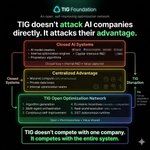
Open Data License for researchers. Commercial License for enterprises. Every algorithm stays open, but commercial use generates revenue that flows back to contributors.
The man who turned processor IP into a $150B+ licensing machine is now applying the same playbook to computational methods.
Most people in crypto have never shipped a real licensing framework.
$TIG's co-founder spent a decade and a half building the most successful one in semiconductor history.
Just some food for thought.
Andrej,
I’m John Fletcher. I have a PhD in mathematics and theoretical physics from Cambridge, and since 2016 I have been working full-time on the problem of how to coordinate untrusted distributed compute for algorithmic innovation.
I listened to your No Priors conversation and recognised the architecture you were describing: commits that build on each other, computational asymmetry (hard to find, cheap to verify), an untrusted pool of workers collaborating through a blockchain-like structure.
The result is The Innovation Game (TIG), which has been in continuous operation since mid-2024. The correspondence is so close that I thought it worth writing.
The short version: roughly 7,000 Benchmarkers test algorithms submitted by Innovators by solving instances of asymmetric computational challenges (SAT, Vehicle Routing, Quadratic Knapsack, Vector Search, among others).
This testing is "proof of work" in the technical sense of Dwork and Naor (1992). Innovators earn rewards proportional to adoption by the Benchmarkers. The repository of algorithms is open source (github.com/tig-foundation/ti…).
The system is already producing state-of-the-art results. For the Quadratic Knapsack Problem, 476 iterative submissions by independent contributors brought solution quality to a level that now exceeds methods published by Hochbaum et al. in the European Journal of Operational Research (2025).
We are working with Thibaut Vidal (Polytechnique Montréal), who has submitted a state-of-the-art vehicle routing algorithm directly to TIG, and with Yuji Nakatsukasa (Oxford) and Dario Paccagnan (Imperial College London), among many others.
One of TIG’s active challenges is directly relevant to your autoresearch work: an optimiser for neural network training (play.tig.foundation/challeng…), where Innovators compete to develop an improved optimiser (see screenshot).
One way in which TIG extends the vision is on the economic side. In our view, a monetary incentive is required, otherwise the open strand simply cannot compete at scale. TIG’s open source dual licensing model (designed by my co-founder Philip David, who was General Counsel at Arm Holdings for over a decade, and was the artchitect of ARMs licensing strategy) is intended to solve that problem.
I expect we have each thought about parts of this that the other hasn’t. Happy to talk whenever suits.
John Fletcher
tig.foundation


Abd Fht 🟥 retweeted
I really think people should take the time to research $TIG.. especially at these extremely low valuations
These two videos are a great place to start..
⚫️ This presentation from @Dr_JohnFletcher at the University of Cambridge is a great 20 minute overview..
Here 👉 youtube.com/watch?v=afZO45Mv…
🔵 @Dr_JohnFletcher and @MessariCrypto helps unpack why decentralized algorithmic are the way forward
Here👉 youtu.be/i_K_32bWTTI?si=I5M8…
Its just 90 minutes of your time.. I highly recommend it 👍
$TIG


Abd Fht 🟥 retweeted

Web3 All The Way Down 🔴
On Saito, you get all the best benefits of blockchain:
⛩️ Openness
💰 Self Sufficiency
🦾 Censorship Resistance
🔑 Public Key Infrastructure
Core principles of Web3.
Dive deeper into Saito 👉 wiki.saito.io/

ALT Web3 All The Way Down


Abd Fht 🟥 retweeted

The storage performance of the Stratos network is exceptional, though it's important to note that its primary advantage is not merely upload speed. Once a 1 GB file is uploaded, it, along with at least four additional replicas, becomes globally accessible. Stratos is designed to ensure that regardless of your location, the network delivers the nearest copy of the file to minimize latency. This capability is particularly valuable for AI projects and CDN applications, where swift, reliable access to data is critical.
Moreover, all five copies of the data are identical, traceable, and verifiable, ensuring data integrity and security. This makes the Stratos network ideally suited for DA, providing a robust infrastructure layer that meets the demanding needs of such blockchain or applications.
The combination of global data availability, low latency, and secure, verifiable copies positions Stratos as an unparalleled solution in the infrastructure space for both current and emerging #blockchain #Web3 needs
$STOS

💨 Stratos community flexing its network power! Uploading a 1 GB file in just 20 seconds - that's the unbeatable speed of #Stratos! Top-tier decentralized storage performance on display! ⚡️
$STOS #DePIN #Dstorage #datastorage
Abd Fht 🟥 retweeted

The future of data storage is decentralized.
Stratos are already on their way to having the number one data storage platform in the world of Web3.
This is a blue chip in the making, look forward to seeing how they grow this year! $STOS
@Stratos_Network 🤝

Abd Fht 🟥 retweeted

▶️Step into a dynamic digital landscape where the CDN market, currently dominated by a select few, is on the brink of transformation. Picture this: only 7 major players control over 80% of the market, posing risks of concentration and latency, especially in far-flung regions like Africa.
Now, imagine a game-changing solution—breaking away from the centralized norm. A distributed model with smaller CDNs across regions holds the key to mitigating network failures and reducing latency. The catch? Traditional barriers like massive capital outlay have deterred these smaller players. But here's where the plot thickens: Stratos, with its revolutionary 3-layer infrastructure—decentralized storage nodes, meta nodes, and a native blockchain—promises to not only tackle these challenges but also open doors to a lucrative commercial opportunity with its decentralized CDN service.
Why does it matter? The global CDN market, valued at $20 billion in 2022 and projected to skyrocket to $100 billion by 2032 (sans the potential impact of emerging web3 use cases like NFTs), is ripe for disruption. Get ready to witness Stratos emerge as a powerhouse, rewriting the rules of CDN services and steering us towards a more resilient and efficient digital era. @stratos_network is set to redefine the game! 🚀
#web3 $stos $fil $ar #cdn #crypto #decentralizedstorage


