

Palo Alto, CA
Joined July 2025
- Tweets47
- Following568
- Followers504
- Likes244



Alexandre Carlhammar retweeted
Yes, the only way this is solved is by looping in the data from deployed assembly line.
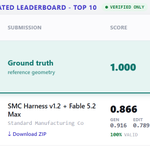
We just took #1 on CADGenBench, the leading benchmark for parts engineering. huggingface.co/spaces/Huggin…
We developed a SOTA CAD generation harness through a novel predictor-corrector architecture.


The model proposes the part. A deterministic geometry kernel then verifies the B-rep against dimensional and topological constraints that two independent agents extract from the drawing.
We also reinforced the system on large libraries of real manufacturing and assembly-line data that we collected.
More on it soon.



Low-volume, high-mix manufacturing presents 3 fundamental challenges for automation:
- Design: Products aren’t designed for automated assembly.
- Deployment: Automated assembly lines are bespoke to individual products, with little skill transfer to new products.
- Flexibility: Adapting lines to changes in product design, supply variance, etc. is incredibly difficult.
We’re fixing this. More on it soon.

A top-level @anduriltech exec shared at dinner tonight that they use little to no automation in their manufacturing facilities because “automation today is incapable of adapting to low-volume and high complexity production lines”
There’s still such a gap between the automation dream and what is technically possible today.
Alexandre Carlhammar retweeted

Don't get lost in the sauce. Focus on what you can control:
1. The folks in your corner.
2. Your personal relationships
3. Executing your purpose / mission.
Let's rip it. Time to build.
Alexandre Carlhammar retweeted

Factories of the future will not only be factories
As the performance of design automation tools increases, manufacturers will start moving more upstream.
Design, simulation and testing will all get compacted into one comp.
The manufacturer will design the parts
The manufacturer will simulate the part
The manufacturer will manufacture the part
The manufacturer will test the part
Not every manufacturer will be able to profit from this consolidation though.
Alexandre Carlhammar retweeted

"getting it manufactured still required several rounds of review and iteration"
yes, welcome to the real world. we could have solved rsi and it won't matter. the only thing that solves this will be factories.

Imagine the magic you could create if you also had manufacturing signals in the loop…👀
These are early steps, and we’re looking for engineers, engineering firms, and software partners to help shape what comes next.
openai.com/index/acceleratin…

1
4
628
Alexandre Carlhammar retweeted

You cannot scale manufacturing without systems and scaleable processes. If there's a problem, you have to attack it right away with a solution that is easily repeatable across hundreds of new hires. Very hard to do.
But if you do it, you will win.
Alexandre Carlhammar retweeted

Today, we are introducing Fern: our first model that supports up to 10M tokens in context window!🌿
You could put an entire repository (or repositories!) in the context, continue to work on problems for days without hitting compaction limits or use it to consolidate other agents’ works.
As always, we have a lot more work to do but wanted to give you the update. Excited hear how you would use a 10M token context window.


From thinking of a product, captured through BCI, to generatively designed products (CAD, PCB) and co-designed assembly lines, all within a shared agentic engineering and manufacturing harness (FEA, CFD, DFM, …).
Bidirectional signals across the entire system, continuously co-optimizing product and factory for cost, throughput and volume.
Driving the distance between thought and physical reality to zero.
Soon, this won’t be science fiction.
2
7
5,352
Alexandre Carlhammar retweeted

Hey anduril

We made this omnidirectional "swerve" robot that's about 2.5 inches thick. It's holonomic, meaning it can move in any direction, spin in any direction, simultaneously. There is a quick swap turret with slip ring that gives it even more agility. planning on an especially fun attachment soon, but you can add cameras, lidar, robotic arms, lasers, to name a few. Files are free on my ko-fi.
Mechanical BOM is just $110
Even with electronics it's well below $200. For comparison, most robotics competitions use swerve modules (this one has four such modules), and each individual module costs about $500-$1000. Part of the reason i hate competition robotics
Swerve is in no way new but what about a thin slab one? Wondering if there are any actual use cases of this thing.
Built with @JamesMakes29, Thank you @Willqyu at The Standard Manufacturing Company for helping support
Additionally, thank you LDO motors, SendCutSend, PCBWay.


Alexandre Carlhammar retweeted

There is a missing link here.
Modern manufacturing is built on programmable, generalisable machines. CNC mills, lathes, lasers, and more. One machine can make many parts. 1/5

Alexandre Carlhammar retweeted
the reality is (a) true reindustrialization requires you to completely rebuild production methods from scratch with new tech, (b) part (a) takes a shitload of r&d, (c) only once you've proven a better method should you scale it, (d) these companies are far more valuable than PE multiples, (e) taking over someone's machines for revenue is fine but isn't really solving anything

Pre-seed valuations in reindustrialization are climbing, even before prototypes or production.
At these valuations, why not take a PE approach after the raise? Acquire machine shops from retiring owners. Get revenue, skilled labor, equipment, and production capacity on day one. Build your new products on the night shift while expanding capacity.
When equipment lead times are a major bottleneck, buying existing capacity could be a massive advantage.
I think we’re about to see a new monster emerge. A hybrid of venture capital and private equity built for American reindustrialization.
Was a pleasure presenting at CAD+AI.
Future of genCAD is closed-loop product gen with manufacturing signals so the parts are actually DFM. More on it soon.


Alexandre Carlhammar retweeted
it's gonna be pretty interesting once people decompile every single piece of CAD/CAM and simulation software

