

Medical Affairs Consulting || Operational Improvement || DOL/KOL Engagement || Insight Programs || Medical Affairs Impact || Launch Support
United States
Joined May 2020
- Tweets3K
- Following78
- Followers63
- Likes21



HCP contracting rarely breaks in one big way. It breaks in small ones: a contract stuck in legal, a status no one can find, no single owner. Three components that help keep it on track: f.mtr.cool/awhtzs42ib #MedicalAffairs #HCPContracting

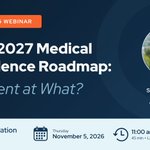
A new tool is not a strategy. Scott Thompson on building an effective Medical Excellence roadmap: define the outcome first, then align process, tools, people and support.
Watch the full webinar: f.mtr.cool/6taigjrku3
18
Your Q1 field insights are ready to act on. In May. By then, the moment has usually passed.
The problem is rarely that teams collect too little. It is that tens of thousands of data points a year cannot be read by hand fast enough to matter. So insight sits in a queue, the richest free-text notes go unread, and field teams submit feedback they never hear used again.
Our breakdown covers why the insights process stalls, and how AI changes it:
🔹 Volume: process structured and unstructured data together, instead of manually
🔹 Timeliness: move from a months-long lag to near real-time analysis
🔹 Visibility: give field teams dashboards that show how their insights are actually used
Done right, the same insights your team already collects start reaching the people who can act on them while they still matter.
If your field insights are sitting too long before anyone acts, this one is worth a read. #MedicalAffairs #MedicalInsights #SocialListening
Read the full breakdown. 👇
accelerationpoint.com/resour…
9
The best Medical Affairs hire is not always the most credentialed one. The leaders who have built both billion-dollar businesses and global Medical Affairs teams often screen for something else first.
On OnPoint, Craig Granowitz, who has run a $2.5 billion commercial business and global Medical Affairs organizations, shares the first trait he looks for in a hire. Not deep expertise, not the right titles. Curiosity. In his view it is the root trait, and the two that matter most grow out of it: when you truly want to understand something, you raise your hand and dig in, and that becomes courage. You keep going until you know, and that becomes tenacity.
The catch is that it has to be real. You cannot perform curiosity in front of a KOL and expect it to land. In a scientific exchange, people read the difference instantly, and a genuine desire to learn is what earns you the room.
The conversation also gets into why Craig calls Medical Affairs the common glue across an organization, and why staying human is a leader’s edge in the era of AI.
If you hire, develop, or lead Medical Affairs teams, this one will shift how you think about what to screen for. #MedicalAffairs #MedicalAffairsLeadership #MSL
Listen now. ⬇️
accelerationpoint.com/podcas…

1
12
Omnichannel. Digital. Optichannel. At what point does strategy turn into overcomplication?
Here is the uncomfortable number: 80% of HCPs still receive generic, impersonal communications from pharma, and fewer than 20% feel personally engaged. The gap between ambition and execution is real, but it is not a channel problem. It is a coordination problem. KOL profiles, CRM notes, publications, and insights all live in different places, disconnected.
In this webinar, Justin Kulovsek walks through a simplified framework for cutting the complexity:
🔸 WHO: identify the right HCP audiences
🔸 WHERE: align your digital strategy with field
🔸 WHAT: choose compliant channels with a clear purpose
🔸 HOW: use content to strengthen scientific exchange
He also names what quietly derails teams: too many channels with no clear owner, digital and field working in silos, scaling before the foundation is set, and measuring activity instead of impact. The fix is not adding more. It is starting with one use case, proving it, then scaling.
If your omnichannel strategy has gotten more complicated than it is effective, watch the full session. #MedicalAffairs #Omnichannel #HCPEngagement
Watch the full webinar ➡️ youtu.be/oohxZsyrpVs?si=Dj3R…

7
Two companies. One KOL. Two systems that don’t talk. 🤝
In a co-commercialization partnership, the hardest part of KOL engagement is often the least visible one: sharing what you learn. Field teams log the same interaction twice, once in their own CRM, once by hand for the partner. Multiply that across two organizations, two privacy rules, and two engagement calendars, and valuable KOL insight gets trapped inside one partner’s systems.
Our article breaks down the four challenges Medical Affairs teams face when more than one organization engages the same experts, and how to keep it consistent:
🔹 Aligning on a single, mutually agreed KOL list before outreach begins
🔹 Reconciling two different engagement strategies into one coherent approach
🔹 Coordinating activity so KOLs are not overburdened or sent mixed messages
🔹 Sharing insights compliantly across different systems and data protocols
Shared KOL data becomes real visibility, and real visibility drives coordinated decisions.
If your team manages KOL engagement across a partnership, this one is worth a read. #MedicalAffairs #KOLEngagement #Kwello
Read the article. 👇
accelerationpoint.com/resour…
7
Today, we honor all who have served.
Their commitment, discipline, and sacrifice continue to shape the communities and workplaces they return to. To all who have served, and to the families who served alongside them, thank you.
#VeteransDay

1
A good Medical Affairs leader can run the business. An exceptional one builds people who no longer need them in the room. 🎙️
On OnPoint, Linda Traylor sits down with Samuel Dyer, MD, PhD, founder of the Medical Science Liaison Society, for a conversation about leadership, communication, and building a career that outlasts any single title. From absolute poverty to leading Medical Affairs teams across 60 countries, his throughline is a reframe worth borrowing: stop asking what your next job is, and start asking what you can contribute that does not exist yet.
A few threads worth sitting with:
🔹 Why the MSL role is a communication role through science, not a scientific one. Science gives you credibility, communication creates the impact
🔹 Why being technically correct is not the same as being effective, especially with KOLs
🔹 Why the higher you lead, the more the quality of your questions matters than the quality of your answers
If you are building a career in Medical Affairs, or the people around you, this conversation will stay with you. #MedicalAffairs #MedicalAffairsLeadership #MSL
Listen now. 👇
youtu.be/0nagK2JfjVU?si=afT8…

17
You cannot attend every session at a major congress. The good news is you do not have to, because much of the conversation is happening in public, in real time.
In this webinar, Scott Thompson and Shruthi Menon walk through a practical, step-by-step way to run congress social listening using tools your team already has, no expensive platform required. The focus is turning the noise of a busy meeting into a structured read on what actually mattered:
➡️ Where to start: the congress website itself, which points you to the official hashtag and the platforms its members use
➡️ How to search X, LinkedIn, and YouTube, filtering by engagement, dates, and disease keywords to cut through the volume
➡️ How to judge which accounts are credible, and how to spot active HCPs outside your existing network
➡️ How to organize it all into a report that answers three questions: how much conversation, what topics resonated, and who drove them
Done right, you get the scientific intelligence from sessions you missed, plus the compliance guardrails to do it safely.
If your team wants a sharper read on your key congresses, watch the full session. #MedicalAffairs #SocialListening #KOLEngagement
Watch the full webinar here.👇
accelerationpoint.com/resour…

22
Listen to our webinar, “Avoiding the Insights Graveyard,” with Scott Thompson. 🎧
When Scott starts an insights project, he asks teams one question: what decisions are you trying to support? Most cannot answer it. The teams that can are the ones where people are already waiting on the insight, because the work started with a decision, not a data collection plan.
His first takeaway is a sentence everyone on your team should be able to finish:
We need to understand ______ so that ______ can decide ______.
For example: understand the barriers to treatment so the field team can decide which HCPs to prioritize. It starts with knowing who is making what decision, and what they need to feel confident making it.
The full session covers three keys to using AI on insights without making the graveyard bigger. 🪦
For Medical Affairs and Medical Excellence leaders who want their insights to drive decisions. #MedicalAffairs #MedicalInsights #AIinPharma
Watch the full webinar today! 👇
youtu.be/W3DwVBomogY?si=UL8U…
1
9
Next Tuesday on OnPoint. 🎙️
Samuel Dyer, MD, PhD, founder of the Medical Science Liaison Society, joins Linda Traylor for a conversation on leadership, communication, and building a career around what you can contribute, not what title comes next.
One idea to sit with until then: the MSL role was never a scientific role. It is a communication role through science.
Full episode drops Tuesday. #MedicalAffairs #MedicalAffairsLeadership #MSL
Stay tuned.

5
💥 Today is the day.
At 11:00 AM ET, Scott Thompson goes live for Your 2027 Medical Excellence Roadmap: Excellent at What? A free 60-minute session on building a roadmap your organization can actually follow.
There is still time to join.
#MedicalAffairs #MedicalExcellence #MedicalOperations
Registration closes soon!👇
us02web.zoom.us/webinar/regi…

5
📈 Teams collect more field data than ever. Turning it into decisions is where most get stuck.
The gap between raw MSL notes and a real medical insight is wider than it looks. Our article breaks down five challenges that quietly block it:
1️⃣ Data collected without clear objectives
2️⃣ Insights that never reach decision-makers
3️⃣ KOL engagement getting harder to do well
4️⃣ CRM data too messy to see patterns in
5️⃣ Over-reliance on a single MSL
The throughline: data collected without a decision in mind rarely becomes insight. Direction is what makes it actionable. The article covers how to fix each one.
If your team collects plenty but struggles to act on it, this one is worth a read. #MedicalAffairs #MedicalInsights #MSLEffectiveness
Read the article. ⬇️
accelerationpoint.com/resour…

6
Tomorrow.
That is when we go live with Your 2027 Medical Excellence Roadmap. Last chance to register before it starts.
If your roadmap looks impressive on paper but the teams you support experience it as more work arriving, this session was built for you.
Scott Thompson walks through three moves that separate roadmaps that pull the organization forward from ones that just add to it, plus a practical way to pressure-test your current roadmap.
📅 Thursday, November 5 | 11:00 AM ET | Free
Built for Medical Excellence and Medical Operations leaders planning for 2027. #MedicalAffairs #MedicalExcellence #MedicalOperations
Register now👇
us02web.zoom.us/webinar/regi…

9
📩 Most 2027 Medical Affairs plans will list more initiatives than last year. Few will say what all of it adds up to.
The October issue of OnPoint is built for that gap, with four ways to plan sharper for next year:
🔹 Scott Thompson on three moves for a 2027 roadmap that pulls your organization forward
🔹 Share of Voice: a non-promotional way to read the scientific conversation around treatments
🔹 Marie-Ange Noué, PhD, CMPP and Linda Traylor on why trust, not technology, is what Medical Affairs runs on
🔹 Justin Kulovsek’s free guide: ten compliant plays for turning DOL insight into action
Planning season is the moment to decide what your team will be excellent at, not just busy with. If you lead Medical Affairs or Medical Excellence, this issue is worth your time. #MedicalAffairs #MedicalExcellence #Pharma Read this month’s issue and hit
Subscribe to get the next one. ⬇️
connect.accelerationpoint.co…

12
Patients describe their conditions and unmet needs in public online spaces every day. Most Medical Affairs teams never hear it.
Surveys give you a snapshot from months ago. The patient conversation is happening right now, in patients’ own words. Patient social listening is the structured way to turn that scattered dialogue into understanding, and our breakdown covers what it surfaces:
🔹 Unmet needs, in patients’ own words
🔹 Gaps where education falls short
🔹 New questions worth exploring through evidence generation
🔹 Priorities that can inform trial design
Done right, this is a population-level scientific activity, not a promotional one, which means pharmacovigilance and compliance oversight belong in the program from day one.
If your team wants to ground its strategy in the real patient experience, this one is worth a read. #MedicalAffairs #PatientSocialListening #PatientCentricity
Read the article. 👇
accelerationpoint.com/resour…

6
Before you add another initiative to your 2027 plan, answer one question: excellent at what?
Medical Excellence teams have shipped more than ever. More initiatives, better KPIs, real progress. What is often missing is a clear line connecting all of it to one outcome. On November 5, Scott Thompson walks through three moves for building a 2027 roadmap that pulls the organization forward instead of adding to the pile:
🔹 Name what you are making excellent. Define the one outcome Medical Excellence exists to improve, and connect every initiative back to it
🔹 Report improvements, not projects. Lead with what is getting better, not just what you launched
🔹 Build the roadmap as a system, not a list, so each initiative connects to the others and to the outcome you named
Then pressure-test it with the same question: excellent at what? If your team can answer in one sentence, the roadmap is working.
Built for Medical Excellence and Medical Operations leaders planning for 2027. #MedicalAffairs #MedicalExcellence #MedicalOperations
Register now. 👇
us02web.zoom.us/webinar/regi…

5
Every treatment in your indication is part of a conversation happening online right now. The question is how much of that conversation is actually about yours.
That’s what Share of Voice measures: the percentage of social discussion in an indication that mentions a specific treatment. One number that shows how present a treatment is in the scientific conversation, and how that presence shifts over time.
The useful part is in how you
break it down:
🔸 By treatment, to see which ones dominate the discussion
🔸 By source, to see which congresses, publications, and KOLs are driving it
🔸 Over time, to catch a shift the month it starts, not a quarter later
And because it reads a conversation that’s already public, it stays firmly non-promotional. It helps Medical Affairs understand the landscape without ever trying to influence it, keeping a clean line between Medical and Commercial.
For Medical Affairs teams who want a sharper read on where the science is heading, this one is worth your time. #MedicalAffairs #SocialListening #KOLEngagement
Find the full article below ⬇️
accelerationpoint.com/resour…

11
Most Medical Excellence roadmaps look impressive on paper and add friction in practice.
Scott Thompson has worked alongside Medical Excellence teams as they build ambitious roadmaps, and seen how often the teams they support experience those roadmaps as more work, not progress.
The difference between a roadmap that pulls the organization forward and one that just adds to the pile comes down to a few deliberate choices. On November 5, Scott shares three of them for building a 2027 roadmap your organization can actually follow.
📅 Thursday, November 5 | 11:00 AM ET | Free
Built for Medical Excellence and Medical Operations leaders who want their 2027 roadmap to work as a system, not a to-do list. #MedicalAffairs #MedicalExcellence #MedicalOperations
Registration is now open👇
us02web.zoom.us/webinar/regi…

6
Credentials get a Medical Affairs candidate in the door. Curiosity is what gets them hired.
Craig Granowitz, M.D., Ph.D., Chief Medical Officer at Lexicon Pharmaceuticals, started as a sales rep, grew a $2.5 billion commercial business, and then built global Medical Affairs organizations at Schering-Plough, Merck, Amarin, and Lexicon.
On Episode 24 of OnPoint, he tells Scott Thompson the three attributes he screens for in every hire: curiosity, tenacity, and courage.
His take on which one matters most: “If you have curiosity, the other two come out of that.”
The conversation also covers:
🔹 Why Medical Affairs is “the common glue” connecting R&D, Commercial, and external stakeholders
🔹 How he reads the health of a team by watching its cross-functional meetings
🔹 Why, in the era of AI, the more human a leader becomes, the more valuable that leader is
For Medical Affairs leaders building teams that can connect science, strategy, and people. #MedicalAffairs #PharmaLeadership #MSL
Listen now in the comments section. 👇
accelerationpoint.com/podcas…

1
1
7