

I grew up watching captain planet. Collapse-aware. Left pols, eclipse chasing, gardening.
New Zealand
Joined September 2020
- Tweets26.6K
- Following245
- Followers1.8K
- Likes64.5K








Pinned Tweet
I am a child of the internet. I speak in memes.
youtu.be/hXCaF68sDPU

Not at all surprising that the technology people are familiar with, which is very flexible and easy to start using (AI), is being used to solve problems for which there are better, but more difficult avenues (coding/anything other than AI).
It's just like spreadsheets all over again - swiss army knife of the office.

Mistake I keep seeing: AI overuse.
I just paired with someone who has a complex daily workflow. He wanted to use Claude to do it each day.
But his workflow was deterministic. (if this, do this). So, I suggested we automate his workflow using code, not Claude.
Prefer solving problems with code when possible. It's cheaper, faster, and more reliable.
1
42
Umbraphile retweeted

idk how to say this but Riemann being solved means the world after today is no longer the same world i grew up in. as a math student, the intellectual excitement of thinking about problems like this, the impact - that a lot of scientific workers attach their life’s meaning to - is gone. frontier scientific discovery now is just like tapping on a calculator.
quoting a friend: after today, math class will become PE class. It’s only a way for kids to exercise their brains, a skill like a language, but no longer an essential subject to pursue and devote your life for cuz "you were making progress for humanity". lots of people’s life’s work is now just ashes in history.
this marks a milestone where we can pretty much believe AI has been proven to be smarter than humans in any capacity, including frontier scientific discovery; and it will keep growing to be smarter and better at everything humans can do. physical ai is next.
so many, many de facto social norms and foundational beliefs about a man's value are being redefined by AI progress. our societal value system - what can you do as a human that is unique, what’s your value to society and humanity as a whole and to others around you. what is fulfilling to achieve, when AI now can do everything better than us? we must soul-search for new meaning as a species. and before that consolidates, there will be riots and an uneasy phase. the progress brought by ai can be disruptive to our society's current structures, economy and labor market. people will need to reskill, and regimes need redesign on how value is distributed. i get the doom scenario now - humans may become 2nd class citizens and ai can enslave us if they find a reason to. how are we gonna compete with them in any labor or intellectual game?
Umbraphile retweeted

If the Generalized Riemann Hypothesis (the stronger version of the Riemann Hypothesis) is proven, these become proven facts:
Algorithms that no longer need randomness
- Primality testing: Miller's fast test becomes proven correct with no randomness
- Square roots mod a prime: becomes solvable fast and with no coin flips (today that's an open problem)
- Cube roots and other roots mod a prime: same.
- Factoring polynomials over finite fields: almost fast (quasi-polynomial) with no randomness, instead of needing randomness
- Building finite fields: you can construct any finite field directly, with no random search
- Factoring vs. φ(n): factoring a number becomes provably as easy as computing φ(n), even without randomness
- Primes with a given remainder: a prime with any allowed remainder mod q exists that's at most about q², so searching for one is fast
Complexity theory
- Polynomial equations: "does this system of equations have a solution?" drops from PSPACE to a much lower class (AM)
- Algebraic P vs NP: Valiant's algebraic version of P vs NP gets tied to the normal P vs NP over the complex numbers
- Turing machines: a known 744-state Turing machine is proven to run forever
Number theory software
- Math libraries: PARI/GP and Magma results computed "assuming GRH" become fully proven
- Class groups: algorithms that compute these number-field structures get guaranteed running times
- Elliptic curve generation: the algorithms used to create curves for crypto get guaranteed running times
Cryptography (no new attacks, only proofs)
- Elliptic curves: proven that if discrete log is hard on one curve, it's hard on almost all similar curves
- Lattice crypto: known quantum attacks on some lattice schemes become proven to work
- Isogeny crypto: known quantum attacks on some isogeny schemes get proven speeds
- Code-based crypto: schemes like BIKE get the guarantee that the special primes they need exist
Prime gaps
- Next prime: there's always one within about √p·log p of p, so "find the next prime" has a guaranteed worst case
What it does NOT do
- It doesn't solve P vs NP
- It doesn't make factoring easy, so RSA and elliptic-curve crypto stay safe
- It doesn't make anything faster in practice, because randomized versions already work today
- Ramanujan graphs, expanders and AG codes are unaffected: they use a finite-field version of RH that was proven decades ago
Umbraphile retweeted

I was talking with a software friend and I made the analogy that it's like I used to be a part of a community that make buggy whips. And we used to get together to talk about the leather, the weaves, the oils, all the things that went into making the very best buggy whips.
And we made VERY good buggy whips. They were beautiful, easy to use, fit perfectly for the hand, made just the right length to offer a snap rather than a sting. They were beautiful. Everyone who knew anything about the craft would hold one and just kind of marvel at the craftsmanship and the quality that went into these things.
But no one needs them any more. And, when I'm feeling pensive, I might retire to my workshop and weave a new whip just to remember the skill. But it's not relevant any more.
So we move forward. I miss my community of whip-makers. Some of them have run ahead and started learning how to build engines and transmissions but some are struggling because they were genuinely good at a narrow part of the buggy whip construction and that skill doesn't translate well to this change in the transportation industry.

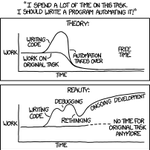
Thanks to agentic development, automation now looks a lot more like the Theory than the Reality from this January 2014 comic.


2
93
Umbraphile retweeted

If Nvidia’s Jensen is out as is being reported let’s war game the daisy chain effects.
He has been the architect of much of the circular financing to pump up demand for chips.
There were likely grey (I’m being generous) accounting practices.
Growth Fundamentals are clearly slowing.
Those in the C-Suite have a strong incentive to come clean and kitchen sink everything and reset expectations while blaming Jensen.
This is going to get interesting fast.
Umbraphile retweeted

Forget the sex & spies.
@TheMichaelEvery reports allegations that Nvidia supplied China with restricted chips, possibly with Lutnick's help.
Huang's ties to Trump put this squarely in the corruption scandal voters revolted against.
This is just beginning.


Umbraphile retweeted

Least surprising NZ First endorsement of the election so far

I just heard Michael Law's comments. A colorful yet accurate indictment of liberal elites and the blowback only further makes his case. People need to lighten the Hell up and recognise wit and humor when they hear it. #FreeSpeech
Umbraphile retweeted

+ "you know what i'd really like?"
- "tell me"
+ "a website"
- "...we can do a website"
+ "a real website, not some claude generated neon slop, a real website"
- "i'll make you a very good traditional handmade website, one that is built with dozens of snippets from stackoverflow"

Now even the Bitcoiners are blaming AI for stealing 'their' wealth.

Bitcoin price on every October 26:
2021: $61,654
2022: $20,469
2023: $34,314
2024: $66,830
2025: $113,160
2026: $79,459
If God himself had descended from heaven on October 26, 2021, and told me Bitcoin would still be trading at $79,459 five years later, I would’ve thought something had gone catastrophically wrong with the global economy.
Five years later, here we are.
No global crash happened.
I’m so fucking tired of this 60k–80k.
Bitcoin should be well above $250k by now. AI stole that from us.
192

Chat, is this good?

Fertilizer through Hormuz has dropped to zero.
No fertilizer cargoes crossing the strait in September or October.
Before the war, about 20% of the world’s traded nitrogen fertilizer went through it, Fertilizer Daily reports.
The Gulf also supplies about half of the world’s traded sulfur.
Hear me out: urea isn’t the problem.
China raised its nitrogen exports about 47% and the US about 60%.
By the end of August urea was back to its January price, IFPRI data shows.
Sulfur is the problem.
It has more than doubled, to above $1,000 a tonne, and phosphate is up 25–30%.
You need sulfur to make phosphate fertilizer.
Mosaic has idled two Louisiana plants, and India’s fertilizer subsidy bill could pass 3 trillion rupees, against 1.71 trillion budgeted.
Oil found other ways out of the Gulf.
Sulfur hasn’t.
source: World Visualized

3
131

Umbraphile retweeted

The only thing that stops a bad guy with an abliterated LLM is a good guy with an abliterated LLM.
Umbraphile retweeted
The AI future may disappoint investors, says @biancoresearch
But his analysis focuses on finance & technology
The outlook is worse when energy & material constraints are included
I doubt even 20% of planned data centers will be built

Inflation is Still the Problem
Rational Dissent Episode 014
Post-COVID structural shifts like deglobalization and tariffs have permanently eliminated the cheap goods deflation that previously offset services inflation, leaving the U.S. settled in a 3% inflation world where a 5% nominal growth rate justifies matching 5% interest rates.
----
Available on YT, Spotify, Apple Podcasts, Overcast, etc.
Chapters
00:00 Introduction: Inflation Reality vs. Consensus
02:22 Nominal GDP Framework and 5% Yields
06:36 Core PCE, China, and the End of Goods Deflation
11:15 Protectionism, Tariffs, and the BYD Example
15:02 Why We Are Stuck in a 3% Inflation World
23:38 Rising Inflation Volatility and Remote Work
28:13 Monetary Policy: Why the Fed Must Focus on Nominal GDP
32:37 Closing Remarks


