

Acquisition Talk • Industrial mobilization 🇺🇸 • PPBE reform • Father
Arlington, VA
Joined December 2018
- Tweets1.6K
- Following367
- Followers1.4K
- Likes2.1K



Have you seen an EMD proposal for an MDAP? The C-17 specification from the USAF was of 13,516 pages and 35,077 pieces of art, to which Boeing provided hundreds of boxes of documentation.

Shout out to insane British planning law for being the reason the 250,000 page Anthropic Riemann hypothesis proof *isn't* the longest document I've ever heard of

1
6
427

Attacking the decel center of gravity with e/acc reindustrialization

ReIndustrialize San Francisco. We’re bringing the Factory to the Frontier.
@HadrianInc is opening a 1M SQFT development factory and engineering campus in SF, Jan 2027. 100 people are already there.
The future of SI is physical; come build American manufacturing super intelligence, for the benefit of the American Workforce and the Nation.
3
16
1,084
China Shipbuilding (CSSC) alone delivered 145 commercial vessels in first three quarters. Revenue +22%, profit +130%. Order backlog 729 vessels / 93.9M DWT. Rapid expansion.
worldports.org/china-shipbui…
Just remember the FY27 requested increase in MAC missiles is supposed to cover FY27 and the shortfall in FY26. It's something like $25-30B per year for the core programs.
deloitte.com/us/en/insights/…

9
1,160

PPP is the better way to normalize military spending than market exchange rates. Brace yourselves.

The Davidson Window and War with China…
“Overall the military balance in Asia has become unstable, and not as favorable to the U.S. as it was just under a decade ago. Recovering stability will require recommitting with Asian allies in a years-long military rebuilding effort and pursuit of economic policies that reduce reliance on Chinese industry. Urgent action today is needed…”
See the article here: dailysignal.com/2026/11/20/c…
Read the book here on what to do about it: amazon.com/Naval-Power-Actio…


70% of tail on major systems is operations and support, so that includes MILPERS... A Predator or Global Hawk was also at 70% in O&S range despite being "unmanned".
I would def expect *sustainment* of newer drones which are more expendable to be on the lower end. For example missile O&S is like 8% of lifecycle cost.
But for sUAS, I could also see having dedicated units actually having pretty significant O&S costs relative to procurement costs. So unless a unit is churning through tons of sUAS in training, then the personnel costs could be pretty high compared to procurement. And where we are today, guys don't want to lose $15K drones on a regular basis.
acquisitiontalk.com/2020/09/…


Yesterday - I noticed tension between how two sharp DoW leaders are viewing UxS business models for the Pentagon.
Here are the numbers. Their takes. My take. And what each take tells us about the future. This is a long thread, and does a full 3-way comparison of:
1) Big Traditional Platform vs. 2) Big Drone vs. 3) Small Drones
- Traditional programs spend 30% up front on RDTE and procurement + 70% on the tail of sustainment
- One of these senior leaders said it could be 10% and 90% for drones.
- 90% of a drone's cost is sustainment????
I'm going to prove his math went wrong right up front... and then end by proving him right.
- Start from 30% up front and 70% sustainment tail
- Assume 70% sustainment tail is spread over 20 years.
- 70 / 20 = 3.5 percentage points per year in sustainment.
- Note this is 3.5 PERCENTAGE POINTS not %
- So 30 percentage points up front and 3.5 percentage points per year running
- 3.5 / 30 = 12% of the up front cost every year in sustainment.
- Maybe this is 15-20% of the procurement pricetag depending on how much RDTE they needed.
Let's compare platforms: So at 15-20%, if DoW buys
Big Platform: $2B battleship it would spend $300-400M per year maintaining (this tracks, although DDGs have longer life and slightly lower cost per year than our assumptions here)
Big Drone: For a $40M drone, $6-8M per year
- Spend $50M up front (RDTE + procurement) then you'd need to spend $450M over the drone's life to reach the 10% / 90% ratio. This does not track. Even if the big drone lasts 10 years, you'd spend $45M per year on O&S on a $40M pricetag vessel (3-5x market COCO rates).
- What's happening with big drone numbers? Three factors. Up front costs are LOW. First year sustainment costs are VERY high. Lifespan of the drone is unknown.
Contractors (especially us VC-backed folks) subsidize the R&D and procurement up front. VCs pay for all R&D on IRAD. Then they undercut each other on procurement price. Suddenly you're charging $0 in RDTE and $30M per drone...
Then you end up with integration and technical debt as the customer asks you to do more. Also, because drones are new, soldiers and sailors need tons of training, maintenance, and other DOTMLPF support. For the $30M drone (that's really $40M) you charge the regular $15M per year sustainment + an extra $20M in integration & training + $5M more in software upgrades and $10M in an exercise sprint in Hawaii that PACOM needed...
Back in the Pentagon, they know some of these are 1-time fees, but they just saw you burn $50M in O&M in the first year on a vessel they paid $30M for. What if the vessel lasts 10 years and you're stuck with the whole bill the whole time?
10 years x $50M = $500M O&S bill on a $30M platform. Truly, the platform is $40M per and if you amortized the VC's IRAD onto it, would be $50M. That takes you to 90/10. Then, if O&S comes down to $20M-30M per year, you're down at $50M vs $300M. If the drone only lasts 5 years, you run it to $50M vs. $150M = 25% vs. 75%
At conservative assumptions, the big drone still comes in at a slightly higher sustainment tail than the traditional platform... but it's not too crazy.
Small drones are a whole different ballgame...
Small Drone: For 200 $5k drones ($1M), $150-200k
But how does a unit of infantry sustain 200 drones?
Maybe 10-20 guys could sustain 200 drones (most are in storage). But 10-20 guys is a $1M-2M tail per year just on personnel.
Another lens: what if your small drone lasts only 3 years? So you procure your 200 drones for $1M (assume away RDTE for now).
- Then you would get to spend $6M over the next 3 years ($2M per year) to sustain them.
- Spending $9M over 3 years ($3M per year) would get you to 90% vs 10% that our friends mentioned.
Could a unit of soldiers operating 200 drones spend $3M per year on O&S tail? 10-20 soldiers at $100k each = $1-2M per year. That leaves $1-2M per year on maintenance, fuel, parts, software updates, exercises, and non-personnel O&S. After your baseline maintenance of $200-500k per year (these are small crappy drone that break) you also need to upgrade them frequently.
In short... the 90/10 split makes A TON of sense for small drones. Small drones have VERY SHORT lifecycles and require a METRIC F-TON of soldiers, sailors, and marines to maintain. They're also cheap, and less intelligent, and simply require more people to do smart things.
@WarOnTheRocks research shows you need 4 infantry per pod of drones... I wrote about it in Palantir / @republicjournal with Bohdan Volyanyuk, after returning from Kyiv and Donbas (link in first comment). Drones take a lot of people.
Core drivers of this cost / price / $$ distortion:
- VCs subsidize up front costs (RDTE + sticker price)
- Technical & integration debt drives high early "sustainment" costs that are really integration + T&E
- Easier requirements process means you add requirements later, but this gets billed in O&S sprints
- DOTMLPF is a work in progress, so government is farming out lots of COCO work to industry, driving up O&S costs.
- Drone lifecycles are unknown and when you multiply early year high O&S costs x conservative long lifecycles = insane lifetime sustainment costs.
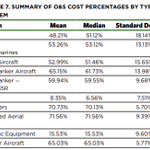
- Last - GAO has been preaching the good word about lots of these O&S cost drivers for years... check out the chart below. Extended life. Upgrades. Omitted costs...
I wrote this because the two leaders I discussed this with yesterday are two of the sharpest $$ thinkers in the Pentagon - one leading Navy's effort and another up at OSW.
Thanks to everyone helping figure out how to make UxS work.

Great debate on whether the DoW needs AUTOWARCOM and what form it should take.
@clarkdefense says it should be similar to CYBERCOM and help define the operational demand for commercially available systems. @MarkCancian believes we need more of an MDA-style acquisition org, not a command.
Bryan: “You keep framing this as a supply problem, like there’s a widget we need to invent. It’s not. It’s a demand problem.”
Mark: “If the Navy already has money for uncrewed systems and still isn’t buying them, how does AUTOWARCOM make them want the systems more?”
Listen to the whole thing on acquisition talk! 🎙️
open.spotify.com/episode/21q…

Eric Lofgren retweeted

HASC Chair Rogers says House GOP leaders are considering combining the NDAA, a CR, a FISA renewal + some full-year approps bills into a year-end omnibus.
“I don’t like the idea, but nobody’s asking my opinion."
In PM w/ @AnthonyAdragna + @sn_handler punchbowl.news/article/house…
Destroyer gets the launcher for CPS. Production line still single-digits and may not ramp up in FY27.
Acquisition mismatch: platforms on one timeline, munitions on another.
armyrecognition.com/news/nav…

Classic GAO conclusion: DoW has no systematic plan for munitions..
Despite the MAC, there is no department-wide plan that ties production and funding to total requirements—leaving efforts reactive to events rather than requirements-driven.
Example: Army 155mm shell ramp-up was not based on total DOD munitions requirement. In my mind the real story there is the failure for the Mesquite plant to produce a single 155mm in over two years.
No single office/entity has authority to direct and assess inventory improvements across services. DOD has a department-wide munitions data tool but limited oversight and inconsistent reconciliations.
gao.gov/products/gao-27-1094…

Annualized rate if 1K for PAC3 is good news. But they'll need significant facilities expansion soon to go beyond and we've often seen ebbs and flows on programs where you get short term bumps until another bottleneck rears.
The Pentagon "can't get more of it" is a bold statement describing a program whose monthly production is up 40+% compared with the same time last year. As of Q3 2026, Lockheed has approached an annualized rate of nearly 1K missiles a year compared with about 500 MSE deliveries in all of 2024. A further significant rate increase can be expected over the next 12-14 months, and as long as funding is prioritized, Lockheed is likely to beat its initial 2K missiles by 2030 ramp target all the while qualifying the Naval MSE, introducing the lower cost PAC-3 ACE and developing the higher performance PAC-3 Edge variant.
Back before Russia-Ukraine, the US Army did not plan to buy (PB FY'20) more than 243 PAC-3 MSE missiles in any single year. The allies could be expected to account for another 100-150 each year. It was not practical, and the Army would not have liked to pay for, qualifying and maintaining multiple sources for key components on a sub 400 missile annual steady state demand at full production rate.
Now that a clear demand signal exists, several critical path components are getting second or third sources qualified or otherwise ramping production. First it was the seeker, where Boeing has been focused on stabilizing and then scaling its latest block variant (cut into production just a couple of years ago). Then it became solid rocket motors, and with Northrop Grumman coming on as a second supplier the constraint moves to other components like this. Once this is solved, I suspect something else will surface requiring attention.
This is all but natural for a program scaling from rather bespoke production levels of only a few hundred hit-to-kill missiles a year to a couple of thousand.
Writer: NatSecLedger

1
18
2,090
Eric Lofgren retweeted

Developing new technology is one thing. Making it affordable and getting it into the hands of our warfighters is another.
I sat down with @NBCNewsNow to discuss cost parity and the importance of scaling these capabilities across our military services.
Russia producing ~6,000 Geran strike drones (double jets than piston powered) and 200+ missiles per month in Ukrainian assessments.
opforjournal.com/p/arsenal-o…

1
255
DoW & Commerce are surveying ~500 firms on why additive manufacturing still can’t scale in the DIB. Qualification of feedstock, machines, software, geometry creates multi-year premiums that traditional subtractive never faced.
AM should be a distributed capacity multiplier for sustainment and low-volume parts. Instead, the process taxes small and commercial entrants hardest.
Need common and streamlined qualification pathways.
war.gov/News/Releases/Releas…

Even if Congress doesn't authorize #AUTOWARCOM, the President can establish it pending:
- 60 day notification/briefing
- Senate confirmation of the 4-star
- Appropriations are available
But it does mean more expansive authorities such as for acquisition would be off the table, in which case DRPM UxS @OwenWest91 and AUTOWARCOM would likely be closely aligned to deliver unmanned.

House Armed Services chair Mike Rogers says Hegseth's new Autonomous Warfare Command won't make it into this year's NDAA (National Defense Authorization Act, the yearly defense policy bill). That nugget was buried at the bottom of this story.
"Autonomy is going to be here to stay, but it's too premature to say that we need a command for that."
Hegseth announced AUTOWARCOM at Quantico on Sept 30. The pitch is a four-star command with "service-like authorities," meaning its own money and its own buying power for drones and other autonomous gear, up and running by Oct 1, 2027.
A president can stand up a combatant command on his own. The money and buying power are the hard part. SOCOM (Special Operations Command) only got those because Congress wrote them into law in 1986. Democrats take both chambers on Jan 3, so the next try would be in front of a brand-new Congress.
Meanwhile Project Agincourt, the office laying the groundwork under Defense Innovation Unit director Owen West, keeps building out the faster way to buy and field this stuff. Rogers himself said it "may happen one day." It just won't be on the Pentagon's timeline this year. nitter.cf/BreakingDefense/status…
