

Co-Founder @BlueWaterShips | Building autonomous ships for democracy’s navies
Joined September 2011
- Tweets3K
- Following973
- Followers2K
- Likes2.4K





Pinned Tweet
Earlier this summer, we raised $50M from Google Ventures for our Series A. This is a unique moment (for 🇺🇸) for two reasons:
1️⃣ This is the fist time U.S. shipbuilding as an industry has a new company, focused on building a ship product, with the capital and team to do so.
2️⃣ Google Ventures’ entry reminds us that, in the defense tech renaissance, much of democracy’s best talent and capital has remained on the sidelines. No longer.
We owe a ton of thanks to our existing investors - all of whom participated in the Series A - the rapidly growing Blue Water Team, and to our very understanding families.
We will work relentlessly.
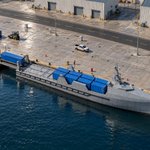
Now check out this dope picture of our hardware on the salt water - more content coming soon.

We are proud to announce our Series A. @GVteam and @davemuni - with all Blue Water insiders joining - have led a $50M round that allows us to deliver for our customers and our country. 🇺🇸
We are not slowing down.
We have used the last year to hire the best robotics engineers in Boston, build a team of veteran shipbuilders, and open a third office in Washington D.C. We are testing on the salt water on ship-scale hardware. We are building capability to attack America's shipbuilding crisis at its core.
This round allows us to build our first full ship and keep pace with a Navy customer that demands speed. We will double down on our fully autonomous design, deepen relationships with our 50+ suppliers, and deliver mass-producible ships to the U.S. Navy and future customers.
Thanks to our incredible employees, their families, and to our investors. All of us know this is only an early chapter in the story of America's maritime industrial renaissance. Much work lies ahead. 🛠️
Damn the torpedoes.
@Sethwinterroth @smarcus @rylanhamilton @Turnip #shipbuilding

Austin E Gray retweeted

A ship that drives itself for a few hours is a demo.
A ship that keeps its own engineering plant running for 2–3 months and 10,000+ miles is what Liberty ships do.
Rylan’s conversation with @demarest_colin at @Axios’ Future of Defense summit is now up: 14 minutes on the hardest problem in autonomous ships.
Watch the full conversation: youtu.be/U5yDbgaqsXY

Austin E Gray retweeted

After yesterday's destruction of Russian warship "MERCURY" in Libya, a wellness check on the festering carcass that used to be the Black Sea Fleet.

Upfront more work in sustainment, integration, and just figuring it out.
Later. Lots of labor savings and speed.
Drones are the same.

When Amazon shifted to an automated warehouse model it did not reduce its human headcount. Rather, it required an upfront surge in engineering talent alongside 1,500+ warehouse associates PER FACILITY to integrate and troubleshoot the machinery.
Read: goasrs.com/amazon-warehouse-…

1
3
305


Austin E Gray retweeted

After the Baltic sea and the Black sea, the war in Ukraine 🇺🇦 is expanding into the Mediterranean sea
Yesterday evening, Ukrainian sea drones sank a Russian 🇷🇺 corvette in Benghazi port, followed by another strike on a shadow fleet ship today.
🧵THREAD🧵1/7 ⬇️


Austin E Gray retweeted

Asked to name the Royal Navy's navy-wide lethality programme, Luke Pollard said the service is developing a Hybrid Navy Concept of Operations combining crewed and autonomous vessels.
ukdefencejournal.org.uk/hybr…


Austin E Gray retweeted

New satellite imagery shows the aftermath of an attack on a Russian naval vessel in Libya’s Benghazi port.
Most of the Steregushchiy-class corvette has capsized and sunk. Debris, fires, and thick smoke can be seen along the pier.
Yesterday vs today (📸: @vantortech)


Austin E Gray retweeted

Russian Freighter Sparta II Attacked: War at Sea Escalates
⚓The Gulf of Finland Incident: How the Russian cargo ship Sparta II caught fire following a Ukrainian drone strike, drifted toward Finnish waters, and triggered emergency maritime responses.
⚓The Role of Sparta II: The vessel's history in Moscow's military logistics network, sanctioned operations, and transit between St. Petersburg and Kaliningrad.
⚓Expanding Battlegrounds: Why maritime operations are spreading beyond the Black Sea into Baltic and northern waters near NATO territory.
⚓The Strategic Sea War: A historical and operational breakdown of naval actions between Russia and Ukraine since 2022.
⚓Global Shipping Impacts: What growing risks to military logistics and commercial shipping lanes mean for regional maritime security.
Video: youtu.be/kcX9EQV7WUY
Austin E Gray retweeted

Breaking: A Russian warship explosion in Benghazi, Libya engulfed the Steregushchiy-class corvette Merkury in flames, almost certainly destroying it 🇷🇺💥
By H I Sutton
navalnews.com/naval-news/202…

Austin E Gray retweeted

A large incident between two Russian naval vessels has occurred in the English Channel where the warship Neustrashimy collied with its own oil tanker leading the crew to start threatening each other with weapons and calling for an execution of a sailor over the radio-Telegraph
Austin E Gray retweeted

Generals Petreaus and Buzzard argue that Congress must give the incoming AUTOWARCOM commander sufficient authority to catalyze generational change. Overwhelming battlefield evidence-and unmanned forces in UKR, RU, IDF-has failed to shatter our budgetary and doctrinal inertia.

How to reshape US military for autonomous warfare nationalinterest.org/feature…

Austin E Gray retweeted

Water jets for propulsion is what resulted in both LCS variants from being true multi-mission platforms. Not only was the towed array perpetually unstable but the noise signature from the water jets drowned out its sensors.
As solo sensor collection platforms I can see some value. However I wouldn’t want these anywhere near a platform you’d want to protect from ASW detection.

🎯 @william_toti hitting the international shipbuilding balance on target.
Build combatants here. Allow auxiliaries overseas.
Until now, policy has suggested that Navy might build destroyers, frigates, or their modules overseas. @steverod78 and I argued in @CMS_Washington that this might be a mistake.
We need to keep our most critical capacity - Destroyers, Submarines - buildable in the US.
Well done team Navy & White House on navigating this sticky issue.

Toti pushes new foreign-built shipyard in the US to focus on frigates, large surface combatants breakingdefense.com/2026/11/…

11
574
Austin E Gray retweeted

👀 👀 👀
"William Toti, who has been nominated to serve as undersecretary of the Navy, has jumped off the “bandwagon of building ships in foreign yards,” instead pitching a new foreign-built shipyard in the US to construct frigates and other vessels."
breakingdefense.com/2026/11/…
Yesterday - I noticed tension between how two sharp DoW leaders are viewing UxS business models for the Pentagon.
Here are the numbers. Their takes. My take. And what each take tells us about the future. This is a long thread, and does a full 3-way comparison of:
1) Big Traditional Platform vs. 2) Big Drone vs. 3) Small Drones
- Traditional programs spend 30% up front on RDTE and procurement + 70% on the tail of sustainment
- One of these senior leaders said it could be 10% and 90% for drones.
- 90% of a drone's cost is sustainment????
I'm going to prove his math went wrong right up front... and then end by proving him right.
- Start from 30% up front and 70% sustainment tail
- Assume 70% sustainment tail is spread over 20 years.
- 70 / 20 = 3.5 percentage points per year in sustainment.
- Note this is 3.5 PERCENTAGE POINTS not %
- So 30 percentage points up front and 3.5 percentage points per year running
- 3.5 / 30 = 12% of the up front cost every year in sustainment.
- Maybe this is 15-20% of the procurement pricetag depending on how much RDTE they needed.
Let's compare platforms: So at 15-20%, if DoW buys
Big Platform: $2B battleship it would spend $300-400M per year maintaining (this tracks, although DDGs have longer life and slightly lower cost per year than our assumptions here)
Big Drone: For a $40M drone, $6-8M per year
- Spend $50M up front (RDTE + procurement) then you'd need to spend $450M over the drone's life to reach the 10% / 90% ratio. This does not track. Even if the big drone lasts 10 years, you'd spend $45M per year on O&S on a $40M pricetag vessel (3-5x market COCO rates).
- What's happening with big drone numbers? Three factors. Up front costs are LOW. First year sustainment costs are VERY high. Lifespan of the drone is unknown.
Contractors (especially us VC-backed folks) subsidize the R&D and procurement up front. VCs pay for all R&D on IRAD. Then they undercut each other on procurement price. Suddenly you're charging $0 in RDTE and $30M per drone...
Then you end up with integration and technical debt as the customer asks you to do more. Also, because drones are new, soldiers and sailors need tons of training, maintenance, and other DOTMLPF support. For the $30M drone (that's really $40M) you charge the regular $15M per year sustainment + an extra $20M in integration & training + $5M more in software upgrades and $10M in an exercise sprint in Hawaii that PACOM needed...
Back in the Pentagon, they know some of these are 1-time fees, but they just saw you burn $50M in O&M in the first year on a vessel they paid $30M for. What if the vessel lasts 10 years and you're stuck with the whole bill the whole time?
10 years x $50M = $500M O&S bill on a $30M platform. Truly, the platform is $40M per and if you amortized the VC's IRAD onto it, would be $50M. That takes you to 90/10. Then, if O&S comes down to $20M-30M per year, you're down at $50M vs $300M. If the drone only lasts 5 years, you run it to $50M vs. $150M = 25% vs. 75%
At conservative assumptions, the big drone still comes in at a slightly higher sustainment tail than the traditional platform... but it's not too crazy.
Small drones are a whole different ballgame...
Small Drone: For 200 $5k drones ($1M), $150-200k
But how does a unit of infantry sustain 200 drones?
Maybe 10-20 guys could sustain 200 drones (most are in storage). But 10-20 guys is a $1M-2M tail per year just on personnel.
Another lens: what if your small drone lasts only 3 years? So you procure your 200 drones for $1M (assume away RDTE for now).
- Then you would get to spend $6M over the next 3 years ($2M per year) to sustain them.
- Spending $9M over 3 years ($3M per year) would get you to 90% vs 10% that our friends mentioned.
Could a unit of soldiers operating 200 drones spend $3M per year on O&S tail? 10-20 soldiers at $100k each = $1-2M per year. That leaves $1-2M per year on maintenance, fuel, parts, software updates, exercises, and non-personnel O&S. After your baseline maintenance of $200-500k per year (these are small crappy drone that break) you also need to upgrade them frequently.
In short... the 90/10 split makes A TON of sense for small drones. Small drones have VERY SHORT lifecycles and require a METRIC F-TON of soldiers, sailors, and marines to maintain. They're also cheap, and less intelligent, and simply require more people to do smart things.
@WarOnTheRocks research shows you need 4 infantry per pod of drones... I wrote about it in Palantir / @republicjournal with Bohdan Volyanyuk, after returning from Kyiv and Donbas (link in first comment). Drones take a lot of people.
Core drivers of this cost / price / $$ distortion:
- VCs subsidize up front costs (RDTE + sticker price)
- Technical & integration debt drives high early "sustainment" costs that are really integration + T&E
- Easier requirements process means you add requirements later, but this gets billed in O&S sprints
- DOTMLPF is a work in progress, so government is farming out lots of COCO work to industry, driving up O&S costs.
- Drone lifecycles are unknown and when you multiply early year high O&S costs x conservative long lifecycles = insane lifetime sustainment costs.
- Last - GAO has been preaching the good word about lots of these O&S cost drivers for years... check out the chart below. Extended life. Upgrades. Omitted costs...
I wrote this because the two leaders I discussed this with yesterday are two of the sharpest $$ thinkers in the Pentagon - one leading Navy's effort and another up at OSW.
Thanks to everyone helping figure out how to make UxS work.

Austin E Gray retweeted

Lots going on at @regentcraft right now.
Squire autonomous drone Seaglider for defense
All-electric Viceroy Seaglider to connect the coastlines of the planet with high-speed, affordable transportation
And a factory to build it all in America
Lets go!
Austin E Gray retweeted

Even if Congress doesn't authorize #AUTOWARCOM, the President can establish it pending:
- 60 day notification/briefing
- Senate confirmation of the 4-star
- Appropriations are available
But it does mean more expansive authorities such as for acquisition would be off the table, in which case DRPM UxS @OwenWest91 and AUTOWARCOM would likely be closely aligned to deliver unmanned.

House Armed Services chair Mike Rogers says Hegseth's new Autonomous Warfare Command won't make it into this year's NDAA (National Defense Authorization Act, the yearly defense policy bill). That nugget was buried at the bottom of this story.
"Autonomy is going to be here to stay, but it's too premature to say that we need a command for that."
Hegseth announced AUTOWARCOM at Quantico on Sept 30. The pitch is a four-star command with "service-like authorities," meaning its own money and its own buying power for drones and other autonomous gear, up and running by Oct 1, 2027.
A president can stand up a combatant command on his own. The money and buying power are the hard part. SOCOM (Special Operations Command) only got those because Congress wrote them into law in 1986. Democrats take both chambers on Jan 3, so the next try would be in front of a brand-new Congress.
Meanwhile Project Agincourt, the office laying the groundwork under Defense Innovation Unit director Owen West, keeps building out the faster way to buy and field this stuff. Rogers himself said it "may happen one day." It just won't be on the Pentagon's timeline this year. nitter.cf/BreakingDefense/status…
