

Chief Transformation Officer @investwithaqua | Took a stab @ building the investment bank for startups | ex-McKinsey, Praxis
NYC
Joined August 2021
- Tweets804
- Following6.3K
- Followers749
- Likes25K







Pinned Tweet
The Future of Exits is the Private Markets IPO
The Investor Liquidity Event, or ILE, will exist by the end of the decade, and is going to completely reshape capital markets


Interesting element of the private markets transition + nature of tech today: capital is increasingly specialized, labor is increasingly fungible


If traditional science funding is a supply-push mechanism, what are the demand-pull equivalents to solve more basic-research style problems?
Advanced Market Commitments are a step in the right direction, is there anything else?
3
362
Inter-state population in-flows & out-flows are underpriced in an era of secular population aging
The "Long Texas" thesis gets stronger & stronger

I have a hunch that the assumption that a white collar career will progress (promotions every few years, management as you get older) is a holdover from the days of triangular population pyramids 1900s-60s and the 60s-2000s sectorial switch from industry to services
3
463
As the venture megafunds grow in size, I'm wondering who's going to be the first to launch an infra fund
Still think this is the most contrarian category where there's a lot of room to run (expect projects to cluster in the South / Southwest for the foreseeable future)

This autonomous monorail seems very cool
Doesn't look like any of the heavy-hitters in hard tech were involved though . . . I guess more of a pureplay infrastructure bid than VC?
Does anyone have the back story @IanRountree @Cam39Porter


2
4
476
One takeaway from yday (and from Iraq / Afghanistan, though this is obscured given the cultural focus on the democratic transition efforts, rather than the initial operations) is that air superiority is still under appreciated.
Waiting on the next Mahan to put it together
1
380
A non-AI macro bet:
Incoming blue collar wage growth is very underpriced by SV (FF maybe the only big fund that gets macro) – humanoid robots won't get good enough fast enough to match the demand surge
Suspect this plays out w/ automation amongst vertical service providers (think @BuildMonumental approach), where your CapEx investment quickly generates operating leverage
Lots of co's in this space, but it's still shockingly underpriced relative to blue collar wage growth
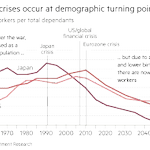
Aging society is here, workforce to dependents ratio peaked in 2010, and every year more people retire than enter the workforce. Temporary salve was ZIRP + immigration.
ZIRP makes asset values appreciate faster than wages (except for people whose wages are tied to managing said assets); immigration applies downward pressure on wages (disproportionately blue collar).
Both are getting turned off at the same time. So it's a secular demand surge (retiree growth means you have more people requiring labor b/c healthcare consumption grows rapidly @ that age), alongside a new barrier to growing supply (b/c even a 50% reduction in blue-collar immigration meaningfully changes labor market growth)
Wage appreciation will be rapid in blue-collar + healthcare sectors b/c supply growth is decelerating while demand is accelerating. Will drive operating costs up for a lot of different businesses, demand for labor-automation is going to spike like crazy (fwiw, this is the main driver of the CCP's robotics push, their workforce:dependents ratio peaked a few years ago).
1
3
372
Appa Bollera retweeted
Estimate is cool, but there's little compelling reason to believe that the counterfactual is possible. Japanese workers to dependents ratio peaked in '91, and the nation's growth potential was on a permanent downward trajectory from there.
There's a default tendency to view financial crises as causing material changes in the world (and qua reflexivity, this is true), but the initial causality seems to run the other way – see also US birth rate collapse after the Great Recession. Intuitively, this makes more sense – finance tends to be proactively reactive, thus a "peak" in future growth potential should gum up the works of all kinds of financial plumbing (also a decent signal of the scale of economic restructuring our new low-pop growth world is primed for.
Meshes nicely with @ConradBastable's theory of Japanese real estate values

Appa Bollera retweeted

People who say asset management is the best business in the world have never seen the unit economics of asset management management
One of the subtler shifts that is often underappreciated in tech-investing is that macro-changes do affect the types of companies most likely to achieve PMF.
Biggest one that comes to mind is the soon-to-be-realized growth in labor demand (downstream of a combination of workforce aging + complete change in immigration dynamics)
The bull-case for both AI-enabled services + robotics deployment for lots of blue-collar service use-cases wherever possible is about to boom, because industry @ large is not pricing in wage growth accurately
1
9
476
cc @MosesSternstein with the National Nursing Home vs. Finance bros model. This change is going to have huge downstream implications for the biggest SV bets of the next decade
Lots of people are constantly looking for the next version of the "Berkshire acquires Geico & trades the float" model e.g.
- Bill Ackman w/ Howard Hughes
- PE megafunds getting into the insurance game
I suspect the next similar "free capital" innovation is going to come from elder care.
- Lots of assets are locked up in retirement accounts, and never liquidated except for one key event (moving into a care home)
- This is a standardized process for many care homes – ecosystem of service providers handling every stage of liquidation for XYZ reasons
- Assets are not usually drawn down all at once, and payments are usually handled on a month-to-month or annual basis, but liquidation is a one-time event
First fund that buys one of the large senior living platforms will unlock a surprising amount of capital imo
2
4
340
Excellent piece

We have a existential manufacturing problem in America.
Why aren't there Amazon/Tesla-scale gigafactory warehouses filled with CNC machines? Will we ever be able to make our own products again? How do we accelerate the turnaround of American manufacturing?
I asked this question a few months ago, and it's more relevant than ever. I firmly believe it's unacceptable to be a country that, ultimately, isn't able to make its own stuff. This isn’t just about economics—it’s about national resilience. It’s about the stability, defense, and sovereignty of the United States. A country that cannot produce its own goods is inherently fragile.
Maybe this is irrational patriotism or stubbornness. Defense considerations aside, we must strive for price parity with our neighbors—subsidies can provide a short-term boost, but they are not a sustainable foundation for a competitive manufacturing economy.
Future growth will require a return to cash-flowing, material-output businesses depending heavily on manufactured goods. Controlling our own destiny is a good thing.
I’d like to kickstart a series of essays in coordination with @newindustrials, Blueprints for Reindustrialization, by contributing the first piece and setting the tone for what I hope will be a lively conversation from boots-on-the-ground operators.
A few spicy takes up front. We’re not in first place. We killed the golden goose to increase quarterly profits. We lack both the capacity and the skills. We ought to create more high-paying manufacturing jobs, not low-paying manufacturing jobs.
The most fundamental thing we need to do is increase efficiency. Manufacturing costs are inherently higher in the United States, period. After adjusting for the cost of living an average salary in Shenzhen is approximately $2,730, while in Houston, it's about $4,414. We’re 61% more expensive right off the bat. In addition to labor differences, other nations actively subsidize their raw material inputs. It’s tough to make the economics work when you’re so far behind.
I’ve been on the front lines of making complicated stuff quickly for most of my life. The last four years of operating in defense-critical applications have been eye-opening. Whereas previously I could reach out to international partners for work, now I have to comply with U.S. rules for sensitive technologies. The contrast in capabilities and skill sets between the two locations is incredible.
It feels like a barren wasteland of talent, with a huge vacuum left by the retiring skilled tradesmen. In addition to a population crisis, we are certainly facing a hardware-skilled labor crisis. Nearly every week, I’m desperately begging vendors to take our money. It's quite literally like the Futurama Fry meme—money in hand, begging someone to take it. More often than not, the answer is “we don’t have the capacity.” I’m a tiny customer, and we have no macro-scale event currently happening. This is not what national resilience looks like.
Here’s an uncomfortable truth we need to say out loud: China has its shit together in a way difficult for us to replicate, in regard to manufacturing. They've made it a top-level priority to be the world's destination for manufactured goods. Moreover, did we think they would stop at dollar-store trinkets? Foolish. Every dollar of revenue in China is compounded into creating their huge critical mass of machines, infrastructure, and expertise. The plan has been running for decades now. They're climbing the ladder of technology as we paid them to do it. We could do the same. We could simply decide that it matters to make stuff here.
It seems like we have a few knobs we can turn:
• External taxes (import tariffs)
• Internal tax breaks (low-cost/risk loans)
• Technological breakthroughs (automation)
• Operational excellence (scale)
• Irrational actor patriotism
Now, let's be realistic here. No amount of impassioned chanting of dynamism is going to shift the tides, though the X (formerly Twitter) grassroots discussion will kickstart the conversation. We're dealing with a scale truly hard to appreciate. We’re at least a trillion dollars behind. Policies to nudge this in the right direction are a bit over my head; I’m just an engineer with some ideas. I am, however, quite curious to sit down and understand what D.C. thinks about this. How do we foster growth and make domestic manufacturing powerhouses, akin to Foxconn and Pegatron? How do we pick winners and put the pedal to the floor? Before diving into specific scale considerations, let's address the macro issues.
We need a set of policies that can accomplish several objectives simultaneously:
• Capital equipment incentives: implement dollar-match assistance to incentivize companies to invest in capital equipment now, jump-starting the manufacturing sector this fiscal year
• Long-term corporate tax breaks: provide tax incentives to corporations that successfully and measurably return their supply chain domestically
• Future import tariffs: this is the “buy equipment now, China pays later” approach. Announce import tariffs 1-2 years in advance and use the proceeds specifically to defray the costs of upfront incentives. This gives domestic industries time to prepare and enhances competitiveness when the tariffs take effect.
• Worker payroll credit: offer tax reductions to employees in specific manufacturing jobs (identified by NAICS codes), which appear directly on their paychecks. This boosts enthusiasm for the field and makes manufacturing careers more attractive.
Capital Equipment Incentive. We should consider implementing a CHIPS Act equivalent for broader manufacturing—offering targeted, low-interest loans and dollar-matching on new capital expenditures. Imagine gov-backed loans at the Fed rate, paired with a dollar-for-dollar match on new machinery and automation purchases.
This approach must be carefully executed to avoid turning into a grift-a-thon. The goal is to provide the activation energy for private industry to shift toward domestic manufacturing, not to heavily manipulate the economy or dictate specific actions. We should apply a light touch—enough incentives to motivate small businesses to expand in a healthy manner without distorting the market. If anyone on Capitol Hill is looking for bill names:
• MARS (Manufacturing and Reshoring Strategy)
• FORGE (Fostering Onshore Resilient Growth & Employment)
• PRIME (Promoting Resilient Industrial Manufacturing Economy)
Future Import Tariffs. The primary purpose of tariffs is to make domestic manufacturing more attractive by creating price parity between imported and locally-produced goods. If imports and domestic products cost the same, there's a compelling reason to choose domestic suppliers. Unfortunately, this approach often leads to higher prices overall.
Announcing import tariffs two years in advance—a "buy equipment now, China pays later" strategy—can encourage immediate investment in domestic manufacturing. This gives domestic industries time to prepare, invest in capital equipment, and enhance competitiveness before the tariffs take effect.
Importantly, the revenue generated from these tariffs could be used to fund the proposed capital expenditure (capex) incentive purchasing program. By directing tariff proceeds toward dollar-match assistance and tax incentives for domestic manufacturers, the tariffs not only level the playing field but also provide the financial means to strengthen the domestic supply chain. This ensures that the funding ends up in the right bucket, enhancing the effectiveness of the incentives and making domestic manufacturing a more viable alternative.
It's crucial to remember that tariffs are only a tool—a means to an end, not a permanent solution. They should be used cautiously, much like steroids for domestic industries. In the long run, there are only two sustainable, tariff-free paths to achieving global competitiveness in American manufacturing:
• Specialization: becoming the best in a specific sector through deliberate investment in capital equipment and the development of a highly-skilled technical workforce
•Technology-driven productivity gains: achieving productivity improvements that offset our comparative labor and raw material cost disadvantages
Achieving specialization requires conscious decisions and priorities. For instance, Japan's metrology industry exemplifies how a nation can become a leader in a specific field. Mitutoyo precision measurement tools are cherished by machinists worldwide, reflecting Japan's cultural emphasis on making tools as excellent as possible rather than merely adequate.
While technology is often touted as the silver bullet, it's challenging to implement and defend over the long term at a national scale. Limitations like material science dictate the performance of tools—for example, constraints are more about the maximum surface feet per minute achievable by tungsten carbide than machine rapid speeds. Automation, although promising, has so far failed to deliver transformative gains. It often shifts costs rather than reduces them, moving expenses from production workers to capital expenditures and software development.
Efficiency gains rarely outweigh these increased system costs. Numerous projects have attempted to replace a $15/hour worker with a robot arm, only to fail spectacularly. It’s a bit of a blanket statement, I admit, but is directionally correct based on my boots-on-the-ground experience and conversations.
Moreover, technological advantages have a shelf life; they diffuse into the global market over time. A breakthrough might buy a decade or two of increased productivity, but resting too long on these gains risks falling behind. Unlike semiconductors, where Moore’s Law drives rapid advancement, manufacturing technology evolves more slowly, with hardware typically remaining viable for 10–20 years before becoming unprofitable.
The reality is that deploying technology in this industry is difficult. While many small improvements are available, few shops have the resources to integrate these disparate pieces effectively. It's unrealistic to expect a typical machine shop to have dedicated software engineers to troubleshoot low-level FANUC communication issues with robot handlers or set up complex databases to coordinate RFID toolholder tags.
One CNC shop owner shared a stark perspective: he believed there wasn't a single truly profitable shop in the U.S.—most were simply coasting on fully depreciated machines. While this view is extreme, it underscores the challenges and sentiments within the industry.
Worker Payroll Credit. To attract talent and rejuvenate interest in manufacturing, I propose a worker payroll credit that offers immediate tax reductions to employees in specific manufacturing jobs identified by NAICS codes. This policy would directly increase take-home pay, making manufacturing careers more financially attractive.
By targeting these critical sectors, the benefits reach those essential to rebuilding our industrial base. This approach rewards current workers and incentivizes new entrants, helping to restore the middle-class American dream associated with manufacturing jobs.
Immediate benefits include:
•Attracting new talent: higher net pay makes manufacturing competitive with other industries
•Retaining skilled workers: financial incentives boost job satisfaction and reduce turnover
•Stimulating economic growth: extra income leads to increased local spending and job creation
•Enhancing respectability: recognizing and rewarding workers elevates the profession's status
Administered through the existing payroll tax system, employers could adjust withholding based on the employee's NAICS code, increasing net pay without additional administrative burden. By providing immediate financial benefits, this policy affirms that manufacturing is essential to the nation's economic health and makes it a more attractive career choice.
These policy measures lay the groundwork for revitalizing domestic manufacturing, but they are just one piece of the puzzle. To truly accelerate reindustrialization, the active participation of large corporations is essential. This brings me to the critical role of cost of capital and how leveraging the resources of cash-rich mega-corporations could be the game-changer we need.
Cost of capital is everything. I still think one of the highest-leverage moves is encouraging the cash-flowing mega corporations in the U.S. to consider investing in domestic manufacturing capabilities. The ideas below are tailored for Amazon (@jeffbezos) but could be implemented by a handful of companies. We've also seen how one incredibly stubborn guy could stand up world-class manufacturing in the U.S. and turn a profit (@elonmusk). Like them or hate them, the billionaires serve an incredibly useful market function. You've got to realize that the activation energy to push this type of idea often doesn't come from a quarterly profit-driven market. Aggressive offshoring got us here in the first place. It takes a slightly irrational actor with a LOT of resources and a HUGE amount of conviction to make a move that pays off in ten years vs. the next quarter. I believe that measurable change is more likely to be affected by these entities than a group from YC. Sorry boys, but it’s a billions, not millions type of problem.
Why am I specifically mentioning cash-flowing large corporations? Shouldn't I be advocating for the VC approach? No, in most cases. This is something I feel very strongly about. There are certain buckets of money for each type of problem. It’s important to know where it's appropriate to use high-risk capital (VC), profit-optimizing capital (PE), free cash flow, or government capital. I think that, net-net, VC money is not well-suited for the commodity manufacturing space. It comes at an extremely high cost and contorts business models into places where they won't operate sustainably. Risk capital belongs in areas going from 0-1 where there can be 100x–1000x improvements (someone should go fund a startup to develop next-generation tungsten carbide or single-crystal cutters). We’re talking macro level, and we need low cost of capital (Fed rate plus a percent) on the order of tens of billions.
Okay, end of the Econ 101 section. I want to focus on actionable things that are more scale and operations focused. These can be realized with minimal (zero) breakthroughs. If it works, it would only be rendered more competitive and effective by other upstream policies.
Efficiency is the silver bullet that makes everything downstream just work better. So let’s talk specifics. Let’s exhibit bias for action. What's actionable today? How can "unfair" advantages be leveraged today to save 3–5% in a bunch of small areas? Remember that I’m tailoring this to an Amazon-like entity; this isn’t for a 50-person shop.
• Gigascale (>10,000 deployed machines)
• Focus on operational excellence first, not technology
• Don't invent anything new
• Don't over-automate
• Don't target high gross margin parts. Go med/low.
• Utilization of equipment. Most shops are running 10–12 hours a day at best. Run 24 hours a day.
• Own your freight network. The cost of moving material around is a significant percentage of your profit. Consider that most 3-axis CNC work comes in at 7x–10x the material cost, and materials average $4–$6/lb for nonferrous.
• Access to cheap capital. Leverage your massive free cash flow to block-buy production from top machine manufacturers in exchange for large discounts. This is one of the biggest knobs, in my opinion. I know DMG will knock off 40% for a big enough order of machines. Many small shops are operating on machinery loans of prime plus 3–5% at MSRP.
• Administrative support. Take advantage of your huge existing and battle-hardened accounting infrastructure. It's going to crush the one-person accounting department operating with QuickBooks.
• Bootstrap on your own products. There are hundreds of millions of units of Amazon-brand consumer electronics already being sold. Every one represents a bill of material with at least a few parts well-suited for in-house manufacture: injection-molded cases for Kindles, microwave oven sheet metal frames, etc.
• Massive deal flow. Offer deterministic pricing/lead times in exchange for being the default go-to vendor. You can operate break-even for the first few years to capture market share. At the end of the day, the engineers crave predictability and reliability. We're addicted to Prime 2-day in our personal lives—just imagine having 4-day turn times filled by your shop with 99% reliability.
• Remote programming. Ironically, the most skilled portion of this job (the CAM tool paths) is the easiest thing to make physically distant. I'm typically a fan of being under the roof, but in this particular case, I recognize the difficulty of moving thousands of skilled workers to a few centralized hubs. With standardized cells/tools/workholding, it gets quite a bit easier for remote programmers to be effective. For quantity 1 parts, 80% is programming and maybe 20% is spindle time. Amazon already does Mechanical Turk. This is the skilled $100k+ version of that. I do this every day at my office; it's 100% possible.
• Building space. Amazon's operational efficiency in deploying square footage is crazy. They've hyper-optimized the soup-to-nuts process of going from a plot of land to a finished and productive tilt-wall single-story warehouse. They already have a presence in every major city.
•Software integration. Most shops lag far behind in software, relying on clunky, manual systems that can’t scale. Amazon’s expertise in inventory, tracking, and order management is a killer advantage. Streamline everything—raw material orders, production scheduling, and shipping.
I was first applying these ideas to subtractive machining, but injection molding and sheet metal scale even better. They’re more deterministic, with simpler geometries and higher quantities. LEGO's Billund injection molding facility is a prime example of what’s achievable: over 1,000 machines running nearly lights-out. Apple is another excellent example, with the legendary football fields of Fanuc Robodrills and Brother Speedios knocking out watch frames by the millions. Yet, our current market setup is fragmented—96% of our manufacturing workforce is in small shops under 50 people. This decentralized model isn’t cutting it. When people say, "it’s too expensive to make parts here," what they really mean is that our output per employee is lagging.
Let's review some estimates of the deployed machinery around the world to understand the league we're playing in. Even if we wanted to, we couldn't flip all of Apple's production to the USA—we simply lack the capacity.
Subtractive (mills/lathes)
•2,000,000 (Global)
•300,000 (USA)
Injection molding
1,600,000 (Global)
••145,000 (USA)
Sheet metal
•2,400,000 (Global)
•365,000 (USA)
The numbers are rough and pieced together, but directionally correct. The gap is staggering, and it's going to take years to catch up. As people have pointed out, there would be a huge problem of availability of the machine tools. Even Haas only produces ~2,000 machines per month. My friends in the industry are skeptical that such a thing could even be put together in a reasonable time frame. My experience has been 50-week lead times on transformers, 30 weeks to get high-pile racks permitted. While it seems physically impossible that @Tesla could build a gigafactory in two years, they accomplished exactly that. How do we remove some of the bureaucracy and roadblocks to infrastructure?
Manufacturing is not glamorous, has never been known as such, and perhaps shouldn't be. But at least we could glorify it as a respectable and fulfilling profession. It’s dirty, hard work, and takes considerable amounts of effort to make significant improvement. For decades, software has been the title that works on complex and intellectual problems. Not only do we need to develop necessary skills and produce enough output for high-paying roles, it is essential that manufacturing regain its ability to provide a middle-class living.
The gig economy is an embarrassment to our nation. I think we're in dire need of a skilled trade resurgence. The grand experiment of sending the entire population through college, only to exit with marginal real-world skills, has run its course. We need a pipeline of work that one can enter at an earlier age, gradually learn skills, and climb the ladder of the craft. It should take longer than a 4-week coding bootcamp to start a career. The post-war industrial revolution helped destroy the classic journeyman program in the United States. Other countries maintain working versions. Check out Germany's apprenticeship program (Ausbildung):
• It typically lasts 2–3.5 years, depending on the profession
• Apprentices split their time between vocational schools and practical training at companies
• They can choose from 342 recognized trades
• They receive a monthly salary and don't pay tuition fees
• The curriculum is strictly regulated, ensuring consistent skill development across the country
• Apprenticeships are governed by legal contracts between companies and apprentices.
• After completing an apprenticeship, individuals can pursue further qualifications, such as becoming a master craftsman
State of the market. Yes, I'm aware that Hadrian, Xometry, Protolabs, SendCutSend, and a dozen other smaller services exist. No need to blow up their Twitter handles; we all know each other. I have great respect for each of these companies. They each have their own particular niche they serve very well.
• Hadrian has the biggest head start on the embodiment of a modern high-tech manufacturing process, attempting the monumental feat of end-to-end software controlled manufacturing. It’s the biggest swing by far, but will take an enormous amount of capital to scale to Foxconn levels.
•Protolabs is the king of speed as an automated 72-hour turnaround time shop.
• Xometry has instant pricing and a great marketplace for frictionless orders from real middle-America shops.
•SendCutSend is a beloved institution for all things flat and bent, pulling off organic scaling with the lowest prices around.
Each is a noble effort in trying to make us competitive, though I fear without government assistance in some form, these efforts are a drop in the bucket.
The market has evolved into three or four distinct buckets of work. It all comes back to good, fast, and cheap. It's almost, by definition of the free market, impossible to do all three. If I were advising Jeff Bezos, I might suggest rolling up a few of the best players, but only the ones well-suited to be 50x in size. Honestly, the revenue ratios are just so low compared to any software M&A, everything in manufacturing looks like a bargain. Everyone is concerned with monopolies and antitrust in software; meanwhile, no one is looking at hardware. I don't think that a PE roll-up of existing small mom-and-pop shops would yield much, if any, improvement. Decentralized and diverse is the opposite of what I'm proposing.
It's not a fully formed thought, but one I felt compelled to write down in between actually making parts. For the last two decades, I've been a consumer of manufacturing services, and an occasional manufacturer myself. I don’t have a book to shill, I just happen to have one foot in tech and one foot in blue collar. I started in a machine shop when I was 14, entering my mechanical engineering career with nearly a full apprenticeship under my belt. I started a hardware company in my 20s. Now I'm in my 30s, building hypersonic vehicles and working with America's greatest institutions. After thousands of parts both designed and made, I've had the chance to look around and consider the change I want to see in the world.
• I want the U.S. to control its own destiny
• I want skilled trades to flourish again
• I want to see on-shoring/reindustrialization
• I want McMaster/Amazon levels of speed and excellence applied to my custom manufactured goods
• I want instant pricing and deterministic lead times
• I want consistent quality. Doesn't have to be the best, just predictable
• I want lifelong, well-paying careers for my younger brothers
It seems like a fundamental shift occurred this month. How do we now translate that excitement into a plan?
Rebuilding our industrial base is not just an economic necessity—it's a pivotal step toward securing our nation's future.
The path forward doesn't require us to reinvent manufacturing, but rather rethink and optimize how we utilize our existing resources.
By focusing on operational excellence, scale, and strategic investment, we can start down the long road of restoring America's position as a global manufacturing leader.
3
868
This is the critical distinction between us & China today
Markets are a tremendous tool, but they’re not an end unto themselves. Our capital markets give us an edge in terms of allocating capital efficiently between options, but we have to actually set direction strategically.
The American story is one of locally efficient capital markets optimizing for poor global maxima
The Chinese story is one of locally inefficient capital markets optimizing for better global maxima
1
6
1,088
Northvolt in the EU was a big ISI play. It doesn’t work. You want to help subsidize the industry, but let the market force firms to compete.
Pick the game, not the winner. All industrial policy needs to be downstream of this, or you just end up with a giveaway to large companies + inability for domestic champions to compete globally.
Surprising thing getting lost in discourse around Northvolt is the specific model of building domestic champions they pursued.
The Chinese model is ruthlessly competitive locally (states run their own VC funds but the market decides on winners), in service of building global export-oriented monopolies. Subsidies phase out over time, and the most operationally efficient players in the local markets as globally competent producers.
Import Substitution Industrialization, where you choose domestic champions ahead of time and subsidize their growth, routinely fails to produce globally competitive companies – look @ the limitations of Indian domestic manufacturing through the 20th century for proof.
Effective industrial policy requires competitive pressures at the firm level AND policy support @ the industry level. Not convenient for free-trade maxis or money-spigot policymakers, but very obvious to anyone who understands the East Asian growth story.
5
2
719