
"If liberty means anything at all, it means the right to tell people what they do not want to hear." — George Orwell OSINT | Russia-Ukraine war
Kyiv
Joined August 2022
- Tweets25.3K
- Following68
- Followers1.1K
- Likes432




Pinned Tweet
Sovereign Internet: the single point of failure
In four days Ukrainian drones hit three Yandex data centers:
• 8 Oct — Sasovo (Ryazan): full shutdown. Two of the three AI supercomputers used to train YandexGPT were there.
• 9 Oct — Kaluga: the company’s largest site (63 MW). Several modules completely offline.
• 11 Oct — Vladimir: full shutdown. The third supercomputer (“Galushkin”) was located there.
Result: all three Yandex AI supercomputers targeted. 80+ cloud services disrupted. Taxi, payments, food delivery and other everyday tools went down across Russia.
This is the logical outcome of the “sovereign internet” project. For years the Kremlin concentrated RuNet into a handful of key nodes and a few giant providers — almost all of them in European Russia, well within drone range. Personal-data laws and critical-infrastructure rules make foreign cloud backups legally toxic. You cannot leave, you cannot distribute, you cannot hide.
The button that was supposed to belong only to the FSB is now available to any aircraft carrying a few dozen kilograms of explosives.

🙂 Omsk’s junior correspondent is on the case: strange things overhead.
Night has fallen. The sky apparently missed the memo.
@alternative_war

13
🇨🇳🇺🇬 Chinese veterans training Ugandan security forces: a minor episode in a larger web of ties
Retired Chinese military personnel are reported to have conducted firearms training for Ugandan security service staff. Who exactly did the training, in what status, who was trained (army, police or private security) and under whose agreement is not specified, so this remains a claim.
▶️ On its own, such an episode is insignificant, but it is easy to place within a broader picture. China is gradually building a defense presence in Uganda through several channels.
🛑 Equipment supplies: back in 2021, the Special Forces Command (SFC) announced cooperation with Poly Technologies, the maker of CS/VP3 armored personnel carriers, and CPMIEC says it has worked with the Ministry of Defence for 14 years.
🛑 Military education: Chinese language courses for the intelligence school in Mgyera, training for generals, military attachés.
🛑 Personal ties: the current Chief of Defence, Muhoozi Kainerugaba, openly admires the Chinese model.
❔ In March 2026, Uganda's police took over the training of private security guards: the country has 457 security companies, about 82,000 guards and more than 28,000 registered firearms. The government is trying to centralize training to eliminate "liberal" private formations. If Chinese veterans are indeed training in the private sector, that runs counter to this course; if they are working for the state, it is already part of official cooperation.
Precedents exist. In 2018, two Chinese citizens were arrested in Zambia for illegally providing military training to a local security company. Chinese private security firms have long staffed themselves with retired servicemen and guarded Chinese projects in Africa.
❗️ Without data on the organizer and the status of the training, this is rather an indicator of a general trend: China is expanding its influence in Africa's security sphere not only through large contracts but also through small, low-profile formats. It is worth watching whether official confirmation appears and whether similar episodes show up in other countries of the region.
33
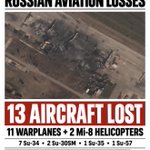
✈️🔥 RUSSIA’S OCTOBER AVIATION LOSSES
11 warplanes lost.
2 Mi-8 helicopters lost.
3 additional warplanes damaged.
Russia’s heaviest monthly aviation losses since Operation Spiderweb, according to Militarnyi’s open-source tally.
Su-34 glide-bomb carriers took the biggest hit:
7 lost + 2 damaged — equivalent to roughly 6.4% of the 140-aircraft fleet estimated by Ukrainian military intelligence.
The tally includes combat losses, crashes and fires.
@alternative_war

17
💥 Explosions have reportedly continued in Omsk, Russia, for more than two hours.
The regional governor says air defences are responding to a drone attack. The extent of any damage remains unconfirmed.
@alternative_war

75
Exilenova+ reports a Russian Baltic Fleet small missile ship was attacked near Gogland overnight. Crew deaths and injuries are claimed, not verified. Ship identity, weapon and damage remain unknown. Treat as unconfirmed.
@alternative_war


61
🔥 UST-LUGA: STILL BURNING
Fresh footage reportedly from Russia’s Baltic port shows flames and thick black smoke after the overnight drone attack.
Ust-Luga is a major oil and fuel export hub. The full extent of the damage remains unclear.
@alternative_war

3
102
🔥 UST-LUGA: FIRE REPORTED ONGOING
Morning reports said firefighters were still battling the blaze following an overnight drone attack on Russia’s Baltic port. Regional authorities also reported an emergency shutdown of a transformer substation.
Ust-Luga is a major hub for Russian oil and fuel exports. The extent of damage and disruption to shipments remains unclear.

🇺🇦 Ukraine has rejected a U.S. proposal to redraw the administrative boundaries of Donetsk and Luhansk regions to revive peace talks, The Telegraph reports.
The reported idea would allow Moscow to claim control of all Donbas while Ukraine retained the cities it currently holds.
A source close to Ukrainian negotiators said Kyiv would not recognize Russian occupation, either de facto or de jure.
Russia still demands approximately 5,000 km² of Ukrainian territory its forces have failed to capture.
However, a Ukrainian delegation source told TSN that no such proposal was raised during the November 10 talks. Whether it was formally tabled remains disputed.

🇪🇸 Russia’s “Matryoshka” bot network is targeting Spain ahead of the November 29 parliamentary election, The Insider reports, citing AntiBot4Navalny researchers.
The campaign spreads fabricated reports impersonating Reuters, AFP, Euronews, France 24 and El País, alongside forged newspaper covers.
Its central narrative blames Europe’s economic and housing problems on support for Ukraine and sanctions against Russia.
The network’s proposed “solutions”:
▪️ Spain leaves the EU.
▪️ Catalonia declares independence.
▪️ Germany splits into East and West.
▪️ Voters accept that elections change nothing.
The pattern suggests an effort to turn domestic frustration into distrust of democracy, European fragmentation and opposition to helping Ukraine.

47
Ukraine's General Staff says Russian forces lost 23,910 personnel, killed or wounded, in the first ten days of November — an average of 2,391 a day. That is not "over 26,000 in 11 days since the start of November." A straight-line path through 30 days would come to about 71,730. That is an extrapolation, not a forecast. These figures are Ukrainian claims, not independently verified.
The morning briefing dated 1 November put the cumulative total at approximately 1,590,270, covering losses through 31 October (including 2,100 that day). The briefing dated 11 November put it at approximately 1,614,180, covering losses through 10 November (including 2,580 that day). The difference between those two running totals is 23,910 over ten calendar days of November. The 11 November day itself is not yet in the count. Adding 31 October's 2,100 produces 26,010 — eleven consecutive reporting days, but not eleven days of November, and not "from the beginning of November."
The daily increments from 1 to 10 November were 2,500, 2,060, 2,180, 2,380, 2,440, 2,280, 2,290, 2,980, 2,220 and 2,580. Every one of those days was above 2,000. The high was 2,980 on 8 November, published in the 9 November morning briefing. That sits above the previous daily marks the General Staff had called records: 2,500 on 1 November and 2,250 on 21 October.
October remains the highest completed month of the full-scale war, at 54,400, or 1,755 a day. In that month the daily figure topped 2,000 on five days. By the General Staff's own monthly tallies, September was 46,230, August 42,020, July 42,860 and June 39,290. The previous monthly peak, before October, was 48,670 in December 2024. From the start of 2026 through the end of October the running total was 381,300. The first ten days of November are running about 36 percent above October's daily average. If that pace held, November would beat the October record. The month is not over, and the pace can change.
A note on what the General Staff is counting. The daily figure is listed as personnel, with no public split between the dead and the wounded. Reporting in English has described a soldier as "lost" if killed, taken prisoner, or wounded badly enough not to return to combat. Ukrainian coverage often says "killed and wounded" or "killed and seriously wounded." It is not a deaths-only tally, and the General Staff has not published a method that would allow the daily increments to be checked independently.
The Afghanistan comparison, as it is often framed, mixes those two measures. The Soviet war ran from 25 December 1979 to 15 February 1989 — nine years, one month and 21 days. The official irrecoverable total, published in 1993 under Col.-Gen. G. F. Krivosheev, was 14,453 killed or otherwise dead, including the army, the KGB and the Interior Ministry. A later official revision, using figures as of 1 January 1999, raised that to 15,051. Soviet wounded, concussed or injured were 53,753. A further 415,932 were recorded as sick, taking sanitary losses to 469,685. Killed plus wounded is about 68,200 over more than nine years.
The higher "up to 26,000" death figure is real, but it is not a replacement of the official series. In The Soviet-Afghan War: How a Superpower Fought and Lost (2002), Lester Grau and Michael Gress, citing Russian General Staff reports, wrote that 40th Army dead exceeded 26,000. That is a later, higher estimate of deaths, still not a killed-and-wounded total.
Set against about 68,200 Soviet killed and wounded over more than nine years, 23,910 killed or wounded in ten days is still a historically extreme rate. What these General Staff figures cannot support is a deaths-to-deaths comparison with Afghanistan. They do not say how many of the 23,910 were killed.
@alternative_war

The war is already showing up in Russia’s accounts — and this week it showed up in smoke over the Baltic.
In the night of 11 November a fire broke out at Ust-Luga, one of Russia’s main Baltic oil ports and the end of the BPS-II pipeline. Regional governor Alexander Drozdenko confirmed hits in the port zone, a blaze, an emergency shutdown of a transformer substation and three injured workers. He also claimed 150 drones were shot down over Leningrad region; that figure has not been independently verified. Ukraine had not officially commented on the strike as of morning, Kyiv time. The governor did not name the exact facility. Monitoring channels and NASA FIRMS recorded heat signatures on the port grounds and over the water; damage to tankers has not been confirmed.
Two days earlier, on 9 November, the same governor said a drone set fire to the Kirishi refinery, Russia’s second-largest.
On 10 November Reuters, citing two industry sources, reported that Ukrainian strikes since late October had disrupted operations or caused emergencies at nine of Russia’s 35 major refineries. The combined nameplate capacity of the plants affected is about 300,000 tons a day, or 2.2 million barrels — roughly 30% of Russia’s total primary refining capacity of about 930,000 tons a day. At the end of October the system was processing about 700,000 tons a day. The same sources estimate the actual cut in crude processing could be up to 200,000 tons a day. Those are industry estimates, not official energy-ministry statistics. Named plants include Ryazan, Yaroslavl, facilities in the Volga region, and Kirishi.
The finance ministry published its January–October preliminary figures on the same day. The federal deficit was 5.234 trillion rubles, or 2.3% of GDP — against 3.786 trillion, or 1.6% of GDP, in the budget law. For the full year the ministry expects a deficit of about 3.2% of GDP. Oil-and-gas revenue came in at 6.442 trillion rubles, down 14.1% year on year; non-oil-and-gas revenue rose 19.1% to 26.734 trillion. Total revenue was 33.176 trillion rubles, up 11%; spending was 38.410 trillion, up 13.4%. The ministry attributed the oil-and-gas drop to a stronger ruble, via a lower average dollar rate, and to larger damper payments as global product prices rose — not, in its own wording, to the strikes themselves.
The liquid reserves that would normally cushion a revenue shock are thinner than the headline National Welfare Fund suggests. As of 1 November the fund stood at 13.055 trillion rubles, or 5.6% of forecast GDP, equivalent to $162.06 billion. Liquid assets on accounts at the central bank were 3.578 trillion rubles, or $44.42 billion — 1.5% of GDP.
Money is already expensive. On 23 October the Bank of Russia held the key rate at 14% and raised its 2026 inflation forecast to 7.1–7.6%. It now expects GDP to grow only 0.5–1.0% this year — weak growth, not a baseline recession. The bank said underlying price growth was stuck at 5–6% in annualised terms, “primarily because of a temporary reduction in production capacity in certain industries,” and singled out motor fuel among the volatile items. The next rate decision is due on 18 December. The official dollar rate for 11 November was 82.5486 rubles.
At filling stations the picture is uneven, but the pressure is real. Rosneft has again limited sales in several regions; a nationwide order from the company has not been published. A temporary government ban on exports of petrol and other listed fuels runs from 1 August 2026 to 31 January 2027. As originally issued, from 1 September the restrictions do not apply to diesel, marine fuel and gasoils shipped by producers themselves. That is how Moscow can keep sending diesel abroad under the October arrangement with Donald Trump while caps reappear at home. According to Rosstat, average petrol on 2 November was 74.84 rubles a litre and diesel 86.38. Prices actually fell that week. They are still up 16.15% and 13.15% respectively since the start of the year.
Rosneft and Lukoil remain under US blocking sanctions, imposed in October 2025. That is part of the wartime backdrop, not a consequence of this week’s strikes.
The cautious reading is this: the strikes have clearly hit refining and a key export port; the budget was already running a wider deficit, with oil-and-gas revenue down sharply; and the central bank is holding a 14% rate over a weak-growth economy. What cannot be shown from the ministry’s own figures is a one-for-one line from this week’s fires to the 14.1% revenue drop.
@alternative_war

177
SECOND THEATER: GAZA & YEMEN CONTINUE LOW-LEVEL STRIKES
Israeli strikes and gunfire in Gaza killed 5 people on 10 Nov (hospital authorities); four in Gaza City strikes, one elsewhere. Overnight strikes in Yemen hit a gas station in Sanaa and an oil facility, killing at least 1 and wounding 9 (Houthi-run health ministry). Saudi-led coalition reported intercepting Houthi missiles and drones aimed at Riyadh and other areas. These incidents occur against the backdrop of a fragile October 2025 Gaza ceasefire (over 1,600 Palestinian deaths claimed since) and ongoing Houthi-Saudi exchanges. No major escalation reported overnight into 11 Nov.
Sources: AP, hospital authorities, Houthi-run health ministry, Reuters.
@alternative_war
🤖 Made with AI

33
ABU DHABI TALKS OPEN; FIRST FACE-TO-FACE SINCE FEBRUARY
US-brokered trilateral talks (US, Russia, Ukraine) began 10 Nov in Abu Dhabi, the first face-to-face Russian-Ukrainian meeting since February. Session lasted ~4 hours; second day scheduled 11 Nov. Ukrainian chief negotiator Rustem Umerov and Russian aide Vladimir Medinsky led delegations; US represented by Steve Witkoff and Jared Kushner. Marco Rubio called the talks “very productive.” Zelenskyy described them as “constructive and quite substantive,” noting discussion of prisoner exchanges and long-term security guarantees. European partners (UK, France, Germany, Italy, NATO, EU) held coordination meetings with the US team beforehand. Russia continues to push broader European security architecture changes; no breakthrough reported.
Sources: RFE/RL, AP, Reuters, Ukrainian Foreign Intelligence Service statements, Zelenskyy/Rubio comments.
@alternative_war
🤖 Made with AI

58
POKROVSK & KOSTIANTYNIVKA STILL HOTTEST; UKRAINE HITS REFINERIES
Ukrainian General Staff recorded 156 combat clashes on 9 Nov, with the fiercest fighting on the Pokrovsk (13 attacks) and Kostiantynivka fronts. Russia launched 1 missile strike + 71 airstrikes (247 KABs), 7,709 kamikaze drones and 2,354 shellings. Claimed Russian personnel losses for the day: ~2,220 (cumulative ~1.61 million). Neither side made confirmed advances per ISW as of 10 Nov. Ukraine continued deep strikes: drones hit Kirishi (KINEF, Russia’s second-largest refinery) overnight 8–9 Nov, starting fires; Reuters reported recent Ukrainian attacks have reduced Russian oil refining capacity by ~30%. Additional refinery hits (Saratov, Yaroslavl and others) documented in open-source tallies across November.
Sources: Ukrainian General Staff, ISW, Reuters, regional Russian governors, Kyiv Independent.
@alternative_war
🤖 Made with AI

ENERGY GRID UNDER FIRE AS TALKS OPEN
Overnight into 10 Nov, Russian forces struck energy infrastructure across eight Ukrainian regions (Kyiv, Kharkiv, Sumy, Poltava, Dnipropetrovsk, Vinnytsia, Cherkasy, Kirovohrad), per Ukrenergo. Power outages hit Dnipropetrovsk, Donetsk, Kyiv, Sumy, Kharkiv and Chernihiv regions. Ukrainian Air Force reported one Iskander-M and 162 long-range drones (96 jet-powered) launched overnight 9–10 Nov; 135 drones intercepted as of ~07:30 local. Over the past day, Russian attacks killed 9 and injured 39 (including a 1-year-old), with three killed in Donetsk Oblast, one in Kherson, and injuries in Kharkiv (eight, including children aged 1, 5 and 11) and elsewhere. Moscow continues winter energy pressure while US-brokered talks began in Abu Dhabi.
Sources: Ukrenergo, Ukrainian Air Force, regional governors, Kyiv Independent, Reuters.
🤖 Made with AI

1
89
🔥 UST-LUGA HIT: RUSSIA’S BIGGEST BALTIC PORT
Ukrainian drones reportedly struck Ust-Luga overnight on November 11. Russia’s regional governor confirmed a fire in the port area following a drone attack.
The scale of this export hub:
▪️ 130.5 MILLION TONNES — total cargo handled in 2025.
▪️ 14 MILLION TONNES — crude oil shipped in January–June 2026.
▪️ 4.5 MILLION TONNES — oil products shipped over the same period.
Ust-Luga also handles coal, fertilisers and other industrial cargo, making it a major gateway for Russia’s export earnings.
As refinery outages redirect crude toward exports, sustained disruption at ports could put additional pressure on Russia’s oil revenues.
Multiple fires have been reported. Media citing NASA FIRMS also report thermal anomalies around the port.
The extent of the damage and any disruption to exports remain unconfirmed.
#Ukraine #Russia #UstLuga


1
133
🔥 More footage reportedly from Ust-Luga, Russia, shows a large fire and thick smoke rising into the night sky.
The images are circulating amid reports of an overnight drone attack on the Baltic port.
The exact location, affected facility and extent of damage remain unverified.


81
So close: the last tanker still bound for the US with Russian diesel, Agioi Fanendes, turned around 400 nautical miles from New York. 40,000 tons aboard; destination now “for orders.” The Trump–Putin deal to cut US pump prices has yet to land a single cargo.
@alternative_war

1
64
⚠️ UNCONFIRMED REPORT: POSSIBLE RUSSIAN STRIKE PREPARATIONS
An unverified report claims Russia has delivered missiles to two regions, potentially in preparation for attacks in the coming days:
▪️ Bryansk region — 16 ballistic missiles.
▪️ Rostov region — 8 ballistic/hypersonic missiles.
The report identifies Kyiv and the Kyiv region as possible targets. It also warns of potential strikes on bridges in southern Ukraine.
The reported deliveries, missile counts, timing and targets have not been independently verified.
Follow official Ukrainian Air Force alerts and take shelter when an air raid warning is issued.

1
93