

A museum in your pocket. Enjoy learning about art from around the world. It has certainly changed the way I see art.
Virginia, USA
Joined March 2026
- Tweets477
- Following230
- Followers47
- Likes254




Pinned Tweet
Free at amazingartadventure.com/app
These two were never in the same room. Grant Wood painted his sister, then his dentist, and put them on one board. Every masterpiece hides something; this is where you find it. Amazing Art Adventure, the art hunt app.
The whole film, seven minutes: youtube.com/watch?v=n-gh3neR…
🎵 Vivaldi, Winter: John Harrison, Wichita State University Chamber Players (CC BY-SA 4.0)
Turner added a hare to Rain, Steam and Speed late, lightly brushed on top of the finished paint, running along the track ahead of the engine. The painter George Leslie, who as a boy watched Turner put the final touches to the picture the day before it went on show in 1844, said the hare, not the train, was meant to stand for speed. Then the paint turned transparent with age. The hare is now invisible; the National Gallery in London, which owns the picture, knows it from an engraving made in 1859. The thing that was meant to stand for speed cannot be seen.

Sandro Botticelli, Primavera, about 1480, Uffizi, Florence. Nine figures from myth cross a flowering lawn in an orange grove, and one of them is in the middle of becoming someone else. Find the one caught mid-change. Wrong answers welcome.

Writing. In Ferdowsi's Shahnama, Tahmuras binds two-thirds of the divs by magic and crushes the rest with his mace, and the captives buy their lives by teaching him to write, in thirty different scripts. So the verse panel floating on the gold sky above the battle, and the columns of verse beneath it, are by the poem's own logic the demons' ransom, written on the same page as the fight that paid for it. Check the king's weapon too: his mace ends in an ox's head. Hunts like this are the whole app: amazingartadventure.com/app?…


The winged lion of Saint Mark, the symbol of Venice, was most likely made in China. To guard a tomb.
📍 Most likely cast in Tang China, later reworked into St Mark’s lion. Today: Piazzetta San Marco, Venice, Italy.
This is today's Artwork of the Day on Amazing Art Adventure 🎨 Free app at amazingartadventure.com/app. A new masterpiece story every day.
📜 Narrated in the spirit of Marco Polo's book of marvels.
🎵 A. Gabrieli, Ricercar del sesto tuono: Metzner, organ (CC BY 3.0)
📷 Wolfgang Moroder (CC BY-SA 3.0)
📷 FrDr (CC BY-SA 4.0)
📷 Falk2 (CC BY-SA 4.0)
📷 Effems (CC BY-SA 4.0)
📷 Zairon (CC BY-SA 4.0)

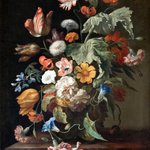
Rachel Ruysch did something most women painters of her day did not: she married, had ten children, and kept painting. From 1708 to 1716 she was court painter to a German prince, the Elector Palatine, who let her stay home in Amsterdam as long as she sent him one picture a year. Then, at 59, she won 75,000 guilders in a lottery. She went on painting until she was very old anyway, and near the end of her life a book of poems about her paintings was published, an honour no Dutch artist had ever had.

Attributed to Sultan Muhammad, Tahmuras Defeats the Divs, about 1525, a page from the Shahnama made for Shah Tahmasp, The Met, New York. The king has beaten the demons, and they buy their lives with a gift. That gift is right there on the page. Find it. Wrong answers welcome.

Everywhere. Once the jungle and the tiger were finished, Rousseau covered the whole picture with a mesh of thin, see-through silver-grey stripes, and that veil is the rain. The National Gallery points out how the stripes echo the tiger's own stripes and the long blades of grass, so the storm hides in plain sight. The jungle is invented too: Rousseau never left France, and its plants are house plants and tropical species he saw at the Botanical Gardens in Paris. Hunts like this are the whole app: amazingartadventure.com/app?…


This face is painted on a shield that bulges toward you. Caravaggio made it look hollow.
📍 Caravaggio, Milan-born, painted in Rome c. 1597. Today: Uffizi Galleries, Florence.
This is today's Artwork of the Day on Amazing Art Adventure 🎨 Free app at amazingartadventure.com/app. A new masterpiece story every day.
📜 Narrated in the spirit of Ovid's Metamorphoses, as Italy read them in 1597.
🎵 Rognoni, diminutions on "Susanne ung jour": Phillip W. Serna (CC BY-SA 3.0)
The Amazing Art Adventure retweeted

Italian actors recreating Caravaggio paintings.
#HappyTuesday 🧙🧹
Light pours in through the gap between the cliffs. Down in the valley, the water lies still enough to hold it.

Look at his eyes. Goya's paint there was badly damaged. A restorer largely repainted them.
📍 Francisco Goya, Madrid, Spain, c. 1820 to 1823. Today: Museo del Prado, Madrid.
This is today's Artwork of the Day on Amazing Art Adventure 🎨 Free app at amazingartadventure.com/app. A new masterpiece story every day.
🎵 Victoria, "O vos omnes": The Tudor Consort (CC BY 2.5)
📷 1874 photo: J. Laurent, Fototeca IPCE (CC BY-SA 2.5 es)
Nobody bought The Cornfield. John Constable painted this Suffolk lane in his London studio in early 1826, and it failed to sell at the Royal Academy and at four more exhibitions after that. The church tower and red roofs in the distance never existed: as his son Charles later pointed out, Constable invented the village to give the eye somewhere to go. After his death in 1837, a group of admirers, Wordsworth and Faraday among them, bought it and gave it to the National Gallery, the first picture by Constable to enter the national collection. Even the title is theirs; he had sent it to the Royal Academy as 'Landscape'.

Henri Rousseau, Surprised!, 1891, National Gallery, London. A tiger crouches in the jungle as lightning cracks the sky. It is raining too, and Rousseau did not leave the rain to your imagination. He painted it. Find the rain. Wrong answers welcome.

Two clay pipes. The grinning man behind the table holds one as the violin and the other as the bow, and the man in the sash gestures as if conducting. The National Gallery reads it as a duet with the woman at the window, who may be singing, while admitting nobody can be sure this is a musical party at all. Hunts like this are the whole app: amazingartadventure.com/app?…


Christ's apostles, dressed in fashionable imports. Around 1700 a painter in Ethiopia, Wäldä Maryam or someone he trained, lined them up with Saint Paul across two panels, and every holy man wears clothing imported from India. He posed and dressed them almost alike, so the group reads as one body, then gave each man a face and a hairstyle of his own. Captions in Ge'ez, an ancient language of East Africa, name every one of them.

Pieter de Hooch, A Woman Drinking with Two Men, probably 1658, National Gallery, London. There is no instrument in sight in this room. Yet someone here seems to be playing the violin, and someone else seems to be conducting. Find the violin. Wrong answers welcome.

The light. Gabriel is the blazing column at the left, and her eyes are turned toward it. The Philadelphia Museum of Art says Gabriel 'appears only as a shaft of light.' Higher up, the shelf on the wall crosses the beam to make the shape of a cross, as the museum's teaching notes point out. Hunts like this are the whole app: amazingartadventure.com/app?…


The Leaning Tower of Pisa first leaned the other way. Slightly north.
📍 Piazza dei Miracoli, Pisa, Italy.
This is today's Artwork of the Day on Amazing Art Adventure 🎨 Free app at amazingartadventure.com/app. A new masterpiece story every day.
📜 Narrated in the spirit of Boccaccio's Decameron.
🎵 Chominciamento de Gioia (medieval Italian): Ririkuku (CC BY-SA)
📷 PaestumPaestum (CC BY 4.0)
📷 Nan Palmero (CC BY 2.0)
📷 Chabe01 (CC BY-SA 4.0)
📷 Zairon (CC BY 4.0)
📷 Holger Uwe Schmitt (CC BY-SA 4.0)
📷 Thomas Fuhrmann Jakobsthal (CC BY-SA 4.0)