

Decoding immune system's role in aging| Ex-Postdoc @YosefLab | @WeizmannScience (Systems Immunology) | @UCBerkeley (EECS)
The Immune-Aging Project
Joined March 2012
- Tweets228
- Following689
- Followers315
- Likes1.6K







Pinned Tweet
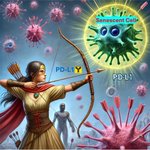
Immunotherapy a key to fight aging? We break down our recent study in this animation! 🧪 Immune checkpoint anti-PD-L1 can enhance the immune system to remove senescent cells & ameliorate age-related phenotypes! nature.com/articles/s41556-0……
@JuliaMMagdalena
@KrizhanovskyLab
@UriAlonWeizmann
@IdoAmitLab
#Aging #AntiAging #Immunotherapy #Longevity #Healthspan #Immunotherapy4aging
@NatureCellBio
@WeizmannScience
Amit Agrawal retweeted

What happened to the children treated with gene therapy 25+ years ago?
@amitmechaging & @JuliaMMagdalena sit down with Prof. Alain Fischer to explore their long-term health and immune function.
Burstcast premieres 8 October.
youtu.be/kK-Hg5VYBTo
#GeneTherapy #immuneaging

We learned to prevent heart attacks by measuring cholesterol. Intervening years before.
We haven't done the same for immune aging. Not because the biology isn't there. Because we don't yet have the equivalent measurement.
We explored this in the discussion.

We wait until older adults get sick. Then we treat them.
Targeted mTOR inhibition offers a different path: enhancing immune function well before the first symptom.
Premieres 8th April at 6:00 PM CEST / 9:00 AM PT
Burstcast link in the comment.

60
Launching our first Burstcast with Prof. Rafi Ahmed.
T cell exhaustion is often framed as immune dysfunction in chronic infection. Yet its regulatory architecture suggests a far more structured biological state.
Premieres at 6:30 PM CET / 12:30 PM EST: the inaugural episode of Burstcast with Prof. Rafi Ahmed.

3
59
Amit Agrawal retweeted

How to identify persistent senescent cell with increased resistance to apoptosis? Check our latest preprint with spotlight on cell surface v-type ATPase ATP6V1B2.. @NatalyFreizus @KrizhanovskyLab @UriAlonWeizmann biorxiv.org/content/10.1101/…

Amit Agrawal retweeted

Our immune system is an evolutionary masterpiece. Every day it protects us from the thousands of different viruses, bacteria and other microbes that attempt to invade our bodies. Without a functioning immune system, we would not survive.
One of the immune system’s marvels is its ability to identify pathogens and differentiate them from the body’s own cells. The microbes that threaten our health do not wear a uniform – they all have different appearances. Many have also developed similarities to human cells, as a form of camouflage. So how does the immune system keep track of what to attack and what to protect? Why doesn’t the immune system attack our bodies more frequently?
Researchers long believed they knew the answer to these questions: that immune cells mature through a process called central immune tolerance (see image). However, our immune system turned out to be more complex than they believed. Mary Brunkow, Fred Ramsdell and Shimon Sakaguchi have been awarded the 2025 Nobel Prize in Physiology or Medicine for their discoveries concerning peripheral immune tolerance.

We live once, but we don't have to die once.

ALT An artistic metaphor for aging research: A classical statue shows cracks of aging not as decay, but as pathways for repar /rejuvenation, filled with luminous gold in a Kintsugi-style repair that restores strength.
102
Amit Agrawal retweeted

Excited to share our new study revealing the intricate dynamics of pregnancy & postpartum physiology! We analyzed 40M lab tests from 300K pregnancies and 160K women (cross-sectional),
we mapped week-by-week changes starting from preconception to months-long postpartum recovery.

Amit Agrawal retweeted
The power of Longitudinal studies for comprehensive view of physiology and pathology. How pregnancy changes our body? Can systemic inflammaging precedes cancer diagnosis? Check out below..
science.org/doi/10.1126/scia…
doi.org/10.1073/pnas.2420502… @UriAlonWeizmann @Mark M Davis


Amit Agrawal retweeted

📑: @JuliaMMagdalena @amitmechaging et al fr/@KrizhanovskyLab show that p16-expressing senescent cells enhance the stability of the immune checkpoint PD-L1, by downregulating its proteasomal degradation to accumulate in ageing and chronic inflammation.
nature.com/articles/s41556-0…

Amit Agrawal retweeted

p16-dependent increase of PD-L1 stability regulates immunosurveillance of senescent cells
nature.com/articles/s41556-0…
Amit Agrawal retweeted
Immunotherapy as an anti-aging treatment?
@KrizhanovskyLab we show that immune checkpoint anti-PD-L1 can enhance the immune system to remove senescent cells & ameliorate age-related phenotypes!
@amitmechaging @UriAlonWeizmann @IdoAmitLab @WeizmannScience
nature.com/articles/s41556-0…
Aging is a complex process, and one of its hallmarks is the accumulation of senescent cells. These cells, while once healthy, have become damaged and dysfunctional.
But why do they stick around? 🤔
Our new research sheds light on this! #aging #senescentcells #aging #immunotherapy
@JuliaMMagdalena @KrizhanovskyLab @UriAlonWeizmann @WeizmannScience nature.com/articles/s41556-0…
Our research opens up new possibilities for developing therapies that target senescent cells, potentially delaying the onset of age-related conditions and improving overall healthspan. #healthspan #futureofaging #longevity #
1
1
338