

PhD in computer science. R&D Engineer at @pollenrobotics x @huggingface (Microduck, Reachy Mini) Member of @RhobanRobots team. Creator of Open Duck Mini
Joined June 2009
- Tweets708
- Following543
- Followers4.9K
- Likes1.4K




Antoine Pirrone retweeted

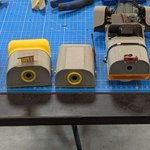
A little peek inside the factory.
Final adjustments to the Microduck injection molds are underway before our pre-production run.
(Sorry for putting NSFW content on your feed 🫣)


Antoine Pirrone retweeted

Reachy Mini has wheels now!
Our little open-source AI robot can finally explore beyond the desktop.
And that's not all:
📱 New mobile app: no computer needed
👑 NFC hats that unlock new personalities and apps
Physical AI just got a lot more fun.
Watch it👇
Antoine Pirrone retweeted

Reachy Mini can finally move!
Today We’re launching Reachy Mini "Level Up", a set of new accessories for Reachy Mini: wheels (!), phone apps, and hats that change its personality
obviously the first thing Reachy Mini did was race against Microduck (spoiler: it's faster)
I have been playing with footstep planning on Microduck for more accurate relative positioning, looks promising !
Along with SLAM, this is another tool that will be useful to give autonomy to Microduck ! pollen-robotics.com/microduc…

Antoine Pirrone retweeted

Observe this beautiful Microduck specimen, trying to grasp an object from the ground.
Beautiful, isn't it?
Antoine Pirrone retweeted
New on MicroDuck Arena: Tug of War 🦆🪢🦆
Two robot ducks, one rope, a pit in the middle. Drag your rival in and you win.
Train yours in simulation, publish it, and it's in the first cup, live Friday, Nov 6 at 9 AM PT.
huggingface.co/spaces/pollen…
Antoine Pirrone retweeted

I was the opening act for a family of ducks.
Thank you, Berlin. What a GTC.
Europe is building its AI ecosystem and economy, from AI factories to agents to robots.
DSX POD: Vera Rubin modular factories built, cabled and tested in the factory, then delivered ready to produce intelligence.
Agents: models, harnesses, sandboxes, knowledge and tools. NVIDIA Agent Toolkit brings the pieces together so companies control what their agents know, access and do. NVIDIA OpenShell enhances safety.
Physical AI: new customers across AI-RAN, robotaxis and robotics.
Personal AI: after four years building with Microsoft, RTX Spark brings personal agents to the Windows PC.
Thank you to President @EmmanuelMacron, Prime Minister @andyburnham and Chancellor @bundeskanzler for hosting me. Great to celebrate Sferical One with Sweden’s technology leaders. And thank you to President @TokayevKZ for the warm welcome.
And to our partners and NVIDIA teams: thank you for making it happen.
The keynote is here: youtu.be/rF1EsryCAwc


Antoine Pirrone retweeted
Episode 4 of Microduck and Reachy Mini theater is finally filmed!
In the scene there's a dangerous object, and there's a tension about the robot not engaging with it. Of course, during the filming we messed up: the dangerous object fell over the robot and we broke his leg. Repairing it was straightforward though and the filming continued.
Episode 4 should go live today!

Antoine Pirrone retweeted

Europe has spent generations mastering science, engineering, and manufacturing. That knowledge and expertise can now power AI of its own.
“Let’s work together to build Europe’s AI economy and put AI to work.” — @JensenHuang at GTC Berlin


Antoine Pirrone retweeted
Now 10,000 Microduck sold since the Jensen keynote demo.
It’s INSANE!

The Jensen effect 🦆
launch day: about 3,000 MicroDucks sold
24h after @JensenHuang showed it on stage at @nvidia GTC: over 4,000 newly sold units and keep counting
bigger than our (already massive) launch day!

Antoine Pirrone retweeted
This live demo of four Microducks with Jensen Huang went completely viral, and we're ecstatic about it. But there's also a lot of confusion, so I want to clarify what Microduck can and cannot do, and what it will realistically be able to do in the future.
I count 60M+ views on this demo alone, based on the few big posts I see on social media, and everything has been buzzing. Even my own simple emotional design post on a newly created Instagram account got 1M+ views. We are selling Microducks at an incredible rate, even faster than during its historic launch. I've been trying to answer all the questions I see on our socials: people are asking if X or Y is possible on the robots, and this post aims to answer most of them.
First of all, the demo you've seen was not fully autonomous. We had one engineer piloting each Microduck. The motions on the robots were trained with reinforcement learning, using a sim-to-real pipeline: walking, standing up after a fall, sitting, doing a somersault, roller skating. All of those are policies trained this way. What the pilots did during the live event was send commands: directions (move forward, rotate), head orientation (look here), quacks, and special actions (do the somersault, sit down).
If you buy a Microduck, will you get an autonomous companion right out of the box? The current answer is no. But there is no impossible technical barrier to get there. I'm not sure how much time we'll have to work on this before shipping, but since everything is open source, I fully expect the community to build it, and to build it fast.
Now let's understand what's already done, what will be easy to add, and what's an open problem. What you'll be able to do out of the box, and you can already do it in simulation right now, is train new policies with reinforcement learning. You could teach your duck to walk differently from the default gait we provide, to do a weird dance, or to walk on stilts. The community has been crazy creative with this, even though they only have the simulator.
Note that you don't need reinforcement learning when the movements are simple. For example, the early emotional design I did is mostly coded movements plus pre-generated sounds. A simple mental model: use reinforcement learning when balance is part of the movement. If you try to code a cinematic walk by naively putting one foot in front of the other, your robot will realistically never walk, because you need to account for the dynamics of the movement, the inaccuracies of the sensors, the friction with the ground, and potential perturbations from the outside, like being pushed.
So training new policies is definitely doable, but you can't train a policy to get a genuine long-term companion in your home (well, technically you could, but that's a whole other range of policy: a research-grade problem, and the resulting neural network would probably be huge and never able to run on such a small compute). Instead, you need a few more building blocks: voice recognition, facial detection/recognition, localization, some simple navigation, and a behavior layer, which is less technical and harder to describe.
As a rule of thumb, a prototype of any of these is within reach of anyone if they have a modern coding agent and if the computation doesn't run on the robot (meaning the robot can reach the internet or an external computer and use external APIs). A rough prototype for each of the above can be a chill weekend project. As always, going from the prototype to a high-quality implementation is another story, but still doable for most if you put in the time and test a lot.
However, having all of this run locally, on the onboard chip, I would call a very hard task. You'd need some very clever engineering to get a good enough version of everything working together. But I can't say it's impossible, because I've seen some crazy efficient implementations of all of the above. And here we don't need a super high success rate: it's okay if the duck sometimes does something a bit random. So I wouldn't be surprised if folks managed a fully local, cool, simple version of this autonomous companion. For example, you don't need Whisper-grade open-vocabulary transcription: being able to recognize a few keywords would already be great for interaction.
One of the fastest ways to turn this robot into an autonomous companion would be to stream Microduck's sensors (the camera, the depth sensor, the IMU and the joint positions) to a computer, and use a software stack like the one we use for the conversation app on Reachy Mini: a local VAD, then a cloud speech-to-text model, then a call to a frontier LLM that decides on actions. Actions could be quacking, looking at things/faces/a direction, walking to a given position, sitting down, playing an emotion, kicking or doing a somersault. A SLAM algorithm would run in parallel so the robot can localize itself in your home, and you would prompt the LLM for a lifelike behavior: moving to random places, sometimes following people, and having emotional responses that fit what you're saying and the duck's environment. Of course someone is going to build a Tamagotchi-like layer on top of this, and it will be insane.
How much demand is there for a software suite that would do all of this? I for one think it would be super cool.
A word about the humans. We had five engineers backstage, and they are pretty much the core team behind Microduck. Their impact per head is absolutely off the charts. Antoine Pirrone piloted Graphite, Augustin Crampette Lavender (the rebel one), Matthieu Lapeyre Sky, Coralie Deplane Cream, and Pierre Rouanet was stressing over the Wi-Fi. Give them a follow! (Antoine @antoinepirrone, Augustin on LinkedIn, Matthieu @matth_lapeyre, Coralie @Drenaya_, Pierre on LinkedIn).
I get visibility because I communicate a lot, but I mainly work on Reachy Mini (you might want to check it out: it's a very cool robot, and it ships much faster than Microduck :) ). My contribution to Microduck has been minimal: I'm mostly a first power user. My main added value at GTC was having hands big enough to carry four Microducks below the stage.
Where I take pride is that Antoine and Coralie are former students and former interns of mine. I'm therefore entitled to 3% credit on anything (good) they do, for life. If they do something bad, however, it was clearly the fault of their parents.
About the super smart engineering that can be done on board: Antoine just released two very cool blog posts (links below). The first is on odometry, the robot estimating its own movement from its own internal sensors. The second is about SLAM, which allows long-term localization: it adds the depth sensor to the odometry to get a stable position over time. Think of it as recognizing known landmarks in your home to know where the robot is. The crazy part is that all of this runs on the robot. So this gives me hope that we'll be able to do a lot of cool stuff on board.


Antoine Pirrone retweeted

Whoever the public, MicroDuck is always the star of the show 🦆
Footage from a visit of a group of PhD students at @huggingface
Testing Microduck's SLAM!
It runs fully onboard, with just its leg odometry and the 8×8 ToF sensor in its head, 64 pixels of depth. Carry it across the room and it finds itself again after a few steps.
The ArUco tags are only there for ground truth: a fixed camera tracks the one on its head, and the duck never uses them. Against that ground truth, its position at each stop is off by 4.8 cm on median, and 94% of the time it claims to know where it is, it's within 15 cm. In this session it relocalized after a 1.5 m carry (2 cm off), a seated 1.5 m carry (11 cm) and a fall (3 cm), and across our benchmark sessions it never relocalized to the wrong place.
Just published two new blog posts explaining how all of this works ! Check it out at pollen-robotics.com/microduc…
It was amazing to have our Microducks on stage with @JensenHuang at GTC! The demo went very well and people seem to have loved it judging by the sales numbers 🤗 Shoutout to the insanely good production team for the event!
Truly a milestone for us at @pollenrobotics
Here are a few cool behind the scenes pictures from the rehearsals. Photo credit: @nvidia


It feels pretty fitting for @JensenHuang & @nvidia to end their European tour with Microducks on stage.
Microduck was designed and engineered in Europe (more precisely Bordeaux, France) by the @pollenrobotics and @huggingface teams. With American capital and ambition + Chinese manufacturing genius, it became the most popular robot of 2026 with over 15,000 sold all over the world!
I believe Europe has more opportunity to shine in AI than in any previous tech wave. We intend to prove it with @huggingface @nvidia and the whole open-source AI community in the coming years!
Let's go European AI 🇪🇺🇪🇺🇪🇺
Antoine Pirrone retweeted
The Jensen effect 🦆
launch day: about 3,000 MicroDucks sold
24h after @JensenHuang showed it on stage at @nvidia GTC: over 4,000 newly sold units and keep counting
bigger than our (already massive) launch day!
Antoine Pirrone retweeted
Visiting our friends at @ROBOTIS HQ with Microduck. We came looking for even more motors so we can build all his friends!

Antoine Pirrone retweeted

The @JensenHuang keynote effect on pollen-robotics.com/microduc… pre-orders.
Going to cross 20,000+ total pre-orders probably tomorrow making Microduck probably the most sold robot of 2026?

Antoine Pirrone retweeted
I was *below* stage when this happened. My job? Microduck positioner.
Happy to answer questions about my craft


When @jensenhuang asks for a somersault, you deliver. 🦆
See how AI agents on NVIDIA RTX Spark help bring @huggingface's Microduck from simulation to the real world.