

Arabiqa is an account dedicated to Arab history and civilization. | Posting a lot on continuity between pre-Islamic and Islamic Arab history.
Joined July 2021
- Tweets1.1K
- Following67
- Followers3.2K
- Likes1.7K





Pinned Tweet
Recently, the Comoros’ historic medinas were registered as a UNESCO World Heritage site.
This rich legacy dates back to a time when Arab sailors traded and settled in these islands, mixing with the locals.
Often forgotten, the Comoros are actually the southernmost Arab country.


Lost Arab cuisine — Al-Andalūs Edition:
1/ Hūt Mutajjan: oven-baked fish with fermented sauce.
2/ Mu'assal: a honey pudding.
3/ Tharīda Tuzīd fī l-Bāh: chicken dish with bread.
4/ Ka'b al-Ghazāl: almond-stuffed cookies.


Mashā’Allah and Naubakht designed nothing. They weren’t even engineers; they were astrologers.
The real designers were the Arab engineers who planned the city and its quarters, not those two.
Baghdad was designed as a circle in 4 parts: all 4 designed by Muslim Arab engineers.


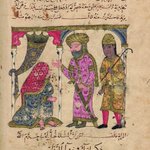
Mu'āwiya and his servant visiting Maysūn. Arab miniature, Egypt or Syria, ca. 1315.
The love story between Mu'āwiya and Maysūn is well known in Arabic literature.
Maysūn was a noblewoman from the Christian Arab tribe of the Banu Kalb and the mother of Yazid I.

ARABIQA 🇵🇸 retweeted

Arabs far surpassed the ancient Greeks in mechanical engineering, as demonstrated by Al-Jazari’s remarkable inventions: water clocks, candle clocks, automated musical devices, and water-raising machines.


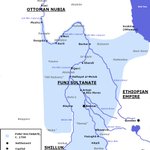
From 1504 to 1821, Sudan was the heart of a sultanate ruled by the Funj, an Arabic-speaking group claiming descent from the Umayyads.
According to local traditions, the Funj people were born of the union between an Abyssinian princess and an Umayyad prince who fled the Abbasids.


ARABIQA 🇵🇸 retweeted
Writing about Alexander’s march in 331 BCE, Roman historian Quintus Curtius described territory east of the Tigris as “Arabia.”
Jan Retsö suggests this may reflect an ancient Arab presence in Adiabene (modern Erbil), possibly dating to Achaemenid times.


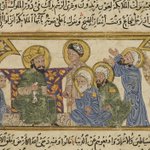
An Arab miniature painting dated 1307, depicting the birth of the Roman Emperor Augustus, based on the book "Athār-ul Bākiya".
The Arabic text and the miniature portray the birth of Augustus through a post mortem caesarean section.

Fragments of Tiraz style textile. Egypt, 12th Century. Fatimid period. Caliphate of Al-Hafiz.
Egypt was one of the main centers of Tiraz production in the medieval Arab world.
Gold embroidery was particularly prized in the time of the Fatimids, who had very refined tastes.


ARABIQA 🇵🇸 retweeted
The cultural development of the Maghreb was characterized by its ability to continuously incorporate elements from Al-Andalus.
With the conquest of Al-Andalus by the Almoravids, the Andalusians gradually imposed their cultural hegemony on the Maghreb: both in arts and sciences.


ARABIQA 🇵🇸 retweeted
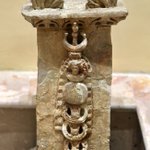
Incense burner depicting a Samya (Hatran religious banner). 2nd–3rd century CE.
These banners always featured three symbols: a round plate with the bust of a local deity, a crescent moon, and an eagle at the top.
Note: the eagle was the symbol of the Arab kings of Hatra.

Other example of the Abbasids seeking continuity with pre-Islamic Arab history:
Al-Samsamah, a sword that belonged to the Kings of Himyar, was kept as a precious relic in the Abbasid caliphal treasury.
The Abbasids were proud Arabs, hence their attachment to the old Arab past.


The Fatimids also showed an interest in Himyarite swords, notably the caliph Al Mustansir Billah, who obtained a hundred of these swords from Ali Al-Sulayhi, the first Sulayhid sultan of Yemen:

