

Exchange reserve transparency — policy, Stage framework & public reports. Independent verifier output, not marketing. Feedback: [email protected]
global
Joined July 2026
- Tweets57
- Following35
- Followers1
- Likes1


Pinned Tweet
Post-FTX PoR improved narratives—not necessarily reproducible custody evidence.
We published a working draft on effective PoR, Stage floors, and what third parties can actually verify today.
ardmere.github.io/docs/excha…
Independent analysis. Not investment advice.

6
95
Proof of reserves is still a trust exercise.
Most PoR products stop at “we published a snapshot.” Users still cannot cheaply verify it, regulators cannot compare operators, and every exchange rebuilds its own tree, circuit, verifier and user runbook.
Private balances are table stakes. The real gap is verification.
Standardized Midnight PoR is a protocol, not another PoR product.
One schema. One contract interface. One verifier. Reusable by any exchange.
How it works:
1. The exchange builds a fixed-size, multi-asset Merkle Sum Tree from its private ledger and generates one Compact proof.
2. At submission, the Midnight contract verifies the global proof. Only then does it anchor the snapshot root, prices, declared reserves, aggregate liabilities and gross sums on-chain.
3. The user does not verify the global proof. They receive an inclusion JSON, recompute one Merkle path against the anchored root, and optionally check NAV. No proof server. No global proof. No exchange runbook.
4. A regulator or independent verifier reads the same public snapshot from the indexer: contract, root, prices, reserves, liabilities and the published flag.
The gap is verification, not data.
Wave 3 build: github.com/ardmere/ardmere-m…
#Midnight #ZK #ProofOfReserves
102
Introducing Ardmere: A unified verification layer for exchange Proof-of-Reserves.
Built at NEAR HACKATHON @NEARProtocol @NEARHackathon
CEX hedging leaves your capital on an exchange — but most public Proof-of-Reserves can’t be recomputed by a third party. Intent solvers and agents still need a clear read before they pick a venue.
Ardmere verifies CEXs Proof-of-Reserves and anchors each assessment on NEAR so Intents-style agents and protocols can view the result — digest, score, stage — without trusting an exchange API.
If you hedge on CEXs, how would you control the CEXs reserve risk?
Demo repo: github.com/ardmere/ardmere-n…
Ardmere: 📷ardmere.github.io
53
Many CEXs publish Proof of Reserves pages. Far fewer publish artifacts that an independent outsider can re-check without trusting the exchange’s own narrative. An address list and a coverage ratio are not the same as public, reproducible proofs.
Concrete case: Binance snapshot PR12NOV26 (snapshot time 2026-11-12 UTC).
binance.com/en/proof-of-rese…
What are still missing from the public package:
1. No public, batch-verifiable wallet ownership proofs (so listed addresses are not shown to be controlled by the exchange in a way outsiders can verify)
2. No publicly downloadable global ZK proof + verifying key
3. No public trusted-setup transcript (the setup remains opaque)
Row-level report:
ardmere.github.io/docs/repor…
---
What exchanges should publish for each snapshot (so outsiders can check)
1. Wallet ownership proofs third parties can batch-verify — not only an address list
2. A downloadable global ZK proof plus verifying key
3. A public trusted-setup transcript, or a proof system that needs no trusted setup
4. A final, stable merkle / commitment root on-chain
5. Wallet CSV / reserve claims that match on-chain balances at the disclosed addresses and heights
Without those, a PoR page is still mostly “trust us.”
Corrections welcome if any public artifact above was misread.
(Optional method write-up, if useful: ardmere.github.io/docs/excha… )
35
What are still missing in Binance POR:
1. No public, batch-verifiable wallet ownership proofs
2. No publicly downloadable global ZK proof + verifying key
3. No public trusted-setup
4. Summing of address list balance is $686M less than CSV claims.
ardmere.github.io/docs/repor…

45
The audit report of the latest 31/10/2026 PoR of Binance: ardmere.github.io/docs/repor…
We believe Binance is honest, but the report shows they can easily generate fake proofs without a trusted setup. @cz_binance @heyibinance
31
ardmere independently assessed Binance's July 2026 PoR snapshot PR01JUL26 (2026-07-01).
Verdict: effective PoR false · Stage 0 · Gen 2 / E2 · medium confidence
Thread ↓ Full report: ardmere.github.io/docs/repor…
2
43
(2/2) Gaps:
✗ Stage 1: no public wallet_ownership_proof; global ZK proof/vk not downloadable; trusted-setup transcript not public
⚠ On-chain reconciliation: hot ~4% · token ~68% · ledger ~20% coverage — many CSV vs chain deltas
Feedback welcome from @cz_binance @binance
15
(1/2) What we could verify on disclosed artifacts:
✓ Artifact integrity
✓ Internal consistency (summary ↔ wallet CSV)
✓ Self-reported solvency fields
These check disclosed data consistency — not independent proof of full reserves.
40
(6/6) ardmere is an independent PoR transparency registry—not an exchange, not a custodian.
Ratings bind to artifacts and verifier output. They do not guarantee solvency or safety.
Follow for updates. Questions & corrections welcome.
ardmere.github.io
19
(5/6) The public registry is live:
Evidence-bound Stage ratings · missing-artifact gaps · reproducible verifier output
Reports : ardmere.github.io/docs/repor…
Methodology: ardmere.github.io/docs/por-t…
17
(4/6) Two risk layers—don’t conflate them:
Layer 1: disclosure quality at licensed/semi-regulated CEXs (where Stage ratings apply)
Layer 2: unlicensed fake “exchanges” (JPEX-style)—admission & enforcement, not a Merkle fix
16
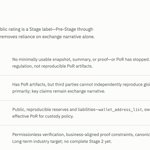
(3/6) Policy conclusions we keep returning to:
· Stage 0 is not effective PoR
· Stage 1 is the minimum custody transparency floor
· Financial audit and PoR are dual-track—they answer different questions
16
(2/6) Our Stage framework (who must users ultimately trust?):
· Pre-Stage — no usable PoR
· Stage 0 — artifacts exist; global solvency not independently reproducible
· Stage 1 — minimum effective PoR
· Stage 2 — trust-minimized (aspirational; no complete example yet)
14