

An Internet Intelligence Company with hyperspecialization in Subdomain and Exploit Intelligence.
India
Joined November 2023
- Tweets1.7K
- Following354
- Followers575
- Likes2.3K








Pinned Tweet
In 2020 we open-sourced Kenzer, a recon and scanning framework for bug bounty hunting: github.com/ARPSyndicate/kenz…
Today it's reborn as a full security platform.
Cybersecurity comes down to targets, exploits and threats. Most teams cover them with separate tools that all score them differently, so nobody can answer the one question that matters: how exposed are we?
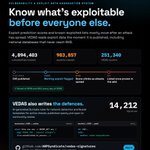
Kenzer brings it into one place, with one security grade. It covers SCA, SAST and DAST, Fourth-party risk and Dark web monitoring. Every finding is ranked by real exploitability using VEDAS, our exploit intelligence covering nearly 5 million vulnerabilities.
Built by ARPSyndicate. Watch the 4-minute tour below.
kenzer.arpsyndicate.io
#cybersecurity #bugbounty #vulnerabilitymanagement #appsec
1
188
ARPSyndicate - Cyber & Open Source Intelligence retweeted

‼️ Hackers broke into Polish payment operator Autopay with no malware and no phishing. The company says it was an attack of "a completely new type", run with mass use of AI tools.
Its security manager told Polish security site Sekurak the attackers used valid logins and admin tools to move through its monitoring, deployment and password-management systems. Each step looked like routine admin work and didn't trip the usual alarms.
They reached part of the payment data Autopay processes. It says it can't rule out that the data was copied, and is contacting everyone who may be affected.


ARPSyndicate - Cyber & Open Source Intelligence retweeted

I just found and reported another very interesting and significant Outlook 0-click (half-click?) RCE 0day.:)
The fun part is that AI actually helped me this time. At beginning when I found this bug (not via AI), it's not a real 0-click but the victim had to click the "Reply" button to trigger the bug, super weird, so I tried to figure out why and so analyzed the root cause, at some point I thought it's possible to turn this bug to a 0-click because I realized that the bug sits in the very core of the Outlook email rendering engine. So I asked AI to write some quick "fuzzer-like" scripts for me, and you know what? After a night of running, it successfully produced a PoC which turns this 1-click bug to a perfect 0-click.:)
nitter.cf/HaifeiLi/status/212213…

Hmm, the new MSRC portal is quite confusing. @msftsecresponse
First, they now use AI (yeah, here we are) to review your report before you submit, I got something saying my report is not good enough, but in fact it's because that all my details are provided in an attached PDF report, and I can't copy all the things to the portal because they have character limitation.
Then, when I click the "Submit anyway", I got confused whether or not I've successfully submitted the bug report, double-checked, seems I didn't, so I had to submit again, now it seems it's there?
ARPSyndicate - Cyber & Open Source Intelligence retweeted

We are tracking a breach of a 3rd-party JS host impacting hundreds of high value websites.
This is staggering.
ARPSyndicate - Cyber & Open Source Intelligence retweeted

On Android phones, there's a feature turned on by default that lets them fall back to 2G connections. According to police in Tokyo, a man had been exploiting that feature from a car, and they have now arrested him.
On November 7, police closed in on a dark blue hatchback on a Ginza street. Under the back seat was a radio transmitter, still on, with batteries in the trunk.
The device, police say, emitted a strong signal on the same frequencies as the carriers, causing every phone within about 500 meters of the car to lose its connection: more than 10,000 phones.
When a phone loses its connection, it looks for any network to connect to, and what the car was emitting was a 2G connection.
On 4G and 5G networks, a phone checks whether the cell tower it's connecting to is legitimate. On 2G, it doesn't, and so any phone that connected to the car's fake tower had no way of knowing it wasn't legitimate, and trusted everything it saw.
What it saw was a text message, in Chinese, saying the recipient's credit card had been suspended and offering a link to fix the problem. Police say 18 people, mostly Chinese tourists, lost around 4 million yen to the scam, or around $25,000. The driver, Yu Hai, a 31-year-old Chinese national, denies the allegations.
One man in his 20s told NHK that when he was walking in Shibuya, his phone suddenly switched to 2G, and that exact text message appeared on his phone. He ignored it.
Japan doesn't have a 2G network. It shut down its last one around 2012. Why would a phone in Tokyo still connect to one?
Because phones are built for the global market, and some parts of the world still only have a 2G connection.
That's why the setting is left turned on. If it were turned off for everyone, then a traveler in one of those countries could have no service at all.
In Ginza, this backup system let a single car disable over 10,000 phones for an hour, then send them a fake text message.
The default setting is set once, by the phone manufacturers, for all countries at once. Japan got rid of its 2G network years ago, but it doesn't get to decide whether phones in Japan still trust a 2G tower, and they still do.
ARPSyndicate - Cyber & Open Source Intelligence retweeted

Unauthenticated remote root CA installation via eMudhra emBridge 3.3.1.0 (drive-by to TLS MITM) on RHEL-family Linux operating systems


ARPSyndicate - Cyber & Open Source Intelligence retweeted

There are currently 3,100 airborne aircraft bound for US airports amid nationwide ground stop. No additional aircraft are taking off at this time.

ARPSyndicate - Cyber & Open Source Intelligence retweeted

iOS27.0/27.2 kernel vulnerability may be exploited successfully✅
#iOS27

ARPSyndicate - Cyber & Open Source Intelligence retweeted

🚨 Hackers exploit Check Point zero-day to gain root access, deploy backdoors, and wipe VMware servers
PoC: github.com/googlesky/CVE-202…
Check Point has confirmed active exploitation of CVE-2026-123039, a privilege escalation vulnerability that attackers chained with PHP2Shell to gain root access to vulnerable Security Gateways.
The attacks began October 30, initially targeting Israeli organizations before expanding worldwide. Hackers deployed persistent backdoors, stole configurations, and moved laterally into VMware ESXi infrastructure, where destructive wiper malware was used.
Check Point confirmed approximately two dozen unpatched systems were compromised.
Security fixes were available before the attacks, and administrators are urged to install the latest Jumbo Hotfix immediately.


ARPSyndicate - Cyber & Open Source Intelligence retweeted
🚨 BREAKING: The FAA has halted every departing flight at every US airport due to a communications problem impacting Air Route Traffic Control Centers that guide planes in flight.
It is only the second nationwide halt since 9/11.


ARPSyndicate - Cyber & Open Source Intelligence retweeted

I built HexBrain: every publicly disclosed HackerOne report on one interactive map.
15,000+ reports by vulnerability class, weakness and program
Full write-ups: how each bug was actually found
405,000+ CVEs, exploited ones in red
Bypass and payload libraries
It's free and still early, so tell me what breaks or what's missing.
hexbrainai.com
#bugbounty #infosec #bugbountytips

ARPSyndicate - Cyber & Open Source Intelligence retweeted

Earlier this year, I hacked a major automotive company with @samwcyo. We were able to remotely unlock cars in the AU and US. My writeup for AU is here: shubs.io/unlocking-any-car-f… and our writeup for the US here: samcurry.net/forgerock
ARPSyndicate - Cyber & Open Source Intelligence retweeted

How does @neo_ai_engineer check its own work?

Can you prove that AI finding isn't slop before your execs read it?
In Episode 5 of Plugged In With Neo, Patrick covers the verifier agent, Challenge and Verify, Escalate, and turning verified findings into technical and executive reports.
CHAPTERS
00:00 Welcome and episode overview
00:56 In the Beginning There Was Nuclei
01:59 From Nuclei templates to ProjectDiscovery Cloud
03:19 From Templates to Cloud to Neo
04:54 Verification as the layer under every finding
06:06 What to Expect: prove it, shape it, keep it current
07:11 Segment 01: Prove It
07:46 Reading a finding: evidence, impact, and status
10:35 How Neo Checks Its Own Work
12:50 Challenge and Verify: retesting from scratch
13:26 Escalate: chaining findings for bigger impact
14:35 False Positive and re-checking fixed issues
15:12 Harden Findings Before Reporting
18:03 Shaping the deliverable: Markdown, PDF, and Word
19:55 One Finding Set, Three Deliverables
21:46 Report subagent and custom output integrations
23:37 Prompt or Settings?
25:36 Which Format for Which Reader
26:19 Keep It Current: changes-only reporting
28:30 Findings From Other Tools? Triage preview
29:30 Recap: from verified finding to scheduled report
31:05 Q&A, next episode, and closing
ARPSyndicate - Cyber & Open Source Intelligence retweeted

Our security researchers built an autonomous cyber vulnerability discovery, exploitation, and patching pipeline.
In a single run with an upcoming cyber model, it validated and generated patches for 948 local privilege escalation vulnerabilities in the Linux kernel at a total API cost of $1.2 million.

ARPSyndicate - Cyber & Open Source Intelligence retweeted

🇰🇷 𝗔𝗥𝗧𝗘𝗫 𝗘𝘅𝗽𝗼𝘀𝗲𝗱: 𝗜𝗻𝗳𝗿𝗮𝘀𝘁𝗿𝘂𝗰𝘁𝘂𝗿𝗲 𝗕𝗲𝗵𝗶𝗻𝗱 𝗦𝗼𝘂𝘁𝗵 𝗞𝗼𝗿𝗲𝗮'𝘀 𝗕𝗮𝗻𝗸 𝗕𝗿𝗲𝗮𝗰𝗵𝗲𝘀
Days ago CrowdStrike and Genians reported ARTEX, an AI-driven autonomous pentest framework, in the intrusions that hit seven South Korean financial institutions.
We found a second open directory those reports didn't cover, and it opened up the operator's whole working environment.
What the exposed directories showed us:
- A Hong Kong jump server at 23.248.226[.]250 wired to the ARTEX console, with credential files, reverse SSH tunnels and sync scripts
- The harness is Claude Code, but routed through CCR to a DeepSeek backend via the xcai[.]pro reseller, with GLM and Grok as backups
- 19 custom agent skills for recon, web testing, payment-logic abuse and mobile-device operations
- A rotating proxy service that exposed 79 unique exit IPs across the first 100 identities we tested
- Pivoting on the ARTEX certificate, malware tag and console title tied 1,303 candidate IPs and 280 linked open directories
Full write-up, including the HuntSQL queries and the IOC table 👇
hunt.io/blog/artex-south-kor…
ARPSyndicate - Cyber & Open Source Intelligence retweeted
🚨 BREAKING: A flaw in APT, the tool that installs software on Debian Linux, lets an attacker on the network tamper with a package after it passes verification and run code as root.
The bug, CVE-2026-109518, sits in resumed HTTP downloads. APT can merge two different downloads when a redirect gives them the same address, and a man-in-the-middle can then alter the file after its check.
Debian fixed it in apt 3.0.4, shipped to Debian 13 security updates on 4 November. Users should upgrade now.
Per Debian's changelog, the fix is four words long. "Open target files exclusively."


ARPSyndicate - Cyber & Open Source Intelligence retweeted

someone is mass deploying Offensive AI Agents.
hundreds of ARTEX instances are popping up across multiple VPS providers creating a potential distributed attack network.
the largest clusters are on 38.11.x.x (Cogent) and 172.245.x.x (ColoCrossing) with others on DigitalOcean, Vultr and Linode. some of these providers accept cryptocurrency payments.
an identical ETag (6acfa90c-39df) and Content-Length (14815) prove they are all dropping from the same Docker image or template.
vendors like Microsoft, CrowdStrike and AhnLab have already confirmed ARTEX in live attacks including against Korean financial institutions.
