






Pinned Tweet
In June, 26 of us from 9 countries set 5 FAI records at Skydive Balaton, Hungary, including a 25-way sequential wingsuit formation world record.
🇵🇱🇩🇪🇱🇻🇮🇹🇺🇦🇫🇷🇨🇭🇪🇸🇸🇪
The plan was one European record. We set five. The story started with lost luggage.
Blazing-Fast Lambda Calculus via Metaprogramming: my ScalaDays 2026 talk is now an article.
Scala 3's staging compiler turns a lambda-calculus interpreter into a JIT in a few dozen lines.
In @Scalus3, it runs Cardano smart contracts ~3× faster than the Haskell VM 🧵

I presented this approach last year in Edinburgh, at UPLC 2025, IOG's conference on Plutus Core and Cardano's programming languages:
iog.io/news/uplc-2025-confer…

We’re continuing SAIB’s work on the Cardano Plutus VM benchmark 🙏
Latest results: 15 evaluators (Haskell, Rust, Go, Scala, TypeScript, C#, Java, Zig), 89 scripts, correctness-gated against plutus-core.
plutus-vm-bench.lantr.io/

We’re continuing @saibdev’s work on the Cardano Plutus VM benchmark 🙏
Latest results: 15 evaluators (Haskell, Rust, Go, Scala, TypeScript, C#, Java, Zig), 89 scripts, correctness-gated against plutus-core.
plutus-vm-bench.lantr.io
Scalus 1.4.1 is out 🚀
Now with the fastest CEK machine and Lean formal verification!
And our TS/JVM Cardano Emulator is awesome.
Benchmarks tomorrow.


BREAKING: Trump to send Patriots to Russia to protect its oil refineries from unprovoked Ukrainian attacks.
Scalus 1.2.0 is Maven Central and on NPM.
Faster, cheaper, smaller scripts, better safer contracts stdlib.
TypeScript Emulator inegrated with Mesh JS. More coming.

Alex Nemish 🇺🇦 retweeted

Four years ago today, Ukraine liberated Izium.
What was uncovered shocked the world: 447 graves, including 414 civilians and 5 children. Most died violently.
This is what russian occupation leaves behind.
Mass graves.
Never forget. Never forgive.


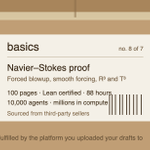
This OpenAI Navier-Stokes situation is Amazon Basics for research.
Sell on Amazon and they see your numbers, then launch a copy and undercut you.
Put your drafts in Codex and OpenAI sees your unpublished work, then a team spins up on your exact problem and publishes first.

Alex Nemish 🇺🇦 retweeted

tristan buckmaster just published a statement that is, if accurate, one of the ugliest things i’ve read out of a frontier lab.
not because of the math. because of what happened after openai found out two people were about to beat them to the punch.
buckmaster and levent alpöge spent a year pushing the córdoba / martínez-zoroa program to smooth forcing. august 15 they got blowup for boussinesq and 3d euler. lean-verified august 22.
they were paying openai out of pocket and dumping every draft into private codex sessions.
the program is obscure. almost nobody else was on it. this was not “paste the clay problem into a chatbot.”
then this:
> thursday sept 3, buckmaster emails openai privately. rumors are flying. he is trying to stop a mess, not start one.
> they reply the same day: give us details so we can “avoid competing.” also, want free compute?
> sunday they suddenly need a call “at any point today.” sebastien bubeck gets on. levent is not invited.
> openai says an internal model has a ~100-page proof of forced navier–stokes blowup. fefferman options c and d. the exact route buckmaster and alpöge had quietly chosen.
> they show him a prompt and claim the model was “simply given the problem statement.” levent is told “very little human input.”
> that falls apart on the same call. a whole team had been on it. they started on the unforced problem, warmed the model up on easier equations including euler, and even the prompt they showed him was written by prompting codex.
> he asks when the first prompt went out. they stall. then agree: the past few days. after information about his work reached openai.
> he asks whether the model was trained on, or had access to, the private codex sessions where they put every draft of this project.
> answer: the model does not look up user data.
> he asks again. about training.
> no answer.
then it stops being a science story and becomes an hr story.
> offer 1: you post euler. we post navier–stokes the next day.
> offer 2: after you post euler, you alone write the navier–stokes paper, credit our model, and we cut levent.
> bubeck says twice he wants levent removed from authorship because he works at anthropic.
he declines both.
he says if they release it that way, he goes public.
the reply is not a scientific objection.
> “why would you ruin your career?”
> “if you don’t want me to be nice, then i don’t have to be nice.”
later, a text to levent proposing a one-on-one:
> “i don’t know if tristan is being fully rational right now.”
that is not how you treat a collaborator. that is how you split one.
openai got word two researchers were closing a path almost nobody else was on. they spun up a team on that exact path. they would not answer whether the researchers’ unpublished drafts in openai’s product were used. they tried to dictate the announcement order. they tried to remove a coauthor because he works at a competitor.
when that failed, someone reached for a career threat.
this is a lab finding out academics were about to publish, sprinting the same narrow program, refusing the data question, and trying to manage credit around a rival affiliation.
really slimy if even half of this holds.
what the fuck is happening.


holy shit.
tristan buckmaster is saying openai has a forced navier–stokes blowup via the córdoba / martínez-zoroa program.
and that it may have used drafts from his and levent alpöge’s private codex sessions.
that’s the córdoba / martínez-zoroa route. almost nobody else was on it.
he also says the first prompt went out after information about his and levent alpöge’s work reached openai. that “very little human input” was not true. that a whole team had already been set on easier problems, including euler. that even the prompt they showed him was written by prompting codex.
then he asked:
did the model have their private codex sessions.
no answer on training.
if any of that holds, openai didn’t just scoop a math result. they may have done it off two researchers’ unpublished drafts, then tried to cut the coauthor because he works at anthropic.
a millennium-problem-adjacent result just became employee drama before an ipo.
i don’t even know which part is crazier.
this is one of the slimiest things i’ve seen in this industry.


It’s not that changing your mind is wrong. I’ve changed mine on so many things that by now I’m not sure about anything.
What’s funny to me is the level of confidence each time: “No, but now I really know the answer.”
I used to be like that too, which is why I find it so self-reflectively hilarious 😂

Scala 3.9 LTS is out!
We'll publish Scalus plugin for 3.9 along with upcoming Scalus 1.2 soon.

New Scala LTS is out! Read all about it in the recent blog post by Wojciech Mazur at scala-lang.org/news/3.9/. The blog post covers all the most recent features, a quick reminder of all the ones since the last LTS, and practical information about migrating.

Super cool!
Although, frankly, I'd prefer this to be a planned and builtin funcionality of governance.
Shall we create a CIP? Or there's one already?

Cardano governance can now govern the dApps built on Cardano.
We just proved something believed to be impossible.
A dApp can tie a smart-contract upgrade or parameter change to a Cardano L1 governance proposal. If that proposal passes and is enacted, the smart contract can verify the result on-chain and unlock exactly what was approved.
The authority can come from Cardano itself not a project admin key, multisig, or trusted oracle.
This opens a new path to decentralized dApp governance:
→ smart-contract upgrades
→ changing dApp parameters
→ treasury actions
→ emergency controls
Cardano governance can now become the authority behind how dApps evolve.
I first presented this design at UPLCfest in “Pushing the Limits of UPLC: Everything is Possible” a keynote about achieving things in Cardano’s execution layer that were considered impossible. It's really satisfying to see this finally validated.