
kinda polymath person - only techy tweets here.
Texas, USA
Joined June 2015
- Tweets15.3K
- Following4.7K
- Followers569
- Likes42.5K









Augusto Bortoluzzi retweeted

‼️ UPDATE: Security firm Calif says it took over Jira, Confluence, Jenkins and Keycloak servers with Java4Shell, without even logging in.
The flaw sits in the code Java uses to decode Base64, a common way to send data as text. A short malformed string makes it write past the end of its memory.
Calif's researcher says OpenAI's Codex helped him find the bug in an hour and build a working exploit in two more, for under $200 in AI costs.
Oracle shipped a patch tonight. Calif is holding back its exploits until people have patched.


Augusto Bortoluzzi retweeted

An FPGA board plugged into an active Thunderbolt or M.2 port can patch your live RAM and unlock a locked Windows screen with any random password.
So how does Direct Memory Access (DMA) attacks bypass OS authentication? Well high-speed peripherals need fast data transfers, so modern laptops let PCIe devices read and write physical memory directly, bypassing the CPU and operating system permission checks.
Running open-source firmware like PCILeech on an FPGA card (such as a PCIe Screamer), an attacker connects to an exposed Thunderbolt port or an internal M.2 slot. The board registers as a standard PCIe endpoint and streams raw physical RAM over USB to another laptop. From there, PCILeech scans live memory for the Windows authentication library (msv1_0.dll inside winlogon.exe) and patches a single conditional jump instruction. Typing any random password at the lock screen then unlocks the desktop, leaving BitLocker volume keys and active sessions intact in memory.
Let me give you two settings stop this:
* Enable strict IOMMU (Intel VT-d or AMD-Vi) in BIOS so peripherals only access isolated memory buffers.
* Turn on Kernel DMA Protection, which blocks external PCIe tunneling while the screen is locked.
(Second image was enhanced with AI)
🤖 Made with AI


Augusto Bortoluzzi retweeted

Apple built Exclaves (🤌) with a microkernel, hardware isolation, and formal verification to prevent this ... or at least convince us they were trying to make spying harder.
Meanwhile, the sad reality: Apple's audio daemon just trusted the identity supplied by the app. 🫠
Meta's red team found an Apple bug that let iPhone and Mac apps record from the microphone even after the user denied permission.
The app forged an ID token to pose as Apple's own audio service, which then skipped the permission check.
On one iOS 27 beta, the orange mic dot never lit up, and the logs pinned the recording on Apple's service, not the app.
Apple fixed it in August with iOS 26.6.1 and macOS Tahoe 26.6.2. Its patch note calls it just "a logic issue."


Augusto Bortoluzzi retweeted

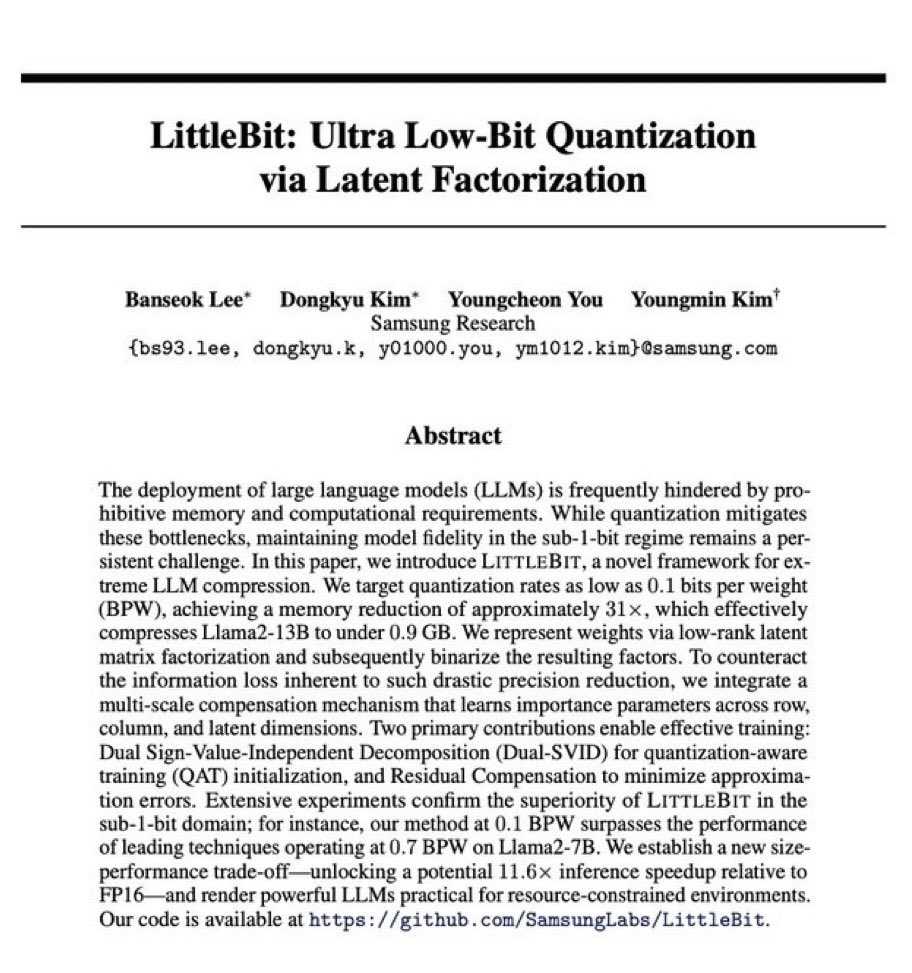
Samsung open-sourced a method that shrinks 13B parameter LLM into less than 1 GB.
The method is named "LittleBit"
Normally, AI weights are stored as regular numbers. LittleBit instead uses latent factorization to compress them below 1 bit each.
Some setups get all the way down to 0.1 bits per weight.
The architecture is where it gets wild.
Once a model is compressed this far, most of the math goes away.
LittleBit doesn't make the hardware grind through expensive floating-point multiplications. It runs the core computation with a simple bitwise XOR.
Heavy matrix math becomes simple sign flips.
What this means for deploying models:
• Up to 11.6x faster inference than standard FP16 models.
• Much less memory needed, and much less bandwidth to load the model.
• Holds up even below 0.5 bits, where older compression methods completely break down.
This is more than a smart optimization.
It's a roadmap for running huge, advanced AI locally on cheap, low-power hardware.
Augusto Bortoluzzi retweeted
‼️ Facebook's Android app read the photos, videos and metadata on Italian users' phones without specific consent. Italy's privacy watchdog has fined Meta €805M for it.
The feature suggests gallery shots to post. It was on by default, behind one vague, app-wide permission that, granted in full, lets the app read the entire photo library.
About 20 million Android users in Italy have had it since 2023.
Meta wanted Ireland's regulator to handle the case. The watchdog refused.
Meta has 60 days to switch it off by default and ask for consent separately.


Augusto Bortoluzzi retweeted

‼️ NoisyTCP: 11-Year-Old Linux Kernel Flaw Allows Attackers to Crash Servers Remotely
Details: cybersecuritynews.com/noisyt…
NoisyTCP is an 11-year-old Linux kernel bug. It lets a remote attacker crash a server without logging in.
The flaw is tracked as CVE-2026-99288. The flaw sits in the kernel’s TCP code, which handles almost all network traffic on Linux. Kim says it can be triggered against plain TCP listeners.
A server doesn’t need unusual settings, firewall rules, or special sockets. It only has to call listen() and receive packets from the attacker. That puts Nginx, Apache, and SSH servers in their default setups at risk, as well as proxies.
#cybersecuritynews #Linux

Augusto Bortoluzzi retweeted

这绝对是今年最让人拍案叫绝的硬件逆向神作:安全研究员 Kate 发现英伟达旗舰计算核心 GA100 芯片内部存在一个电压故障注入漏洞(Voltage Fault Injection),并亲手把一张当年矿潮遗留下来的阉割版 CMP 170HX 8GB 矿卡,原地解锁成了满血的 A100-80GB!
当年英伟达为了防止矿工抢占数据中心显卡,拿 GA100 大核心切出了 CMP 170HX 矿卡,不仅在硬件熔丝(Fuses)层面砍掉了显存容量、禁用了 NVLink 高速互联、把 PCIe 降到 Gen1,还锁死了张量计算吞吐。
Kate 顺着 GA100 上电启动读取板载熔丝配置寄存器的微妙时间窗口,用精密控制的电压毛刺(Voltage Glitching)去干扰芯片的熔丝传感放大器——让芯片在自检瞬间把原本烧断的限制熔丝全部误读为 0(未熔断状态),再配合重新植球焊满的高带宽显存,一举解开了英伟达在硅片层面的全部封印:不仅显存认满 81,920 MiB(80GB),连原本被阉割的 PCIe Gen4、NVLink、MIG 切分 也全数复活。
更离谱的是实测性能:因为英伟达在卖零售版 A100 时为了保证晶圆良率,统一锁在了 108 个流多处理器(SM);而这张被毛刺攻击彻底放飞自我的 GA100 核心,居然把晶圆上全部完好的 120 到 126 个 SM 单元 全点亮了,跑出来的真实算力比官方正版 A100 还要快出整整 1.2 倍。

Augusto Bortoluzzi retweeted

🚨 Hackers exploited Log4Shell in VMware vCenter to breach a Russian software developer.
BO Team gained root access, planted backdoors, and compromised its code-signing server—raising fears of a software supply chain attack.
Read: thehackernews.com/2026/11/bo…

Augusto Bortoluzzi retweeted
Meta's red team found an Apple bug that let iPhone and Mac apps record from the microphone even after the user denied permission.
The app forged an ID token to pose as Apple's own audio service, which then skipped the permission check.
On one iOS 27 beta, the orange mic dot never lit up, and the logs pinned the recording on Apple's service, not the app.
Apple fixed it in August with iOS 26.6.1 and macOS Tahoe 26.6.2. Its patch note calls it just "a logic issue."
Augusto Bortoluzzi retweeted
‼️ BREAKING - Trezor confirms hidden hardware implants in 3 'Safe 5 crypto wallets' sold by former reseller CryptoBilis.
The implants can steal recovery phrases and transmit them over mobile networks.
A firmware update won't undo earlier exposure.
Details ↓ thehackernews.com/2026/11/tr…

Augusto Bortoluzzi retweeted

any ladies out there disgusted by the jensen huang cheating allegations?
if you own an RTX 5070 or higher, it’s time to take a stand
sell that disgusting piece of hardware to me for $50
don’t let that man’s GPU sit in your house. know your worth ladies
Augusto Bortoluzzi retweeted
‼️ BREAKING - Critical Apache HTTP/2 flaw could allow unauthenticated remote code execution.
CVE-2026-119618 affects versions 2.4.55–2.4.70 with HTTP/2 enabled.
CVSS 9.8. Fixed in 2.4.71, but some #Linux distributions still await patches.
Read more → thehackernews.com/2026/11/cr…

Augusto Bortoluzzi retweeted
In November 2024, 404 Media reported that Detroit police circulated an internal warning claiming seized iPhones were mysteriously rebooting inside evidence lockers. Detectives theorized that newer iOS devices were communicating over a secret Bluetooth mesh to trigger remote reboots through Faraday cages.
Reverse engineer Dr. Jiska Classen audited the iOS 18.1 code and found the real trigger: Apple had added Inactivity Reboot. It does not rely on cellular, Wi-Fi, or Bluetooth state. It is an idle timer managed directly by the Secure Enclave Processor (SEP).
Mobile forensics centers on two states: After First Unlock (AFU) and Before First Unlock (BFU). Once you enter your passcode after boot, Apple's Data Protection architecture derives class encryption keys and caches them in memory so background tasks, calls, and notifications work. Forensic boxes like GrayKey and Cellebrite target this AFU state to exploit memory vulnerabilities or pull unencrypted caches.
Apple narrowed that exploitation window. When an iPhone stays locked for 72 hours, the SEP notifies the AppleSEPKeyStore kernel extension. The extension coordinates with user space to gracefully terminate SpringBoard and reboot. If any process attempts to block the reboot, the system triggers a kernel panic to force the restart anyway.
Rebooting into BFU does not make extraction impossible. Cellebrite and GrayKey can still pull unencrypted system logs and certain cached thumbnails in BFU. But sensitive user data protected by Class A, B, and C keys stays locked behind the Secure Enclave's anti-replay and rate-limiting hardware.
The forensic industry immediately adapted. By October 2026, 404 Media revealed leaked documentation showing Magnet Forensics developed GrayKey Preserve, a field device designed to freeze an iPhone's AFU state before the 72-hour clock runs out. Apple did not make forensic extraction impossible. It forced mobile forensics to race against an expiration timer.

Augusto Bortoluzzi retweeted

Recovering AES keys using power analysis: A hacker’s guide to power consumption side-channel attacks. 📟⚡📊 👩🏻💻🔑
More details on:
LinkedIn: lnkd.in/p/d6vyPuWk
Substack: it4sec.substack.com/p/recove…
Telegram: t.me/it4sec/104

Augusto Bortoluzzi retweeted

Motorola has announced their new high end flagship phone including upcoming official support for GrapheneOS as an OS option.
Motorola Signature 27 will be the first Motorola device supported by GrapheneOS. More devices will be supported in the future.
motorolanews.com/motorola-si…


Augusto Bortoluzzi retweeted

I'm not even sounding the claxon for this it's just horrible.
Any text > 256chars is a valid root password, holy shit
sshhole.com/

Augusto Bortoluzzi retweeted

Our security researchers built an autonomous cyber vulnerability discovery, exploitation, and patching pipeline.
In a single run with an upcoming cyber model, it validated and generated patches for 948 local privilege escalation vulnerabilities in the Linux kernel at a total API cost of $1.2 million.

Augusto Bortoluzzi retweeted

🚨 Critical zero-click Android RCE patched; CVE-2026-58868
A heap buffer overflow in Android’s Framework component could allow remote code execution without additional privileges or user interaction.
The flaw resides in the onOutputReceived function within FrameDecoder.cpp, where an out-of-bounds write can occur while processing media frames.
• Severity: Critical
• CVSS: Not yet assigned
• Affected: Android 14, 15, 16, 16 QPR2 and 17
• Fixed: Security patch level 2026-11-01 or later
• PoC: No public exploit identified
• Exploitation: No confirmed in-the-wild attacks
Administrators should aim for the 2026-11-05 patch level or later, which includes this fix and the remaining November security updates for kernel and hardware components.
Source: source.android.com/docs/secu…


Augusto Bortoluzzi retweeted
Covering your device's camera with tape blocks the lens, but it does nothing to the sensor right beside it.
In January 2024, MIT CSAIL researchers published a paper in Science Advances showing how the ambient light sensor on a tablet can be repurposed into a coarse imaging system. On Android, ambient light sensors require zero runtime permissions. Any app can read the raw lux values in the background, with no permission prompt and no green camera dot on your screen.
The sensor is just a single photodiode designed to auto-dim the screen. It has no lens, no shutter, and no pixel array. It only outputs a single brightness number over the internal bus. The researchers turned that single number into an imaging tool using dual photography, treating the display screen as an active array of light sources and the photodiode as a single-pixel detector.
As the screen displays changing light patterns, that light reflects off your hand hovering above the glass back into the sensor. An algorithm called Plug-and-Play Quantized Compressed Sensing combines an L_p-norm dequantizer with a deep denoiser to solve the inverse problem. By matching the known display output against the tiny fluctuations in reflected light, it reconstructs an image of the hand from the perspective of the display.
The research was demonstrated on an unmodified 17.3-inch Samsung Galaxy View2 tablet, recovering 32 by 32 pixel images of hand positions, pointing, pinching, and scrolling. The physical constraints are severe. The attack needs objects in contact with or centimeters from a large display, and small smartphone screens do not provide enough surface area. Reconstructing a single frame with subsampled patterns took 3.3 minutes, while natural video took tens of minutes. The experiment demonstrates that zero-permission passive sensors leak spatial interaction data when paired with an active screen.
Operating systems could neutralize this by placing the sensor behind a runtime permission prompt, capping its sampling rate to 1 Hz, and quantizing lux readings into coarse steps. Until mobile platforms restrict the bus, physical tape on the lens leaves the adjacent light diode completely accessible.