
Assistant professor of economics @UVA; Past lives: PhD @MITEcon, @Uber, @AQRCapital, @UChicago
Joined January 2012
- Tweets2.5K
- Following1.6K
- Followers8.6K
- Likes117K



Pinned Tweet
Introducing the Stripe Economics of AI Fellowship:
The economics of AI remains surprisingly understudied. The fellowship aims to help fill that gap, by supporting grad students and early-career researchers with $, data, a conference, and community –

Macrohistory in Six Facts 🧵
basilhalperin.com/essays/mac…


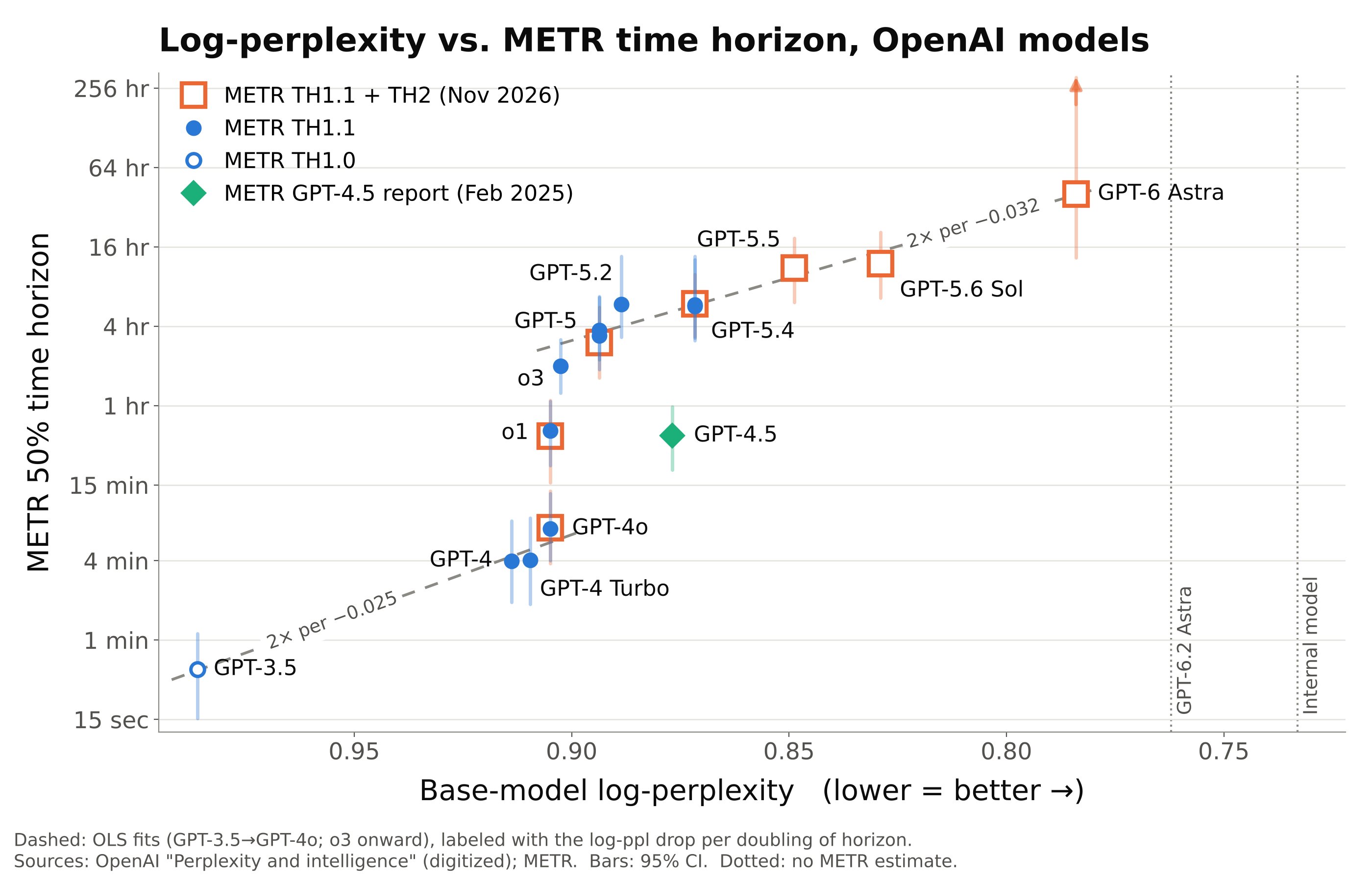
Loss vs. time horizon:
(1) Time horizon = exponential in pretraining loss
(2) Reasoning models look like a one-time jump in the relationship (slope ~unchanged, flatter if anything)

We decided to provide more transparency into pretraining progress at OpenAI for the sake of moving toward shared safety bars. In “Perplexity and Intelligence” I argue for common limits based on perplexity and other measurements, with progress beyond them gated on our ability to understand AI behavior.
openai.com/index/perplexity-…


After Q3 earnings reports last week, we can officially update @brightertmrrw -- hyperscaler capex > cashflow


What the heck is going on with OpenAI internal AI R&D time horizons: a thread of musings

A recent set of posts by @ramez on the current state of recursive self improvement highlighted that OpenAI's report on their own research automation shows that models struggle to do their R&D work — the models' 80% time horizon is only 15 minutes:
🧵

Here is the time horizon data that OpenAI shared publicly
nitter.cf/_Chris_Ong/status/2096…
POINT 1/ There are two ways to extract METR-style "50%-accuracy time horizon" from this data:


Today we are releasing new data on how models have accelerated AI research at OpenAI since the start of this year. Recursive self-improvement will be one of the most consequential AI developments of the next few years, and a shared public understanding for how models enter into the AI research process will be a critical part of democratic governance of AI and pacing the model frontier.
openai.com/index/research-ac…

1
20
2,640
"Happiness" is measured & disambiguated in the literature a few ways, and unfortunately they point in different directions:
1. "Life satisfaction": flat since Covid (!)
2. "Emotional affect": flat (!)
3. "Global happiness" (?): down
4. Consumer confidence (below): way down
1/n


this "Romantasy for Men" is (1) secretly a ratfic? (2) an excellent parody (3) excellent

“My beef isn't that Romantasy exists, it's that men can't have the same thing.”
I got this comment after writing about Romantasy and A Court of Thorns and Roses, but they were utterly unprepared for how far I am willing to go to prove a single anonymous Internet commenter wrong.

1
3
1,135


Higher US interest rates from the Volcker Shock in the 1980s spilled over globally to help cause the LatAm debt crises
As AI keeps pushing up real interest rates -- US to globally -- it seems totally plausible we get a 'second Volcker shock' of sovereign debt crises...

Had a lot of fun chatting again with my twin brother @dylan522p
We went through lab economics over the next few years - the shift from inference to training as RSI draws near; and how Anthropic and OpenAI are on track to control most of the world’s usable FLOPs within the next few years (because they can monetize compute better and thus outbid everyone).
And then we discuss whether the >$10T of total AI capex we’ll see by the end of the decade will cause a sovereign debt crisis, where hyperscaler debt raises interest rates, drives non-AI exposed countries into bankruptcy, and crashes non-AI equities.
One question we weren’t able to resolve is whether there’s anything that can counter all the forces barrelling towards centralization in this industry - the economies of scale in training, the scarcity of compute, and eventually continual learning and RSI.
0:00:00 – Two labs will soon control most of the world’s compute
0:07:01 – $6 billion in fab capex enables $1t+ of end revenue
0:13:08 – Compute prices will rise if the labs outbid everyone
0:18:22 – Which layer will capture most of the surplus?
0:25:40 – Will datacenter regulation slow down AI?
0:29:43 – Labs are shifting compute from inference to R&D
0:33:27 – China gets less than 10% of new compute, but its labs need less
0:48:48 – Will AI cause a sovereign debt crisis?
1:07:52 – Will the world's future workforce belong to a few companies?
...especially again in developing countries, which may see the effect of *globally* higher interest rates -- global capital markets are integrated -- but benefit less from AI-induced growth
nitter.cf/BasilHalperin/status/2…
4
13
2,840
makes u think
nitter.cf/StefanFSchubert/status…

The borrowing to finance AI investment is contributing to rising interest rates on government debt, the FT reports
Cf @BasilHalperin

AGI and the EMH: what does the market tell us about AI timelines?
TLDR: Markets are not putting much probability on the development of transformative AI (aligned or unaligned!) in the next 30-50 years – as evidenced by low *real interest rates*
forum.effectivealtruism.org/…
August 11, 2026: The first recorded instance of an economics paper being turned into a video game

How fast can you get AI to build itself?
@justinwangx and I built a web game about that, based on real research into recursive self-improvement (RSI)
You play a frontier lab investing in R&D, trying to build superintelligence
Play RSI Simulator: paradigm.xyz/research/rsi/ga…

(I'm afraid to admit that this is @ncasenmare erasure, whose game versions of Schelling 1971 and Axelrod 1984 are amazing. Any other examples?)
ncase.me/polygons/
nitter.cf/BasilHalperin/status/2…

New paper on the economics of RSI – and a new org, the Elasticity Institute:
A list of my own takeaways…

Very happy to share the first paper from @ElasticityInst: The Economics of Recursive Self-Improvement. Two parts:
(1) a graphical representation of feedback loops, to formalize a variety of RSI-related arguments, where each arrow represents responsiveness (elasticity);
(2) a survey of existing evidence with a loose calibration & a “wish list” of evidence that would help us calibrate better.

1. It’s the 🌞summer of RSI🌞 …but what the heck is “recursive self-improvement”?
Lots of people using this term but it became clear – only while writing the paper – that many are using different definitions and talking past one another…
nitter.cf/cherylwoooo/status/207…

Relatedly -- my favorite anti-monopsony bait:
If sticky wages are via monopsony (rather than monopolistic unions as usual), then, *tightening monetary policy **raises** employment & output*...
(for the same reason that a higher minimum wage boosts employment under monopsony)


Sticky wages yes, but how? Sticky wages in most contemporary models assume that all workers belong to a union that has a labor monopoly and charges above market clearing wage. Reality, not many unions, and more worry about employer market power. Unreality of NK model assumptions at some point sticks in throat. So WHICH sticky wage model would you like us to use?
worthwhileblog.ca/2014/02/21…
or to put it another way: if you think minimum wages are too low, then on the margin the Fed should be biased toward deflation to raise the real minimum wage
nitter.cf/BasilHalperin/status/1…
1. I haven't seen any new empirics contradicting the claims...
2. ...and in fact the post-Covid inflation looks like good evidence for the importance of sticky wages!
3. + the literature has in fact more fully moved to this view, HANK models really do default to sticky wages

This quoted post is unavailable.
👁️


AI Economic Indicators is live! This new platform from @DigEconLab tracks the economic impact of AI. I joined @erikbryn and the wonderful team at DEL earlier this year to work on this project, and I'm thrilled to have it out in the wild.
Translating this for economists (language barriers!): model of --
1. Full automation: multisector, networked AK economy
2. Full reinvestment: 100% savings rate
3. Leontief technology
=> calibrate to input-output network + depreciation data
=> 100% GDP growth per year

How fast could an industrial explosion (robots making robots...) be with current levels of physical technology?
New post from Damon Binder from looks at detailed data on factory throughput and adjusts for the most obvious physical bottlenecks: rising energy costs and lags in making new factories
Conclusion: ~1 year doubling times look plausible.
(link in reply)
