

WWII battlefield guide based in The Netherlands. I lead tours across Europe, sharing the stories of the men who fought, where they fought.
The Netherlands
Joined January 2010
- Tweets3.5K
- Following313
- Followers12.8K
- Likes10.9K




Two British tanks were lost here in November 1917. One of them broke down trying to rescue the other.
This marker near Bourlon stands where Falcon II came to a halt on 27 November. The tank on top is a male, with a six-pounder in each sponson. Falcon II was a female, armed only with machine guns.
That morning seventeen tanks of F Battalion, Tank Corps, went in with the 62nd (West Riding) Division in a final attempt to take Bourlon village. Falcon II, F13, stopped here on the edge of the village. Flirt II, F4, tried to tow it clear and stripped its own gears. Both tanks were left to the Germans.
For decades Flirt II was thought to have survived. The Museum of Lincolnshire Life displayed its Mark IV under that name until a partial serial number found inside identified it as Daphne, a tank of D Battalion.

Easy Company crossed this river into German-held territory in October 1944, to help trapped British airborne soldiers and others to escape. In the picture, my friend Edwin Popken stands in for them, looking south across the water to what was then the Allied side of the river.
A month after the Battle of Arnhem, more than a hundred men of the 1st Airborne Division were still hiding north of the Rhine, sheltered by the Dutch resistance. Major Digby Tatham-Warter, an escaper himself, helped the resistance gather them in the woods north of the river. Lieutenant-Colonel David Dobie crossed the river to Allied lines and helped plan the rescue from the south bank.
On the night of 22 October the resistance led the evaders to the riverbank near Renkum. A Bofors fired tracer to mark the crossing point. Canadian engineers brought the boats over, and a patrol of Easy Company, 506th Parachute Infantry, under Lieutenant Fred Heyliger, held the north bank while the men were taken off. In about ninety minutes 138 men were across, most of them airborne soldiers, Brigadier Gerald Lathbury among them.

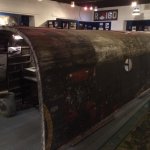
This piece of fuselage comes from a Short Stirling that dropped supplies to the British paratroopers at Arnhem in September 1944. No complete Stirling survives anywhere in the world, and this five-metre section spent almost sixty years as a pig shed on a farm in Beuningen, near Nijmegen.
The aircraft was LK545 of 299 Squadron RAF. On 21 September 1944 it took off from RAF Keevil to drop supplies to the 1st Airborne Division at Oosterbeek. Flak set it on fire over the drop zone. Corporal Clement Sproston, one of two Army air despatchers on board, kept pushing the load out, high explosive among it, while the rear gunner's ammunition went off inside the burning fuselage. Flight Lieutenant Reginald Turner then crash-landed west of Nijmegen, and all eight men survived. Sproston received the Military Medal.
The farmer who helped clear the wreck took part of the fuselage home and used it as a shed. It came to the museum at Deelen in July 2003.
The Arnhem resupply is part of our Arnhem and Oosterbeek tours.

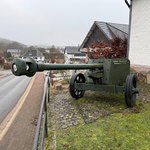
Barely 1.2 metres tall, and it could knock out almost any Allied tank it met. This German 7.5 cm Pak 40 stands by the school in Meyerode.
It was meant to be lighter. Its predecessor used light alloys, but those were now reserved for aircraft, so the Pak 40 was built in steel throughout. In action it weighed over 1,400 kilos. A crew of six could fire fourteen rounds a minute from behind two thin shield plates set apart, but on soft ground they often could not move it without a tractor.
More than 23,000 were built, and they became the backbone of German anti-tank defence. The Ardennes offensive reached Meyerode in December 1944, but where this gun fought is not recorded. The stone beside it names no unit. Its inscription says that in war there are neither victors nor vanquished, only victims.
The St. Vith sector is part of our Battle of the Bulge tours.

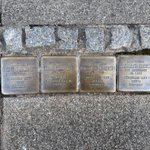
In May 1940 she wrote to the Pope and asked him to pay for her family’s passage to America. The letter was found in the Vatican archives in 2025. Her name is on the second of these four stones outside Hölderlinstraße 37 in Stuttgart.
The Einsteins, no relation to Albert, had lived in this house since 1931. Leopold was a merchant from Laupheim who had served at the front from 1914 to 1918. In 1938 he was made to hand his business to one of his own workers for nothing, and his eldest son Fritz was put to forced labour clearing the burnt-out synagogue. No ship was ever paid for. On 26 April 1942 Leopold, Elisabeth and fourteen-year-old Ingeborg were deported to Izbica in Poland with 278 others, among them the last Jewish children in Stuttgart. Nothing more was heard of them. Fritz was murdered at Stutthof that August.
The second son, Kurt-Werner, survived 49 months in the camps and returned to Stuttgart in 1945. There is no stone for him.

Dropped by American aircraft in the 1960s. Dug out of the ground decades later. Now lined up at the Cu Chi tunnels, northwest of Ho Chi Minh City.
This section of Bailey bridge stands at the liberation museum in Groesbeek. Each steel panel was designed so six men could carry it, and the whole bridge went together by hand.
At Son, one had to. On 17 September 1944 the 506th Parachute Infantry Regiment of the 101st Airborne reached the bridge over the Wilhelmina Canal just as the Germans blew it. XXX Corps reached the canal on the evening of the 18th. Royal Engineers started building at about and worked through the night. By on 19 September a 33-metre Bailey bridge crossed the canal, and the Guards Armoured Division drove north.
Today we followed the Americans of Market Garden with a group of Dutch guests.

For several days in June 1944, American paratroopers advancing towards Carentan passed a knocked-out tank with a dead crewman still inside.
The wreck stood at this crossroads outside Saint-Côme-du-Mont, which the Americans came to call Dead Man’s Corner. The house at the junction, now a museum, served as an aid station for Fallschirmjäger-Regiment 6, commanded by Major Friedrich von der Heydte.

Late on 7 June, the 1st Battalion, 506th Parachute Infantry, 101st Airborne Division, advanced towards the junction with M5A1 Stuart light tanks from Company D, 70th Tank Battalion. The leading tank was knocked out by German antitank fire.
For years, the dead man was identified as Lieutenant Walter T. Anderson. But Company D's records tell a different story. Anderson commanded Tank 17 and was killed north of Saint-Côme-du-Mont. The wreck at Dead Man’s Corner was Tank 12, penetrated through its front armour on the driver's side.

Research into the company's casualty records points to Sergeant Anthony I. Tomasheski as the probable tank commander and Private Aaron D. Curry as the driver. Curry had qualified to drive tracked vehicles and was reported killed by burns from antitank fire. Eyewitness testimony indicates that the driver remained inside the wreck.
Curry's official date of death is 12 June, five days after the tank was hit. Researchers suggest that this may have been the date his body was recovered and identified, although this has not been confirmed.

Anyone who has read about Arnhem has seen this photograph. Almost nobody knows the name of the man in it.
He is Serjeant John Turl of E Squadron, Glider Pilot Regiment. Sergeant Dennis Smith of the Army Film and Photographic Unit took the picture on 21 September 1944. It shows Turl (right) and Sergeant Whawell (left) searching for snipers at the school on Kneppelhoutweg in Oosterbeek.
Turl did not have to be there. As a fireman in the National Fire Service he held a reserved occupation. He gave up that exemption to join the Gloucestershire Regiment, then volunteered again for gliders. His squadron landed at Wolfheze on 17 and 18 September. Once on the ground, glider pilots fought as infantry under whichever officer found them, and Turl ended up far from his own squadron, in a mixed party on the southern edge of the perimeter.
He was killed four days after the photograph was taken, on 25 September, the day the withdrawal across the Rhine was ordered. He was 25, and he lies in Arnhem Oosterbeek War Cemetery.
Today we followed John Turl with his relatives from the landing zone at Wolfheze to his grave.

Pvt Tom Clevenger was flying to Groesbeek in a glider like this one, strapped in beside a trailer of high-octane gasoline and ammunition.
He was twenty, a wireman with Headquarters Battery, 320th Glider Field Artillery Battalion, 82nd Airborne Division. On 18 September 1944 flak tore through Glider 52 inches above his head and it broke loose from its tug. It hit the ground at about 90 miles an hour and turned over. All seven aboard got out. With help from Dutch civilians and the 101st Airborne, they reached their battery near Groesbeek the next afternoon. The men there had seen a glider go down in flames, knew about the gasoline, and had given them up for dead.
Today we followed Tom’s footsteps to the fields near Mook where he was wounded.

One of the three figures on this monument in Heppen is John F. Kennedy's brother-in-law. The other two are unknown soldiers.
The monument was unveiled in 2004 for all the foreign soldiers who died liberating Leopoldsburg and Heppen. It stands near the Mangelschots farm, a German strongpoint on 9 September 1944. That morning Major William Cavendish, Marquess of Hartington, led his company of the 5th Battalion Coldstream Guards against it. He was shot in the chest at the farmhouse.
Company Sergeant Major James Cowley took command, and the farm fell within the hour. Cowley received the Distinguished Conduct Medal.
Cavendish had married Kathleen Kennedy four months earlier. He is buried at Leopoldsburg War Cemetery.

For two years these three soldiers stood above Gold Beach while the British Normandy Memorial was built around them.
David Williams-Ellis's bronze was unveiled at Ver-sur-Mer on 6 June 2019, the 75th anniversary of D-Day. The memorial opened on 6 June 2021. To get his British Tommies right, coming off the landing craft at a run, Williams-Ellis needed fit young men who could hold a charging pose, so he modelled them on a professional footballer and a ballet dancer. The wall that now encloses them carries the names of the 1,746 killed under British command on D-Day itself. The 160 columns beyond hold 22,442 names, everyone who died under British command in Normandy between 6 June and 31 August 1944.

For 81 days in 1972, South Vietnam fought to retake Quảng Trị. This church stood in the way, on the road the paratroopers had to come up.
It was built in 1955 for the Catholic families of Long Hưng, a village on Highway 1 just outside the town.

North Vietnam had captured Quảng Trị that spring, and its troops made the church one of the positions they held against the South Vietnamese Airborne Division coming up from the south.
The fighting left almost nothing of the town. The church lost its roof but kept its walls, and it was left standing as a ruin.

The Battlefield Explorer retweeted
A visit to the Eagles Nest overlooking Berchtesgaden, our last stop and literally a highlight of the tour. Tomorrow we are all heading home and it it was an absolute pleasure to guide this Engeland to the Eagles nest tour for @WWIImuseum with @BattlefieldDisc
The man who navigated this B-29 across the North Atlantic in 1980 used the sextant he had carried on B-29s out of Saipan in the Second World War.
It is B-29A 44-61748, It's Hawg Wild, in the American Air Museum at Duxford. It flew from Kadena on Okinawa with the 371st Bomb Squadron, 307th Bomb Group, during the Korean War, then spent twenty-three years on the Navy weapons range at China Lake, California. In February 1980 Skip Cregier flew it east from Tucson.
With the compass system unreliable and no radio beacons in range, Henry Ramey fixed their position from the sun and moon as far as Iceland. It landed at Duxford on 2 March 1980.

Three of the four guns at Longues-sur-Mer are still in their casemates. No other German coastal battery in Normandy kept its original guns.
They are 150mm naval guns, set back from the cliffs between Gold and Omaha beaches and directed from a fire control post on the cliff edge. Bombing before D-Day cut the telephone cables between the two, so on 6 June 1944 the gunners worked from visual signals. They opened fire on HMS Bulolo, the Gold Beach headquarters ship, which moved off. HMS Ajax silenced the battery by mid-morning.
The crews repaired their guns and turned them on Omaha, until the French cruiser Georges Leygues and USS Arkansas knocked out one gun and damaged two others. The next morning all 184 men of the Kriegsmarine garrison surrendered to the 2nd Battalion, Devonshire Regiment.
