

Building @SwiftTun — a no-KYC VPN built to survive censorship. Writing about privacy, crypto and how the internet gets blocked. Sharing our real numbers.
Joined May 2021
- Tweets392
- Following70
- Followers80
- Likes668



Pinned Tweet
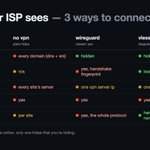
what your internet provider actually sees, depending on how you connect.
no vpn: every domain you visit
wireguard: no domains, but it knows you're on a vpn. the handshake gives it away in milliseconds
vless + reality: looks like normal https to a normal site
none of these hide that you're online. only one hides that you're hiding.
what are you using right now?

if you code with ai agents, the "do you trust this folder?" prompt is now your firewall. open repos you didn't write in restricted mode or a throwaway container, and never let an agent auto-approve commands in someone else's code


4 signs your vpn is about to get blocked, before it actually is:
1. works on wifi, dies on mobile data
2. same slowdown every evening
3. app says connected, nothing loads
4. only the big sites break
two of these at once usually means your protocol got fingerprinted. switch before the full block hits.
which one are you seeing?

all | privacy · crypto · vpn retweeted

A free and open-source LocalSend and WeTransfer alternative for sending large files directly between devices with end-to-end encrypted P2P transfers. Cross-platform, with support for Windows, Mac, Linux, and mobile devices. No accounts, no servers, and no size limits

ALT AlterSend: free, open-source app to send files directly between devices over the internet, with no cloud, servers, or size limits. Tags: Large File Transfer Service, Windows, Mac, Linux, Android, iPhone, Russia. Alternative to LocalSend and WeTransfer. Dark banner reads "Send files. No cloud." beside a dark-mode app window showing a Send/Receive tab and a drag-and-drop file area.
all | privacy · crypto · vpn retweeted

‼️ Anthropic and Google researchers found a flaw that lets one crafted packet hijack a server during network boot, before Secure Boot checks the OS.
Almost all servers on earth are affected.
CVE-2026-97631 sits in TianoCore EDK II, code in the UEFI firmware of most servers.


Readers added context they thought people might want to know
The vulnerability is limited to servers actively PXE network-booting with vulnerable EDK II firmware; most servers boot from local disks and are unaffected in normal use, with Intel noting limited impact on supported products.
github.com/tianocore/edk2…
arstechnica.com/security/2026/…

vless + reality: the client opens what looks like a normal tls 1.3 connection to a real, popular site. if a censor probes the server, it gets that real site back. to block it they'd have to block normal https too, and that breaks banks, shops and government sites
all | privacy · crypto · vpn retweeted
what your internet provider actually sees, depending on how you connect.
no vpn: every domain you visit
wireguard: no domains, but it knows you're on a vpn. the handshake gives it away in milliseconds
vless + reality: looks like normal https to a normal site
none of these hide that you're online. only one hides that you're hiding.
what are you using right now?
france almost blocked tiktok, instagram, snapchat and x during protests last week. no law cited, carriers pushed back, nothing got blocked.
this is how it always starts. not with a ban, with a letter asking carriers to "be ready".
the tech side is boring: dns, sni filtering, ip ranges. an afternoon of work.
every country that blocks apps today ran this test first. the only real defense is having a way around it set up before you need it
pov: explaining to airport security why your phone has 4 vpns, 2 crypto wallets and a password manager called "groceries"
things i learned running a vpn that only takes crypto:
- every government thinks it invented blocking
- nobody cares about protocols until it breaks at 2am
- "it says connected but nothing loads" is now the most read sentence of my life
- people would rather send crypto to a stranger than type their email
- the internet isn't broken. it's being broken, on purpose
i post about privacy, crypto and how the internet actually gets blocked. stick around
all | privacy · crypto · vpn retweeted
xbox tried the game pass price hike on netflix and netflix just cancelled the subscription
all | privacy · crypto · vpn retweeted
blade can walk in sunlight but somehow can't survive development hell
censors don't block "vpns". they block things that look like vpns.
how it actually works:
- wireguard and openvpn have fingerprints. dpi spots the handshake in milliseconds
- a server that suddenly gets thousands of users from one country gets its ip flagged
- china's firewall actively probes suspicious servers, pretending to be a client, to see what answers
- even the shape of your traffic can give you away: one long encrypted stream to one ip, nothing else around it
the game was never hiding your data. it's hiding that you're hiding.
that's why the setups that still work look exactly like a normal https visit to a real website