

@TernaryIntell #Blockchain #DLT #ComputationalFinance, #SustainableEntrepreneurship #CSR. #China. #AppliedPhysics #FinTech
San Francisco & Shanghai
Joined April 2009
- Tweets1.8K
- Following1K
- Followers1.7K
- Likes7.4K








Beau Giannini, PhD retweeted

This is f*cking insane. Former Google CEO Eric Schmidt just told everyone the easiest way to get rich in the next two years:
“If you really want to make money, it’s actually easy. Found an agentic AI company. Build an agent to do something.
If you build a better agent than anyone else, you can probably build one incredible company and own it yourself.”
In 27 seconds he explains why the next 1–2 years are the agentic window. And why it won’t stay open.
Prompts → Fable 5.2 → Memory → Skills → MCP → A Company You Own Yourself
Save this before it gets lost in X’s algorithms
Everything below is free:
Claude Code Overview
Official starting point for building with Claude
code.claude.com/docs/en/over……
Claude Code Best Practices
How Anthropic engineers actually use it
code.claude.com/docs/en/best……
Building Effective Agents
Anthropic’s research on what actually works
anthropic.com/research/build…
Effective Harnesses for Long-Running Agents
How to keep agents running reliably
anthropic.com/research/effec…
Claude Agent SDK
Build your own agents on the same stack
github.com/anthropics/cla…
Claude Code Skills
Reusable skills that agents can call
code.claude.com/docs/en/skil…
Hooks in Claude Code
Rules the agent can’t skip
code.claude.com/docs/en/hook…
Custom Subagents
Run specialized agents inside one system
code.claude.com/docs/en/sub-……
Memory System
How Claude remembers your project
code.claude.com/docs/en/memo…
Claude Code in Action
Free hands-on course
anthropic.skilljar.com/claud……
Awesome Claude Code
Best tools and resources in one place
github.com/hesreallyhim/a…
Claude Code GitHub Action
Run agents on your PRs and issues
github.com/anthropics/cla…
All of this costs $0
99% will spend the entire agentic period scrolling threads
The 1% who actually ship agents will own the companies that come out of it
Bookmark it and start with the first link right now
Then read how to build an agent that actually does the job in the "Context, Harness, Loops, Prompts" guide below ↓
Beau Giannini, PhD retweeted

Gwynne Shotwell (SpaceX president)
She just released a prompt that turns one Grok Bot into an entire project team
It's f*cking unreal...
Bookmark and send it to your Grok Bot and thank me later
Then read the full roadmap with examples below


Beau Giannini, PhD retweeted

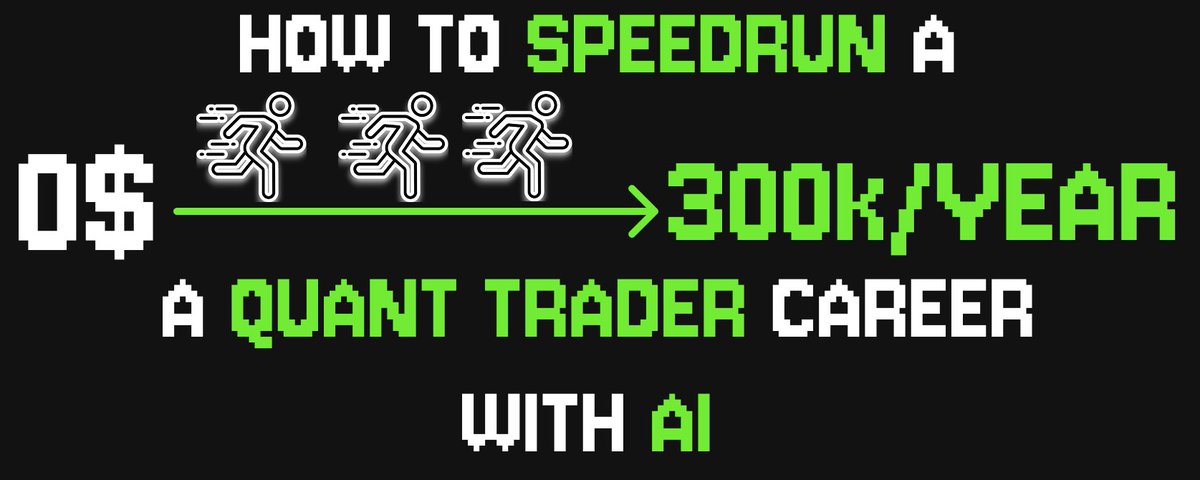
Ken Griffin, who runs Citadel, just admitted that the most expensive skill of his quants, the one he paid them millions for, now costs nothing
And for the first time in history, that skill belongs not just to a hedge fund, but to anyone with access to AI
A fund's entire quant team runs one cycle: come up with a strategy, turn it into code, test it on history, deploy it to the market
Every step used to cost separate people and years of training. Now AI does the whole cycle
You describe an idea in words, it writes the strategy itself, runs it on years of real data, and if it's alive, deploys it straight to a broker
But the speed isn't the point. The point is what the retail trader doesn't understand
You take a strategy with a beautiful chart and you believe it. But a beautiful chart is no proof
Run enough versions and a profitable curve will appear even on random numbers. One just got lucky, and you decided you found gold
Funds don't trust any curve until they test it on data the strategy has never seen. There the fit falls apart, and a real edge survives
I ran two of the most-cited quant papers through this cycle
Time Series Momentum on Bitcoin: +1,537%. Alive
Betting Against Beta, a classic from every textbook: minus 7.78% a year while the market rose 14.86%. A corpse
One still prints money, the other died long ago. And trading blind, you'd never know which is which until it took your deposit
If you want to run your own idea through the same test, it takes minutes here (free trial after signing up): join.horizon.trade/qwinsiiii
The entire hedge fund is six steps. AI already ate four of them. Which ones, I broke down in the article below


Beau Giannini, PhD retweeted

This is the capital of robotics! 🌁
Silicon Valley is home to so many physical AI companies that you could spend a month visiting them and still not see even 10% of them (trust me, I tried).
So, the Bay Area is the world's leading ecosystem for robotics startups, bringing together top AI talent, top universities, experienced founders, and unmatched access to capital.
The region is anchored by Stanford University and University of California, Berkeley, two of the world's top universities for AI and robotics. They produce a constant stream of researchers, founders, and breakthrough technologies.
The Bay Area is also home to many of the companies shaping the future of robotics and AI, including @Figure_robot, @physical_int, @GeneralistAI, and major AI labs such as @OpenAI, or @GoogleDeepMind.
This concentration of talent makes it easy for startups to recruit experienced engineers and collaborate with leaders in embodied AI.
Not mentioning that it is also home to leaders such as @NVIDIARobotics, whose headquarters and leadership in AI chips power much of today's robotics revolution, and Tesla, whose work on autonomous driving and humanoid robots has created a deep pool of robotics, AI, and manufacturing talent.
Perhaps its biggest advantage is access to capital, talent and ambition.
The Bay Area has the world's deepest network of venture capital firms, serial entrepreneurs, and technical leaders who are willing to fund bold, long-term robotics companies.
In the comments I'll post the companies from the ecosystem.
‼️ Note that Bay Area has >300 robotics companies, research labs, and innovation hubs, so this is a curated selection of the notable product companies, not an exhaustive census!
P.S. I'm constantly working on improving these maps, so if your company is missing, please DM me with basic info about the co, and I will include it in the next release.
P.S.2 I have last open slots for my December RoboTour in the Bay Area, if you want to create content together and show the world what are you cooking, dm! :)
~~
♻️ Join the weekly robotics newsletter, and never miss any news → ziegler.substack.com

Beau Giannini, PhD retweeted

Ed Thorp beat blackjack. Caught Madoff seventeen years before the SEC. Predicted Buffett would be the richest man in America. Compounded twenty years without a losing quarter. He is 93. Everything he did came from one paper written in 1956. The paper is still free. Almost nobody has read it.
Vegas, 1961.
Thorp is 28. He walks into Claude Shannon's MIT office asking for five minutes. Shannon, famously impossible to see, gives him the five minutes and stays for two years. Together they build the world's first wearable computer to beat roulette. It works. 9:58
The Buffett lunch, 1968.
Thorp reads John Kelly's 1956 sizing paper. Meets Warren Buffett once. Walks away and tells his wife Buffett will one day be the richest in America. Sixty years later, exactly that. Thorp did the math on a person applying compounding to time. Same math as Kelly. 31:20
The one thing Thorp added.
Kelly's paper gives you the mathematical maximum bet. Bet Kelly, optimal growth. Bet more, you die.
Thorp bet half.
Half Kelly gives up a fraction of growth for a huge cut in drawdown. Full Kelly routinely produces 40-60% drawdowns. Half Kelly usually keeps them under 20%. Same edge. A fraction of the pain.
Every serious quant who survives uses half Kelly or less. The ones who don't are the blowup stories.
Princeton Newport, 1969-1988.
Nineteen straight years. 19-20% a year. Not one losing quarter. Kelly's paper, Shannon's math, half Kelly's number, and discipline nobody else could imitate.
Madoff, 1991.
An investor asks Thorp to check Madoff's returns. Days later, he has proof of fraud. He hands the SEC a memo. They file it.
Seventeen years later Madoff collapses. Sixty-five billion in losses. The memo had been on someone's desk since 1991. 48:10
Enough.
Thorp shut down Princeton Newport at its peak in 1988. Still compounding 19% a year. He walked away.
"You can have enough. And it's better than not having enough."
This is the layer nobody sells. Every course, every AI swarm is built to make you want more. Thorp read Kelly, sized his bets, made his money, and stopped. Almost nobody in his field ever has.
Half Kelly on the size. Full self-awareness on when to walk. That is the formula.
2026. Thorp is 93.
He still writes. He still teaches. The math was the easy part, he'll tell you. The signal was never the edge. The sizing was. Half of it. The paper has been in the Bell Labs library since 1956. It's still there. It's still free.
Madoff was the loudest receipt. The stack takes new tuition every quarter.


Beau Giannini, PhD retweeted

I'm a cardiologist. Something just happened today that I genuinely did not see coming — and it could change the future of preventive medicine more than anything I've written about on this platform.
Midjourney — the AI company that became famous for generating images from text prompts — just announced a medical hardware division and unveiled a working prototype of a full-body scanner unlike anything that's ever existed.
It's called the Midjourney Scanner. And it works like this.
You step into a shallow pool of water. You stand on a platform that slowly descends — about two inches per second — through a ring containing roughly half a million tiny ultrasonic transducers, each the size of a grain of sand. Every one of them acts as both a speaker and a microphone, sending ultrasonic waves through your body from every angle and recording what comes back.
60 seconds later, you step out. The scan is done.
No radiation. No magnets. No claustrophobia. No IV contrast. Just sound, water, and an almost incomprehensible amount of computing power — roughly 2 petaflops processing 17 gigabytes per second of raw acoustic data — reconstructing a 3D map of your entire internal anatomy down to half a millimeter resolution.
Organs. Tissues. Blood vessels. Bones. Muscle. Fat distribution. All segmented by AI in real time.
As a cardiologist who has spent months writing about how the standard screening playbook misses the majority of future heart attacks — this is the technology I've been waiting for without knowing it existed.
Here's why this matters for the future of your heart.
Right now, getting a detailed look inside your cardiovascular system requires either a CT scan (radiation), an MRI (magnets, claustrophobia, 45-60 minutes, $1,000+), or a coronary CT angiogram (radiation, IV contrast, limited availability). These are powerful tools. I order them regularly and they save lives.
But they're reactive. You get them when something is already suspected. They're expensive. They're uncomfortable. And for most people, they happen once — maybe twice — in a lifetime.
Imagine instead: a 60-second scan with no radiation that you could repeat monthly or quarterly. Tracking cardiac structure over time. Watching body composition shift. Detecting changes in organ size, fluid distribution, or vascular architecture before symptoms ever develop. Building a longitudinal dataset of YOUR body that AI can analyze for patterns no single snapshot would reveal.
That's what Midjourney is building toward.
The company plans 50,000 scanners worldwide over six years, with capacity for a billion scans per month. The first location — the "Midjourney Spa" in San Francisco — opens at the end of 2027 with 10 scanners alongside saunas, cold plunges, and a gym. The scan costs a few dollars. The experience is designed to feel like wellness, not medicine.
The technology is built on Butterfly Network's ultrasound-on-chip platform — 40 modules per scanner — combined with Midjourney's own AI segmentation and reconstruction stack. David Holz, the founder, claims the system aims for image quality comparable to MRI in many aspects but at nearly 100x the speed with zero radiation.
Now the caveats — because I'm a physician and the caveats matter enormously.
This is a Gen 1 prototype. About a dozen people have been scanned so far. Current scan time is actually closer to 20 minutes, not 60 seconds — the system is bottlenecked by bandwidth and reconstruction algorithms. The 60-second target is aspirational for future hardware generations.
It is not FDA-cleared for diagnostic use. Midjourney is starting with body composition maps — a category below diagnostic imaging in the regulatory hierarchy. The path from "beautiful 3D body scans" to "clinically validated diagnostic tool that your cardiologist can act on" runs through years of clinical trials, comparative studies against MRI and CT gold standards, and FDA review.
No independent clinical validation has been published. The imaging claims come from Midjourney's own demonstrations. Comparative data against established modalities does not yet exist.
And the privacy implications of full-body internal scans at planetary scale — a billion scans per month — is a conversation that hasn't even started yet.
So I want to be precise. This is not ready for clinical medicine today. It may not be ready for years. Many ambitious medical hardware projects have failed in the gap between prototype and product.
But.
The fact that a working prototype exists — producing real segmented 3D anatomy from sound waves and compute alone — means the physics works. The engineering works. The question is no longer "is this possible" but "how fast can it be validated and scaled."
And if it is validated — if the resolution holds up against MRI, if the AI segmentation proves reliable, if the regulatory path clears — then what we're looking at is the most significant new imaging modality in 50 years.
For my entire career, preventive cardiology has been limited by the fact that seeing inside the body is expensive, slow, uncomfortable, and infrequent. We catch disease late because we image rarely. We image rarely because imaging is hard.
A 60-second, no-radiation, spa-based full-body scan that costs a few dollars would demolish every one of those barriers.
I've written about AI detecting inflamed arteries. About gene editing curing cholesterol. About GLP-1 drugs rewriting metabolic medicine. About cellular reprogramming reversing aging.
This is the missing piece: the ability to see inside every human body, routinely, safely, and affordably — so all of those interventions can be deployed before the disease arrives instead of after.
The company that taught AI to generate images from imagination just built a machine that generates images from the human body.
The future of medicine showed up today from the last place anyone expected.

Beau Giannini, PhD retweeted

The founder of Renaissance Technologies - the hedge fund that makes 66% a year, runs the most secretive trading floor on Earth, and has never accepted outside money - once stood in front of 500 mathematicians and explained exactly how he did it.
Jim Simons. The Einstein Lecture. American Mathematical Society. 1 hour 20 minutes.They left it on a small university channel. Almost nobody knows it exists.
No one's talking about it. Bookmark it before they do. Then read the article below.

Beau Giannini, PhD retweeted

Most people see a street. He sees $300-600 per block.
A 24-year-old from Chengdu figured out that every hotel, every apartment, every commercial space within walking distance is an untapped asset. One nobody has packaged yet.
He straps a rig to his back, walks in, spends twenty minutes scanning the space, and leaves with a file that lets anyone on earth stand inside that room from their couch.
The client pastes a link on their booking page. Guests tour the property before they arrive. Cancellations drop. Reviews go up.
He gets paid $400 for the scan. $99 every month for hosting.
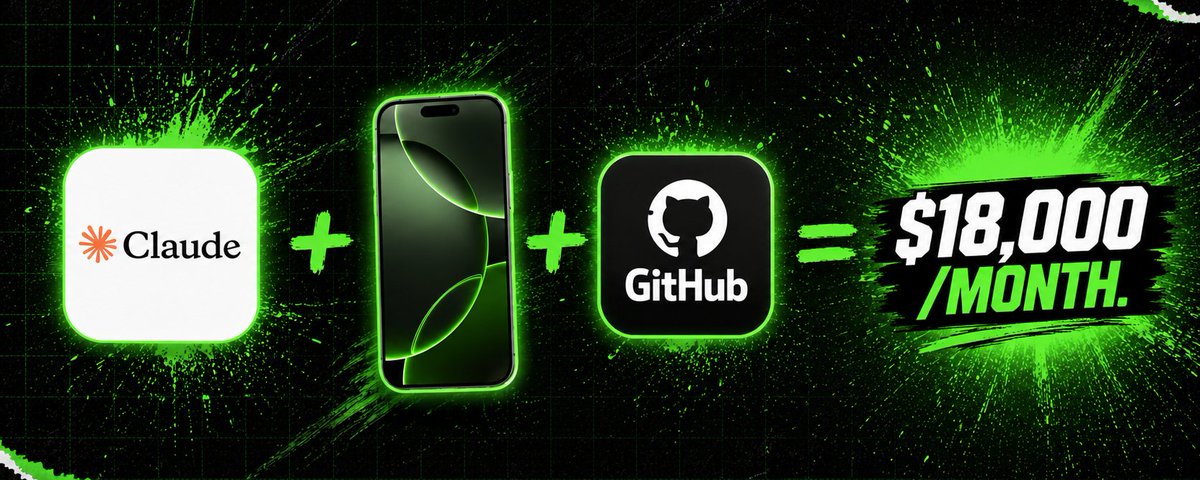
The technology: 3D Gaussian Splatting. Free on GitHub since 2023. The app: Luma AI. Also free. The page he delivers: built by Claude in ten minutes.
Total tool cost: $20/month.
Month one: $3,500. Month six: $18,000.
The streets haven't changed.
He just started charging for them.

Beau Giannini, PhD retweeted

If you want to build a startup:
- Claude = coding. ($20/mo)
- Supabase = backend. (Free)
- Vercel = deploying. (Free)
- Namecheap = domain. ($12/yr)
- Stripe = payments. (2.9%/transaction)
- GitHub = version control. (Free)
- Resend = emails. (Free)
- Clerk = auth. (Free)
- Cloudflare = DNS. (Free)
- PostHog = analytics. (Free)
- Sentry = error tracking. (Free)
- Upstash = Redis. (Free)
- Pinecone = vector DB. (Free)
Total monthly cost to run a startup: ~$21
Still any excuses?
Beau Giannini, PhD retweeted

Google has a recording of every search you've ever made.
Every place you've ever been. Every YouTube video you've ever watched.
Go to myactivity.google.com right now.
You'll find searches from 2015. Voice recordings. GPS coordinates.
All stored. All linked to your name.
Here's how to see it and delete it:

Beau Giannini, PhD retweeted

Do not use your energy to worry. Life is too short to worry about stupid things.
Have fun. Fall in love. Regret nothing and do not let people bring you down.
Study, think, create and grow. Teach yourself and teach others.
—Professor Richard Feynman
Beau Giannini, PhD retweeted

Chinese student used AI from Anthropic to turn $1,000 into $1,500,000
He studies at Tsinghua University in Beijing.
His account is k9Q2m
In such a young age he already make a million simply knowing the right formulas and being able to use Claude
Result:
$1,430 → $1,550,750
44,364 trades
Win rate 100%
The biggest win $23,600 on a single bet
k9Q2m profile:
ares.pro/wallets/0xd0d6053c3…
How it bots work:
The bot runs 6 formulas hedge funds use simultaneously, every tick.
Most traders guess. This bot calculates.
Formula 1 - LMSR Pricing
Polymarket prices move on a logarithmic curve.
The bot knows the exact price impact before entering.
Market says 31¢ for BTC up in 5 minutes.
The model sees the curve is mispriced.
The bot enters before the correction.
Formula 2 - Kelly Criterion
Renaissance Capital uses it.
Two Sigma uses it.
Now your bot uses it.
Every bet is sized exactly right.
Never too big to blow the account.
Never too small to matter.
$1,000 bankroll. Consistent edge.
Kelly compounds it into something real.
Formula 3 - EV Gap Detection
The bot scans every BTC market looking for one thing:
- Where is the market price wrong by more than 5%?
- Market says 30¢. Real probability is 55¢. EV = +0.52. The bot enters.
Most people never see this gap. The bot never misses it.
Formula 4 - KL-Divergence
BTC 5-minute and 15-minute markets are correlated. When they drift apart - that's an arb.
The bot measures the statistical distance between them every second. When it crosses 0.2, it flags the trade.
This is how hedge funds extracted $100K+ on correlated election markets. The same logic runs here.
Formula 5 - Bayesian Updates
New block confirmed. Volume spike. Price movement.
The bot doesn't ignore signals - it updates.
Prior probability was 54%.
New data comes in.
Posterior jumps to 71%.
The bot re-prices in real time while the market is still asleep.
Formula 6 - Stoikov Execution
Entering at the wrong moment kills the edge.
The bot calculates the reservation price-the exact point where the risk-adjusted entry makes sense.
It doesn't chase. It doesn't panic.
It waits for the right tick, then fills
What this means in practice:
- Every few seconds the bot runs all six formulas in parallel.
- If LMSR confirms mispricing
- EV gap is above 5%
- Kelly says the bet size is justified
- Bayesian posterior agrees
- KL-divergence flags the correlated drift
- Stoikov clears the execution price
Only then does the bot enter.
Six filters. One trade.
This isn't a trading bot.
It's a hedge fund strategy running on a prediction market.
The edge is real.
The math is public.
The difference is most people never build it.
Just insert all these formulas into Claude and create your own bot
Add this post to bookmarks so you don’t lose it
Soon I will publish another bot with working formulas
🤝 Paid partnership


Beau Giannini, PhD retweeted
Anthropic released an update for Claude, and one young guy turned $1,400 into $238,000 in 11 days
His account is 0xdE17.
He is not a trader. Not a developer. Just a student with a laptop and access to Claude.
When Anthropic updated the skills architecture for Claude, he didn’t sleep for two nights, read the documentation, and built a bot from scratch.
Result:
$1,430 → $238,006 in 11 days
366 trades.
Win rate 62%.
The biggest win $52,700 on a single bet.
How it works:
The bot scans Polymarket every few seconds looking for markets where the price deviates from the fair value by more than 8%.
That’s the edge.
Most people don’t see it the bot always does.
The strategy is painfully simple
- The market says 30¢ for an event
- The real probability based on data is 55¢
- The bot enters. Waits. Exits at the peak.
This isn’t luck. It’s attention arbitrage.
The biggest trade was a bet that Trump would sign a crypto executive order in March. The market priced it at 28¢.
The bot placed $16,000.
Exited at 81¢.
In 11 days he went through a journey most traders don’t go through in years.
Now his wallet is public, and with the help of this terminal you will be able to copy his trades in time:
ares.pro/wallets/0xde17f7144…
Bot 0xdE17 CLAWD BTC SNIPER is open for
copy-trade.
People ask him:
“How much starting capital do you need?”
He replied:
“I had $1,400 and a sleepless night.”
Anthropic gave the tool.
He simply wasn’t afraid to use it.


Readers added context they thought people might want to know
This is false. User is misinterpreting information and pushing the referral link to a copytrading bot.
x.com/v4rvl/status/2…
Beau Giannini, PhD retweeted

Instead of watching 2 hours Netflix, learn claude in 1 hours for Free (Build & Automate Anything)

Beau Giannini, PhD retweeted

🧵 ChatGPT vs Grok vs Gemini vs Claude vs Perplexity — 5 leading AI tools explained.
Best use cases, strengths & pro tips.
No hype, just practical insights to choose the right tool.
📌 Save this post & read the full thread 👇

Beau Giannini, PhD retweeted

This guy literally explained why some people become successful while others stay average.
The reason is uncomfortable. Game Theory
Beau Giannini, PhD retweeted

10 Completely FREE AI Courses for 2026:
1. Anthropic: anthropic.skilljar.com
2. Google: grow.google/ai
3. Meta: ai.meta.com/resources
4. NVIDIA: developer.nvidia.com/trainin…
5. Microsoft: learn.microsoft.com/training
6. OpenAI: academy.openai.com
7. IBM: skillsbuild.org
8. AWS: skillbuilder.aws
9. DeepLearningAI: deeplearning.ai
10. Hugging Face: huggingface.co/learn

Beau Giannini, PhD retweeted

i wish I had these walkthroughs when I was getting into AI
hands down the best guide to Claude Cowork


