
slowly becoming a neuroscientist.
Joined January 2016
- Tweets6.2K
- Following578
- Followers18.6K
- Likes4.1K



Tim Behrens retweeted

A CRISPR cut can be repaired by swapping DNA between sister chromosomes, a change standard sequencing never sees. Single-cell maps show how often it happens. @eLife @behrenstimb
👇 Link to the full episode in the first reply.
🤖 Made with AI

Tim Behrens retweeted

Is meta-RL in PFC just a big RNN or can we figure out its mechanism?
Here we show that RNNs learn a particular, but general, method for meta-RL. They place options in 'ranked’ subspaces (slots), and dynamically re-rank them. Value doesn’t pick the action; it reorders the slots🧵

New theory about value computations in PFC from the awesome @jowarrn and @jcrwhittington. V excited that we can start thinking about sequence/schema tasks and value tasks in the same language.

💯 fMRI is an extremely useful tool and in some cases the best way to test a hypothesis. It is nevertheless often dismissed by the rest of systems neuroscience. I find it crazy. People are hampering themselves by ignoring the largest (and sometimes best) source of evidence.

Tim Behrens retweeted

World models are central to intelligence - but how do we actually use them to behave flexibly? We review emerging findings on how the PFC’s inner dynamics translate structured knowledge into action. osf.io/preprints/psyarxiv/j7… 🧵 1/15

New review about computations in PFC, led by two deep thinkers, @GabyMohamady and @kristorpjensen with contributions from many more. Discussing the implications of a bunch of exciting recent PFC findings for how we think about PFC computations.

World models are central to intelligence - but how do we actually use them to behave flexibly? We review emerging findings on how the PFC’s inner dynamics translate structured knowledge into action. osf.io/preprints/psyarxiv/j7… 🧵 1/15
Tim Behrens retweeted

Princeton is seeking an AI Postdoctoral Research Fellow in Natural and Artificial Minds. An amazing program! Deadline is Feb. 28
apply.interfolio.com/194534
Super proud of many things about this work from the amazing @KrisTorpJensen. The work is one of my favourite things ever from the lab. Also super proud of Kris for choosing to send it to @elife -we get to see Kris explain every figure! elifesciences.org/articles/1…

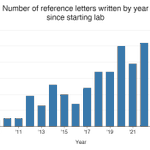
I used to worry that this would keep growing forever, but it seems to have asymptoted. There is hope for those on the upward trajectory :)

I once went to the Vatican with some fellow scientists to debate free will with some cardinals, even meeting the pope (Benedict). It seemed to me that the Catholic Church doesn’t even believe non-human animals are conscious (“have a soul”) so they have a very high bar!

NEW: According to a bombshell report in the New York Times, Anthropic co-founder Chris Olah threatened to walk out of Pope Leo XIV’s AI encyclical launch in May because the pope rejected the idea that machines can be conscious.
Olah’s team then privately lobbied the pope’s advisers “to take the possibility of model consciousness seriously.” Pope Leo XIV held firm.
For months, Anthropic has wined and dined theologians and religious scholars under nondisclosure agreements, hoping they would bless the idea that Claude has moral standing. thelettersfromleo.com/p/nyt-…

Nowhere near for me - still bland and unspecific :( I think Neuro folk still have to write grants for another year or two ....

I asked Astra to look through my published science, identify new directions, and draft five NIH R01 proposals -- the multiyear, $1M-$2M grants that support much of academic biomedical science.
In about one hour, using roughly $20 in compute, it produced entirely reasonable proposals. They were well grounded in my work and structured to appeal to study section reviewers. They looked very similar to what I would write if my goal were to get another grant.
Astra reproduced that logic well. It turned existing work into questions, hypotheses, and experiments that would look familiar and defensible to a study section.
The output was immediately recognizable as the work of an experienced academic scientist. If AGI means being able to produce the work of highly trained professionals, this is a clear concrete example. It produced something academic scientists spend a great deal of time doing.
Academic medical centers build careers, laboratories, and their finances around this process. Scientists spend years writing these proposals as the next fundable extension of their work.


This made a buzz earlier this year, including an eLife paper. I am now pointing to the eLife correction. The authors used the correct antibody, but referred to the wrong one in the paper. They supplied the original receipts during the correction. elifesciences.org/articles/1…


Tim Behrens retweeted

We have 15 open positions at Astera Neuro! We're hiring experimental and computational neuroscientists and engineers to build a large-scale research effort aimed at understanding consciousness = the brain's internal model of world and self.
astera.org/careers/#box=neur…
We're looking for:
• Experimental Neuroscientists
• Computational Neuroscientists
• Optical Engineers
• Hardware Engineers
• Software Engineers
• Probe Engineers
• and more!
I'll share much more about our scientific vision soon. For now: I know we could never have built this in academia. The confluence of talent across different domains, the purposive design of the org structure and open science approach, and the deep, long-term support, all aimed at cracking the brain's internal model, is unprecedented.
If you want to understand consciousness, if you sense a huge gap between our internal experience of the world and our scientific understanding of it, if you believe systems neuroscience needs a fundamentally different, collaborative, and scaled up approach, we are building the ideal research environment for you.
I've never been more excited in my life. Across Astera Neuro, Astera AI, and Astera Simplex, we're creating a whole new discipline around one question: how does the brain build a world model: a symbolic system that perceives the real world from flickering sensory input streams and can think, plan, and experience? Everyone here is converging on this question from a different direction. The degree of conceptual focus combined with tactical breadth is thrilling.
If this sounds like you, come join us.
astera.org/careers/#box=neur…
Tim Behrens retweeted

As part of OHBM online meetings next week:
"25 years of FSL"
Register by Monday. Talks from: Stephen Smith, Frederik Lange, Ludovica Griffanti, Rezvan Farahibozorg, Amy Howard and Hossein Rafipoor, William Clarke, Michiel Cottaar.

Can't attend every session live? Register anyway!
Your registration includes access to meeting recordings for 30 days after the event, so you can catch up on sessions whenever it works best for you.
📅 September 2-4, 2026
💻 Zoom
Register today: humanbrainmapping.org/SEASIG…

Labmaker are now selling our mazes (well Thomas Akam’s Mazes) pre-built.. they rock!! They turn mice into mini-Einsteins.

Investigating how neural populations map abstract task rules during spatial navigation requires behavioral setups where physical paths and environmental rules can be dynamically altered across trials.
El-Gaby et al. addressed this in their 2024 @Nature paper by adopting the open-source pyControl GridMaze. This system provides a modular 3x3 grid of platforms connected by automated, removable bridges, with integrated nose-pokes and fluid delivery on each node. It allowed the researchers to program complex, multi-step state machines that ran with high-precision temporal synchronization alongside neural recording systems.
This level of behavioral automation allowed the team to track how the brain represents transitions between abstract behavioral states as mice navigated changing physical layouts.
Read at length👉nature.com/articles/s41586-0…
@GabyMohamady, @jcrwhittington, Arya Bhomick Adam Lloyd Harris, William Dorrell, @WaltonLabNeuro Thomas Akam, @behrenstimb
While the design is open-source, building a 3x3 platform array with nine independent nodes, multiple motorized bridges, and integrated sensor routing in-house is a massive engineering task.
Get the pre-assembled, quality tested, reliable hardware from us-labmaker.org/products/pycont…

Tim Behrens retweeted

Provocative title ftw. (Tho it inspired kris jensen to give a talk titled "planning in the brain: it's not what nathaniel thinks it is")

The 2026 volume of the Annual Review of Neuroscience is now online 🧠 The most read article is "Planning in the Brain: It's Not What You Think It Is" by @marcelomattar and @nathanieldaw
bit.ly/4w3Nl23
Tim Behrens retweeted

Neural signatures of model-based and model-free reinforcement learning across prefrontal cortex and striatum
elifesciences.org/articles/1…

Tim Behrens retweeted
We’re at FENS 2026!
We’re broadly interested in world and goal models in the PFC and temporal lobe. Come chat to @AdamLoydHarris Mingyu Zhu and Noor AlBarazi as they present some new findings on Wednesday afternoon. #FENS2026 …🧵 1/5
