

The official X account for Binalyze. The investigation platform that makes a SOC complete. Binalyze reveals the truth behind cyber alerts and incidents. Securi
Global
Joined December 2010
- Tweets1.6K
- Following1.8K
- Followers3.5K
- Likes298





Your app logs may say nothing about PHP2Shell. The exploit runs before app code does.
Endpoint evidence shows what happened after. The network shows how they got in and what left.
Jeremy Leasher explains: binalyze.ai/blog/php2shell-e…
#Binalyze #MSSP #CyberSecurity #SOC

PHP2Shell exploitation started before the patch.
3 things MSSPs can do now: sweep before you patch, preserve evidence before you rebuild, and make it a repeatable assessment.
New blog from Jeremy Leasher: binalyze.ai/blog/three-thing…
#Binalyze #MSSP #CyberSecurity #SOC

A risk score tells you an indicator is bad, but rarely why. Now, Binalyze Outpost integrates directly with @RecordedFuture. Click any IP, domain, hash, or CVE to see the verdict, risk score, and exact rules triggered—without switching tabs. Try it: outpost.binalyze.ai/en

Patched isn't the same as closed.
PHP2Shell exploitation started 4 days before the fix. For MSSPs, the IR case ends when you can prove what happened, not when the patch lands.
New blog from Jeremy Leasher: binalyze.ai/blog/patching-cl…
#Binalyze #MSSP #CyberSecurity #SOC

Patched PHP2Shell? Now investigate what’s already there.
Jeff Hamm, Binalyze's Forward Deployed Security Architect, on hunting for webshells and persistence left before the patch, with companion Sigma and YARA rules to get you started: binalyze.ai/blog/investigati…

Why hasn't automated triage fixed alert fatigue?
Our 2026 research found that 67% of CISOs using AI for triage still can't completely trust it. 71% believe AI should be powerful for triage but isn't being used correctly.
Read the report: binalyze.ai/2026-state-of-so…
🚨 300 potential threats ignored every day.
Our 2026 State of the SOC Report is featured in Interface Magazine, highlighting why overwhelmed SOCs need more than alerts.
They need investigative clarity.
Read the coverage 👇
interface.media/blog/2026/10…

2,047 alerts. Every day.
For enterprises with 5,000+ employees, the daily total climbs to 3,115.
No team can investigate that manually. And automation built on telemetry alone can't be trusted to do it for them.
See the full breakdown: binalyze.ai/2026-state-of-so…
Attacks break out in 28 minutes; SOCs take 37 to act.
That's the gap at the heart of our 2026 State of the SOC Report, built on a survey of 400 CISOs and senior IT leaders across the US and UK.
SOCs have a truth problem!
Download the full report: binalyze.ai/2026-state-of-so…
Containment is only part of incident response.
As new details emerge about the ASOS incident, Binalyze's Marie Wilcox features in the Daily Mail's latest coverage.
Understanding the full impact is critical to restoring trust.
dailymail.com/news/article-1…

Alerts are only the start.
Cyber resilience comes from understanding what happened, what was affected, and whether the threat is truly gone.
Thanks to CIO Times for featuring Binalyze.
🔗 theciotimes.com/binalyze-emr…
#SecOps #CyberResilience

What happens when hackers tell your customers you’ve been breached before you do?
The ASOS incident shows how attackers might tell the story first, but evidence should determine what happens next!
binalyze.ai/blog/what-happen…

Who controls the narrative during a cyber incident?
The latest ASOS coverage reports further claims from the group behind the notification.
The faster defenders can establish the facts themselves, the less room attackers have to define the story.
aol.co.uk/articles/asos-hack…

Attacker claims aren’t the same as established facts.
As the Daily Mail covers the suspected ASOS incident, Binalyze’s Marie Wilcox weighs in again!
The challenge now: move from claims and signals to evidence of what actually happened.
dailymail.com/news/article-1…

A cyber incident unfolding on customers’ home screens in real time.
Binalyze’s Marie Wilcox spoke to The Standard about what makes the suspected ASOS incident so striking, and why quickly establishing what actually happened matters.
standard.co.uk/news/uk/asos-…

Attackers don’t just exploit systems. They exploit pressure.
As thousands of ASOS customers received an apparent hack notification, Binalyze’s Marie Wilcox spoke to The Guardian about why teams must resist the panic, follow the evidence and investigate.
bit.ly/4hLrTc6

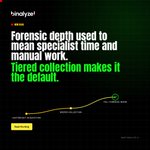
Forensic depth used to require specialist time and manual effort. It simply didn't scale.
Binalyze AIR changes that by automating and scheduling forensic-grade collection for MDR and IR teams. See why forensic depth is becoming the default deliverable:
binalyze.ai/blog/forensic-gr…

MDR sees the whole environment. IR goes deep.
Now both want the same work: continuous investigation built on endpoint evidence.
Oliver Rochford on why forensic-grade investigation is becoming the service to sell:
binalyze.ai/blog/forensic-gr…
#Binalyze #MSSP #IncidentResponse #SOC

Detection tells you something happened. Investigation tells you what actually happened.
That's the conversation we're having in our latest @CIOTimes feature.
Security teams don't need more alerts, they need timely answers.
🔗 theciotimes.com/binalyze-emr…
#CyberSecurity #SecOps
🧑💻 "We monitor everything" isn't the flex it used to be.
2 weeks out: Jeremy Leasher, Forward Deployed Security Architect at Binalyze, on the high-margin services separating top MSSPs from the rest.
Save your sear here 🔗 watch.getcontrast.io/registe…