

Tech; adventure travel, snowboarding, cycling
Joined June 2011
- Tweets9.7K
- Following1.6K
- Followers3.8K
- Likes40K







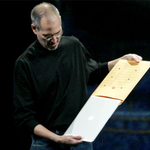

When Jobs said he was against something, it usually meant Apple hadn't come up with a good solution to it yet. That was the same for apps, video on phones, bigger phones, styluses, and now... touch. He was great at talking his book. Once Apple had a good solution, it was now ok.

SJ was: if you want an iPod you gotta have a Mac. (Macs were 2% or so share then). iTunes for Win let Win users experience an iPod. Wow! It made them more interested in buying other Apple products. The iPod bought Apple time till the iPhone came out and was Win compatible.


Brad Silverberg retweeted

I am a lifelong Democrat. I served President Clinton on the National Security Council, worked for Madeleine Albright at the State Department, and served as deputy staff director of the Senate Foreign Relations Committee when Joe Biden was chairman.
I remain a Democrat because I believe in an America where every person and every community is respected and where we all have the greatest possible opportunities to realize our potential.
It is precisely because I believe so deeply in these principles that I feel a moral obligation to unequivocally condemn the anti-American bigots operating within our party who promote hatred and division, incite hostility, foster intercommunal conflict, and denigrate our nation and its values.
These include Abdul El-Sayed, Zohran Mamdani, Darializa Avila Chevalier, and many of the members and leaders of the Democratic Socialists of America, who are seeking to transform our party into a vehicle for their radical political agenda.
Some Democratic leaders believe we should remain quiet because defeating Trump and regaining control of Congress are more important than our internal divisions.
I completely understand this logic.
Trump is running roughshod over our democracy and laying the groundwork for a potential soft coup in November. His administration's corruption, lawlessness, and attacks on our democratic institutions represent an extraordinary threat to our republic. All Americans must fight back against these abuses with everything we have.
But as a Democrat and as an American, I reject the implicit claim that we must embrace anti-American bigots and dangerous radicals to defend our democracy and build our best possible future.
If we become the party that stands by radicals who excuse or glorify the September 11 or October 7 terrorists, what moral authority will we have to challenge the extremism of others? If we remain quiet when political activists call for the destruction of Western democratic institutions, reject fundamental constitutional protections, or encourage hatred and violence against their fellow Americans, how can we possibly ask the American people to trust us?
Just as we Democrats have rightly demanded that Republicans stand against the worst abuses of the Trump administration, we must stand against the dangerous radicals operating in our own party.
Our principles must mean more to us than our immediate political interests.
I believe the vast majority of Americans are decent people who love our country, respect their fellow citizens, and want us all to live together in peace. The time has come for these common-sense Americans to reject the radical extremes on both sides of the political spectrum and unite around a positive vision of our shared future.
I remain a proud Democrat because I believe our party can help lead this national renewal. But if the Democratic Party stops standing for democratic values, it will no longer deserve my support or that of most other patriotic Americans.
We Democrats cannot save American democracy by abandoning our principles. We must defend those principles with the same courage and conviction that we demand of our political opponents.
Our country deserves that kind of leadership, and our party has an historic opportunity to provide it if we put forward a positive vision for America and do not cave to the dangerous radicals in our midst.
My full essay: jamiemetzl.com/the-democrati…

I’ve used a Garmin watch for >15. I tried a Gen 1 Apple Watch but found it bewildering to use. Terrible battery life too. No AOD; had to flick my wrist. I’ve been happy with the Garmin but decided to give the Ultra 4 a try. 1/
I gotta day, setting up the Ultra 4 is a confusing painful mess. Thank God for ChatGPT to explain how to do things; definitely not discoverable, and whether on the watch or the app. I’ve been tempted many times to give up and return it. We’ll see how it does vs the Garmin. 2/
That’s a play you don’t see a lot from the Browns - the victory formation.
Go Browns. I didn’t exhale till it hit 0:00.
Great game so far by Denzel Boston, ex UW Husky. Husky receivers getting it done in the NFL, including Rome Odunze.

I’ve been impressed so far by @Muse . It has a good chance of breaking through for normies. It’s not there yet. For example, when I asked it to de-dupe my Contacts, it presented me numerous times with json to approve. Huh? Normies will be completely scared / turned off.
Muse approval cards should explain the request action in plain words instead of showing raw JSON so that non technical people (or really anyone) can understand what they are approving.
It has a fair way to go before I tell it “Just do it” rather than present me what it wants to do and have me approve it. For ex, I get a lot of spam. I want Muse to go thru my Junk mail folders to identify what’s true spam and what I want to keep, eg, online order receipts
The @AcquiredFM podcast remains an in depth study of a highly relevant company. Even though each episode is hours long, it is information dense and S/N ratio off the charts. And has been well rewarded by listeners.
Ben Thompson’s @stratechery podcasts are similarly high S/N

@acquiredFM is quite enjoyable to listen to. David and Ben have great chemistry and it comes across.
Brad Silverberg retweeted

Years before AI infrastructure became a daily headline, Debo was making the case to those wise enough to listen that compute, energy, memory, and fab bottlenecks would define what was possible.
He’s spent 7 years building Kepler around those problems, unlocking the power of frontier intelligence for everyone by pushing memory and logic chip manufacturing to the limits of physics. And yesterday, Kepler came out of stealth!
I’m not sure people can fully appreciate how capable, principled, and high-integrity Debo is. He is relentlessly principled and tries to do right by people even when no one would ever know the difference. And if there were more hours in the day, I have no doubt he’d find more impossible problems to solve for the benefit of humanity.
Congratulations, Debo + Kepler. So much more to come from this truly exceptional team.

Today, after 7 years in stealth, I, @emeskey and our co-founders are proud to announce @keplercompute.
The world is much better off when we give power & intelligence to the people. When everyone can become their highest selves by pairing their human creativity with the exponentially rising intelligence from our magnificent computers.
Our goal is to unlock the power of frontier intelligence for everyone by pushing memory and logic chip manufacturing to the limits of physics.
To achieve this, we will move the world from one of compute scarcity to abundance where we can make orders of magnitude more chips per dollar and can lower datacenter energies to the limits of physics. We will use physics to ensure we have enough chips and that we can power them on.
Why is compute scarce?
Today's dominant approach - shrinking transistors with EUV - has run into $20B-$40B fabs that take years to build. Sized against that risk, the industry (quite rationally!) grows capex much slower than AI demand that can grow 10x in a year.
In the current system, scarcity is built in.
A different way is possible.
We founded Kepler on the following beliefs:
1. It is possible to build leadership chips without a dependence on EUV
2. It is possible to achieve multiple orders of magnitude more intelligence per watt by evolving chips 2D Silicon to 3D Beyond silicon
3. It is possible to get much closer to the physical limits of computing than we are today while staying within mainstream digital computing
Memory is the biggest binding constraint on AI compute and so we start with a new frontier of AI memory- approaching the bandwidth per watt of SRAM, going up to 10x beyond the capacity of HBM. We use 3D and materials innovations that allow for leapfrogging leading nodes while requiring no EUV lithography and allowing us use fabs that already exist.
Our team co-led one of the industry's first 3D chip-stacking technologies, has led and scaled seven generations of DRAM and multiple logic designs into billions of chips. We built the world's first commercial physical synthesis tool and techniques at the heart of the logic design industry and solved long standing challenges in ferroelectrics, invented beyond CMOS logic devices. We would love to work with you to reinvent chip manufacturing here in America.
We have raised $468m, built our own fab and our AI memories sample this year and ramp to production next year. We are allocated for 2027 and will be scaling in America by 2028.
We are open for business, please get in touch to work together. We are also growing the group of Keplerians and would love to work with you.
Learn More @ Kepler: keplercompute.com/
Read our story in @WIRED: wired.com/story/a-new-dollar…
