

Founder, Oakcliff Capital | Trustee, Classical Charter Schools | Member, Yorktown Partners
Joined January 2010
- Tweets282
- Following260
- Followers2.6K
- Likes73






Bryan Lawrence retweeted

Fox News poll:
Top concerns:
1. Corruption in government
2. Inflation and high prices
3. Gas prices

Bryan Lawrence retweeted

When even the guy who once worked at Enron says WTF...

Billions of dollars’ worth of contracts predicting oil would fall and the S&P 500 would rise were placed about 15 minutes before Trump announced a U-turn on Iran in a post on Truth Social. CFTC staff began to investigate-- then were told to lay off. bloomberg.com/news/features/…

Bryan Lawrence retweeted

Dusting off this tweet from April because this gap in shared understanding of LLM capability is *widening*. It's now less "two groups of people speaking past each other" and more a sharp funnel.
- Napkin math somewhere around 6B people (~75% of the population) have barely come in contact with LLMs at all.
- Around 1-2B (~20%) are casual and infrequent users of free-tier ChatGPT-like products. This group sees derpy chatbots and treats them a bit like a better Google search, a writing aid, or etc. Maybe an agent tries to book you a flight. I have non-tech friends who (reasonably, imo) say they have not much use for it at all. Even many professionals outside of math&code are in this tier. For example, execs and many other functions spend a lot of their time talking to other people, so while they understand what is happening intellectually, it is still second-hand and a bit abstract.
- Now we get to professional use of frontier-grade LLMs in math&code. Somewhere around 20M people (0.2%) see first-hand that large, complex projects that used to take them weeks/months can now be completed by agents with a prompt. Building apps, copying apps, translating apps, decompiling apps from binaries... This has all happened very quickly and recently - less than 1 year ago, I was writing code manually by hand, typing memorized computer code commands into a code editor character by character, occasionally pressing Tab to autocomplete a little chunk of code.
- And finally we get to the ~5,000 people (~0.00006%) with access to frontier-grade systems internally. The external world has seen the preview. It looks like swarms of thousands of agents collaborating over weeks on software mega projects: minting zero days, running cyber attacks and defenses at machine speeds, discovering new science, advancing the frontier of mathematics. Things that would have taken top professionals in the industry years of work. Meanwhile, human review and comprehension are starting to fall behind. For example, people are still involved in the "archeology" of the OpenAI-HF incident from many months ago. Mathematicians may be poring over the 722 manuscripts on frontier mathematics for a while.
The funnel is driven by a combination of factors:
1. The impact scales with ambition, problem size, and horizon. A question with a paragraph answer barely stresses the system. You need a reservoir of big, difficult problems that you really care about. This aspect drives the consumer / professional dimension of the funnel.
2. The jaggedness of the system (which I have written about a lot separately). Capability peaks in domains that are digital, verifiable and economically valuable. This is because LLM capability emerges from reinforcement learning on verifiable rewards on a curated environment mixture driven by revenue potential. This aspect primarily drives the area (e.g. math&code) dimension of the funnel.
3. Access. Free-tier, paid-tier, internal.
So this is the weirdness of the moment. The general public has mostly not interacted with these systems. When they have, it looks like a derpy chatbot. The majority of professionals still see only a modest uplift. And a small sliver of professionals are experiencing the vertigo of the curve going vertical. And it is all happening at the same time.

Judging by my tl there is a growing gap in understanding of AI capability.
The first issue I think is around recency and tier of use. I think a lot of people tried the free tier of ChatGPT somewhere last year and allowed it to inform their views on AI a little too much. This is a group of reactions laughing at various quirks of the models, hallucinations, etc. Yes I also saw the viral videos of OpenAI's Advanced Voice mode fumbling simple queries like "should I drive or walk to the carwash". The thing is that these free and old/deprecated models don't reflect the capability in the latest round of state of the art agentic models of this year, especially OpenAI Codex and Claude Code.
But that brings me to the second issue. Even if people paid $200/month to use the state of the art models, a lot of the capabilities are relatively "peaky" in highly technical areas. Typical queries around search, writing, advice, etc. are *not* the domain that has made the most noticeable and dramatic strides in capability. Partly, this is due to the technical details of reinforcement learning and its use of verifiable rewards. But partly, it's also because these use cases are not sufficiently prioritized by the companies in their hillclimbing because they don't lead to as much $$$ value. The goldmines are elsewhere, and the focus comes along.
So that brings me to the second group of people, who *both* 1) pay for and use the state of the art frontier agentic models (OpenAI Codex / Claude Code) and 2) do so professionally in technical domains like programming, math and research. This group of people is subject to the highest amount of "AI Psychosis" because the recent improvements in these domains as of this year have been nothing short of staggering. When you hand a computer terminal to one of these models, you can now watch them melt programming problems that you'd normally expect to take days/weeks of work. It's this second group of people that assigns a much greater gravity to the capabilities, their slope, and various cyber-related repercussions.
TLDR the people in these two groups are speaking past each other. It really is simultaneously the case that OpenAI's free and I think slightly orphaned (?) "Advanced Voice Mode" will fumble the dumbest questions in your Instagram's reels and *at the same time*, OpenAI's highest-tier and paid Codex model will go off for 1 hour to coherently restructure an entire code base, or find and exploit vulnerabilities in computer systems. This part really works and has made dramatic strides because 2 properties: 1) these domains offer explicit reward functions that are verifiable meaning they are easily amenable to reinforcement learning training (e.g. unit tests passed yes or no, in contrast to writing, which is much harder to explicitly judge), but also 2) they are a lot more valuable in b2b settings, meaning that the biggest fraction of the team is focused on improving them. So here we are.
Bryan Lawrence retweeted

What struck me about this photo is that Trump and Xi invited to their dinner table: an immigrant from South Africa, two Taiwanese immigrants that came to the US as children, and a gay kid from Alabama, all of whom moved to Silicon Valley to make a dent in the universe.

It took courage to write this essay. But where is the curiosity about why the teachers didn’t give homework or control the lunchroom? Or about the charter schools where they do?
Also, PS 307 spends more than $50,000 per child, so it is hard to argue that funding is the issue.
nytimes.com/2026/09/20/magaz…

This is a brilliant presentation by Bill Gurley. Three years ago, his talk about regulatory capture was a must-watch. This new one is related and just as important.
youtu.be/A4Q7zAayW20?is=86_F…
When Unitree Robotics went public last month, the prospectus was in Chinese. This may be why Western media has not focused on the revelation that the $6,000 they are charging for humanoid robots is earning them >20% operating margins.
What Unitree’s robots are capable of doing in a talent show is amazing. So is their likely capability in a factory or an army.
Technology is moving quickly. Regulation will not stop this.
youtube.com/watch?v=7TKP3YRb…

My stepdaughter @sagelattman has started a Substack. She is a great writer, and I’m looking forward to seeing what she posts

I attempted to spend 24 hours at a 24-hour spa in Beijing.
I wrote about this in my recent piece on my new Substack, Lattstack. Expect posts every other Thursday. The next couple will be about China and my time there.
Check out Lattstack here: lattstack.substack.com/


Letting someone else own your company’s context is not smart

Claude Tag is a Trojan horse. Not because Anthropic is doing anything evil. Because the incentives are obvious.
Day one, this looks like a great feature: tag Claude in Slack, let it follow the thread, remember context, connect to tools, break down tasks, chase work, and act like a teammate.
But that is exactly the problem. The moment your AI vendor becomes a shared coworker, it stops being just a model provider. It starts becoming the place where work is interpreted, remembered, routed, and eventually executed.
That is not model lock-in. That is context lock-in. You are now renting your company back from them.
Models can be swapped. Agents can be copied. But the memory of how your company actually works is much harder, maybe impossible, to move: the Slack scar tissue, the exception paths, the customer promises, the unfinished threads, the weird workflows, the implicit owners, the “we tried that in Q2 and it failed” knowledge.
Once that lives inside one vendor’s agent layer, you are not renting intelligence anymore. You are renting your company’s operating memory.
And the pricing model makes it even more dangerous. A human coworker has a salary. Claude has unbounded tokenized activity. The more work moves through it, the more the vendor captures not just IT spend, but labor spend.
This is the enterprise bargain people will regret: Convenience now, and rapid decent into dependency.
The right architecture is simple: rent the best intelligence from whoever is best this month. OpenAI, Anthropic, Gemini, open source, whatever. But own the context layer.
Your company memory should be inspectable, permissioned, portable, and model-neutral. It should not be buried inside the same vendor that sells you the intelligence and the workflow surface.
Claude Tag is useful. That is why it is dangerous. Rent the intelligence, but own the context. Or, regret later.
Marvin and Vicki are new members of the Oakcliff team. They work hard to inform us, but the real test of their effectiveness will be whether they help us make more money for the families who have trusted us with their capital.
Time will tell, but what is certain today is that working with them is fascinating.
youtube.com/watch?v=XEAJqHOT…

Oxford Health is asking NY State for permission to raise the cost of my family's health insurance by 63.5% in 2027. Can we just admit that the Affordable Care Act delivered no such thing?
Bryan Lawrence retweeted

If she wasn’t working for Elon Gwynne Shotwell would be hailed as an incredible success story and the most powerful woman in aerospace.
Instead it’s radio silence from the media

The New York state legislators who negotiate with the state's public sector unions are selected in primary elections in which ~10% of eligible voters turn out and ~30% of those eligible voters belong to a public sector union.
Our Founders anticipated the problem of faction - see Madison's Federalist 10. They would be surprised by how big government has gotten, but not surprised by the problem of unions electing their own bosses.

A fundamental tension in public-sector comp is whether pay should be determined by the labor market, as it largely is in the private sector, or by a broader and more subjective notion of what public employees "deserve."
Great article throughout by @nicholas_bagley

Bryan Lawrence retweeted

Read Michael Beckley on the end of the middle-power moment:
foreignaffairs.com/united-st…

Bryan Lawrence retweeted
America's cultural ideal has been the self-made entrepreneur while Europe's was rooted in aristocracy, with status inherited rather than earned. Europe's inheritance laws show this divide.
Many European countries have "forced heirship" laws that require people to leave 50-75% of their estates to their children. Want to leave the majority of your wealth to charity? not allowed. Your kids are estranged from you, struggling with addiction, or irresponsible? still required to give them the money. Want your kids to avoid a life of entitlement? tough.
Incredibly, these laws look back at transfers made during your lifetime. If you have 3 children in France, you're required to bequeath them a minimum of 75% of your estate. Because French law calculates this based on your assets at death plus all lifetime gifts, giving away more than 25% of your wealth while alive means your heirs can legally sue to force charities or foundations to return the funds. This has limited the development of the nonprofit sector on the continent.
The cultural gap between an entrepreneurial society and one shaped by dynastic wealth is enormous. If you make it yourself, you tend to want your kids to do the same. If you inherit it, the primary goal is protecting the estate for the next gen.
Countries like Spain, France, and Italy legally entrench family dynasties, while America has historically sought to limit them through estate taxes. The result is not only a weaker culture of philanthropy and civil society in Europe, but also less economic dynamism.
This article argues that the U.S. Navy will never be able to open the Strait of Hormuz, and that the reason "isn’t a lack of missiles; it’s arrogance and hubris."
Hubris is not new for the U.S. military. Early battles have tended to be disasters - think Little Bull Run, Pearl Harbor and Kasserine Pass. Disasters led to learning which led to victory. The US military now needs to learn how to fight drones.
Good news: the Ukrainians already know how. Bad news: it will take time for the U.S. Navy to implement.
maxrottersman.medium.com/the…

Bryan Lawrence retweeted

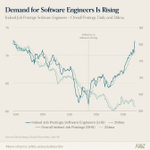
Q: How are job postings for software engineers rising rapidly despite AI agents automating coding?
A: Because there’s far more code to manage than ever before. We’re already seeing a 14x YoY increase in GitHub commits, and it’s accelerating.
AI has dramatically lowered the cost of writing code, so it’s now being used across far more businesses, applications, and use cases.
We’re at the beginning of a massive productivity boom driven by the proliferation of bespoke software throughout the entire economy.
Coding has been AI’s breakout use case this year. The fact that it’s increased demand for software engineers — rather than decreased it — should call into question the entire “AI will cause mass job loss” narrative.

We are frogs boiling
open.substack.com/pub/derekt…