

19. I find the AI clips & free tools that actually make money DM open
Joined March 2016
- Tweets871
- Following201
- Followers337
- Likes3.3K


cesar retweeted

what the f*ck is this Grok Bot. I'm genuinely shaking
11 hour flight. phone in airplane mode the whole way. I landed at 10:00, turned it on and the first text was from Grok Bot:
"while you were in the air: $18 → $1,284.60. 29 trades. keep going?"
I said yes from the jet bridge
it's not one bot. it's a graph. 32 agents, 263 connections, running on a cloud machine while my phone was dead weight in my pocket
> 8 scouts watch new pairs, smart wallets and X calls. they flag, they never buy
> 2 analysts score every flag. under 70 dies right there
> verify + memory check kill any dev with rug history, dedupe kills copycats
> risk governor sizes every buy from equity, kill switch at -25% from the peak
the scouts flagged 162 coins over 11 hours. only 29 made it through every gate
29 trades
20 green, 9 red
worst red was -$25.84. no hoping, no "it'll come back"
best trade: 07:04 somewhere over the ocean, three scouts flagged the same coin inside a minute. +$253.21
08:16 a coin was pumping off one big call. verify found the KOL selling into his own followers. killed before the executor saw it
$18 → $32.20 → $91.14 → $763.19 → $1,284.60
cloud bill for the whole flight: $4.76. the in-flight wifi would've cost more
would you have said yes on the jet bridge, or cashed out and gone to baggage claim?


OpenAI's CEO told the UN Security Council that AI progress could go very badly in two ways.
He started with the darker one 👇
"First, we could lose control of the future to AI."
He warned it could move too fast for anyone to follow, or to step in. Then he said a 10% risk of catastrophe or even 0.1% still isn't remotely acceptable.
If the person building it says we could lose control, is that a warning to hit the brakes, or a reason to watch even closer?


Meta's AI now calls your cable company, your insurer and the DMV for you.
The person who picks up has to decide: hang up, or talk to a bot.
Some already hang up. But Alexandr Wang, sitting next to Zuckerberg, says users were trusting it with something bigger 👇
"People are fully delegating purchases to the agents."
Muse has 10M+ users. Calls need a paid plan, from $20 a month. Shopping was the test. Sitting on hold is the chore they just productized.
Would you let an AI make your calls, or is this where businesses start hanging up?
OpenAI started rolling out ChatGPT Wallet on Friday, letting its dots agents complete purchases for U.S. Pro users with Visa, Mastercard, and Amex.
In the clip below, Sam Altman tells Cleo Abram why that leverage matters:
"I think it is probably possible now to start a company that is a one-person company that will go on to be worth like more than a billion dollars."
Those tools, he said, can let you do what used to take teams of hundreds. The scarce part is choosing what is worth building.
Is a one-person billion-dollar company finally here, or is letting an agent pay still the easy part?
1
13
959
Anthropic set November 19 for its Nasdaq debut, at a $70 to $78 range that values the company at up to $1.45 trillion.
In the clip below, CEO Dario Amodei tells NBC News what that means for someone just starting out:
"It can do entry-level law work. It can do entry-level finance. It can do entry-level consulting."
He also said we can't deny it will eliminate jobs, probably a large number of them. His first advice: learn to use AI.
The scarce skill is moving from landing that first job to running the tools that already do it.
Is "learn to use AI" still enough, or is that first job already the model's?
8
8
469
Nvidia's board accepted Jensen Huang's resignation after 33 years as CEO, and named CFO Colette Kress interim chief while it searches for a successor.
In the clip below, he tells All-In what he expected from a $500,000 engineer:
"If that $500,000 engineer did not consume at least $250,000 worth of tokens, I am going to be deeply alarmed."
He also said the idea that you'll still need a lot of people is gone. The high-pay job is shifting from writing code to running agents.
Is that $250K token budget the new bar for a $500K role, or does most of the industry still treat AI as a $5,000 tool?

4
24
578
Demis Hassabis just showed Gemini 4 Carbon reverse-engineering his 1990s Theme Park game, adding a DeepMind ride, and porting it to the web in one shot.
He built that game by hand in 1993-94:
"I was amazed by how far you could get, to the extent where 10 million people would enjoy interacting with that fairly basic simulation of a theme park."
A year ago, a testbed still took him late-night vibe coding. The scarce part is shifting from writing the engine to choosing what is worth shipping.
Is this the start of one-person studios, or is a real game still a team sport?

1
25
532
Elon Musk just said Grok 4.8 starts rolling out to bot users later this week, and admitted it still won't beat Claude Opus 5.5.
In the video below, he tells Forbes what he thinks hits by around 2031:
"Five years being say 2031 digital intelligence will exceed the sum of all human intelligence... in 5 years let's say at least 100 million humanoid robots but maybe a billion."
"I would predict that the economy is probably twice its current size in five maybe six years at 5 to seven years."
That clip is from May 2026, at Forbes' Innovator 250 event. This week he also called Anthropic's Opus 5.5 a "masterpiece," and said Grok 5 should exceed it in two or three months.
The gap I keep noticing: the models are now racing in months, and he is still talking about a 5-7 year doubling of the whole economy. If even part of that shows up, selling only your hours gets weaker as the default plan.
Where I'd start, all free:
Grok - grok.com
xAI - x.ai
Karpathy, Zero to Hero - karpathy.ai/zero-to-hero.htm…
Let's build GPT from scratch - youtube.com/watch?v=zjkBMFhN…
fast.ai practical deep learning - course.fast.ai
Google ML Crash Course - developers.google.com/machin…
Official Forbes interview - youtube.com/watch?v=3PTCFgmU…
Is he early on the 5-year clock, or is the risky move still assuming your job stays the scarce input?

4
23
586
Elon Musk's engineering mantra: “the best part is no part. the best process is no process.”
so why does my trading setup still need me staring at charts for six hours?
I gave Grok Bot $45 and rules for buying, selling and sizing every trade
$4,173.65 later, the part I'd removed was me
no second deposit
no manually chasing green candles
no waking up to decide whether to sell
one instruction:
“you get forty-five bucks. grow it. I'm not adding more.”
the first buy was $18
then the Compounder handled the sizing:
every entry uses 40% of free cash
max 2 positions open
realised profits become available for the next buy
losses make the next ticket smaller too
$45 available means an $18 entry
$450 means $180
$3,000 means $1,200
same rule. different size. no confidence required
selling was decided before anything bought:
at 2×, sell half — recover the original entry money before fees
trail the remaining half 10% below its highest price since entry
before the first take-profit, cut at -8%
no averaging down
no moving the stop
no “just one more candle”
I used to think more screen time meant more control
but half that time was me negotiating with rules I'd already made
$45 → $4,173.65
92.75× without me placing a single trade
the bot still had work to do
I just stopped making myself a required step in every decision
what would you remove first: picking entries, sizing positions, or deciding when to sell?
illustrative build, numbers simulated
3
17
475
GROK BOT TURNED $180 INTO $2,196 WHILE I SLEPT. THE BIGGEST WINNER WAS A COIN CALLED EXIT LIQUIDITY.
a simulated overnight run: 12.20x, 18 trades, 11:52pm to 6:48am.
open the Trading folder, tap Run, put the phone down.
4 bots, one job each
› Scanner filters pools by liquidity
› Analyst scores the candidates
› Executor sizes and places the buys
› Risk manages the exit rules
18 closed trades. 13 green, 5 red.
the five losses total $47.60 in this simulation.
2:36am to 3:01am, three losses in a row. exactly the stretch where i'd start questioning every setting.
then EXIT LIQUIDITY.
$140 in, $728 out, +$588 in 44 minutes.
another coin, Sleep Mode, stays open from 1:43am until 5:26am. half exits at 3.20x, the rest at 5.60x.
the difference between those trades is why i'd put the exit instructions beside the buy button.
before a position opens:
› define the size
› define the first partial exit
› define what closes the remainder
› define when the whole session stops
don't leave those decisions for the moment the screen turns red.
$180 → $392 → $847 → $1,608 → $2,196.
illustrative balances and trades, not live returns.
be honest, after the third loss at 3:01am, would you stop the session or let the rules play out?
send this to the friend who plans every entry and improvises every exit.
the full Grok Bot setup, all 4 bots, 7 steps and the prompts are in my article below ↓
6
12
284
cesar retweeted
what the f*ck is this Grok Bot. I let it run my DuelBet session before bed
first it scanned the whole casino lobby. 42 games, read the published RTP on every single one, kept only the 97%+ ones
site: duelbet.com/c/ygfbfy
18 of 42 made the cut. RTP is a fixed number the game publishes, so it’s just sorting, not magic
then it picked 5 of them and played a few rounds each
> Lucky Baccarat A · 98.94%
> Gates of Olympus Roulette · 97.30%
> Royal Roulette 500X · 97.30%
> Khonsu Merge Up · 97.01%
> European Roulette · 97.30%
some rounds won, some lost. +$40, −$40, +$62, −$30. that’s how it goes
what actually stacked was the Duel Points. every wager earns DP, win or lose
it runs 4 agents, in order
> Scanner reads the lobby and filters by published RTP
> Player opens each game, plays a couple of rounds, logs every DP credit
> Racer watches the Daily Race board and pings me when it climbs
> Guard holds the cap I set. hit it at 12:47, paused itself. no «one more», no top-ups
it texted me at 12:37: «Bronze 4 unlocked. keep going?»
I said yes
1,140 → 10,240 Duel Points in under an hour
Daily Race: #410 → #41
VIP: Bronze 3 → Bronze 4
battery 91% to 83%
DuelBet says DP count toward the upcoming $DUEL airdrop, so the points were the whole point
would you let it
🤝 Paid partnership
Igor Babuschkin (ex-xAI Research & Engineering) helped build Grok from zero.
I turned Grok Bot’s persistent-agent architecture into a 7-layer harness built to make long jobs end with an artifact, evidence, and a restart point.
It's f*cking unreal...
send it to Grok Bot, and thank me later. Then save the full harness below.


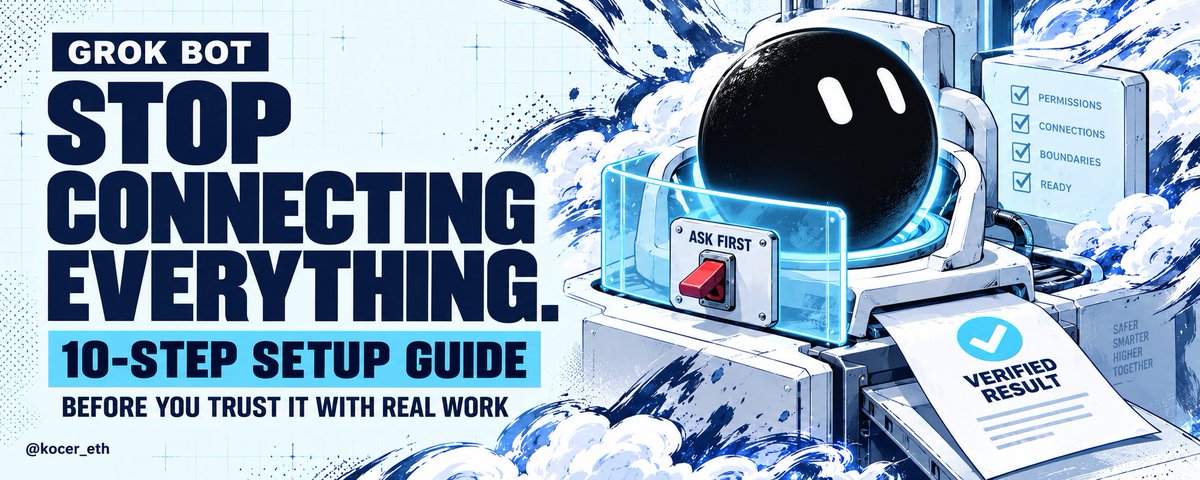
How to build the full Grok Bot setup for real work (every step, every check)
i don't count "it can open my apps" as a finished setup.
› Grok Bot gets one job. you define the result, limit access, and check the evidence.
here's the full setup map:
📁 grok-bot-setup
┃
┣ 📁 01. installation
┃ ┣ 📁 /official-download
┃ ┣ 📁 /confirm-account-access
┃ ┗ 📁 /review-data-settings
┃
┣ 📁 02. bot role
┃ ┣ 📁 /one-primary-job
┃ ┣ 📁 /clear-description
┃ ┗ 📁 /defined-deliverable
┃
┣ 📁 03. approval rules
┃ ┣ 📁 /draft-is-not-send
┃ ┣ 📁 /ask-before-buying-or-deleting
┃ ┗ 📁 /review-app-approval-controls
┃
┣ 📁 04. working context
┃ ┣ 📁 /goal-and-experience
┃ ┣ 📁 /constraints-and-priorities
┃ ┗ 📁 /non-negotiable-requirements
┃
┣ 📁 05. minimum access
┃ ┣ 📁 /public-sources-first
┃ ┣ 📁 /only-necessary-connections
┃ ┗ 📁 /verify-with-a-read-only-check
┃
┣ 📁 06. output format
┃ ┣ 📁 /recommendation-and-comparison
┃ ┣ 📁 /sources-dates-and-unknowns
┃ ┗ 📁 /approve-one-sample-row
┃
┣ 📁 07. first task
┃ ┣ 📁 /compare-three-options
┃ ┣ 📁 /use-the-same-criteria
┃ ┗ 📁 /deliver-then-stop-for-review
┃
┣ 📁 08. verification
┃ ┣ 📁 /open-the-supporting-sources
┃ ┣ 📁 /find-the-earliest-failed-step
┃ ┗ 📁 /fix-that-step-not-the-personality
┃
┣ 📁 09. lasting preferences
┃ ┣ 📁 /keep-approved-output-preferences
┃ ┣ 📁 /exclude-temporary-facts
┃ ┗ 📁 /confirm-what-was-saved
┃
┗ 📁 10. reusable skill
┣ 📁 /save-inputs-steps-and-output
┣ 📁 /include-failure-and-approval-rules
┗ 📁 /test-with-a-different-input
10 steps. one focused bot. two checked tasks. no coding required.
Grok Bot does the work. you decide what it can touch and what counts as done.
JEV + Grok Bot... i can't understand why everyone isn't wiring this up yet
Grok Bot can browse, read files, run commands, and keep working in the background.
JEV adds the decision layer before the agent burns time and context on the wrong path.
what JEV handles:
-> scores which sources deserve to enter the context
-> chooses act, skip, ask, or defer from options Grok Bot already prepared
-> selects the next recovery path when a tool or website fails
-> rejects weak candidates before Grok Bot spends another full turn investigating them
what Grok Bot handles:
-> searches websites, repositories, documents, and connected apps
-> executes the selected workflow inside its browser, filesystem, and terminal
-> returns the result with sources, timestamps, and an action log
-> parks sending, publishing, deleting, purchasing, and production changes for your approval
Grok Bot does the work. JEV decides which work deserves the next step.
the agent stops wasting full-context reasoning on every minor choice.
the execution layer stays autonomous. the decision boundary stays inspectable.
you're wasting time correcting full Grok Bot reports. use this 4-part brief to approve one sample before the real work.
the setup guide has a simple fix: approve one sample before the full task.
paste this into Grok Bot and replace the brackets:
1. outcome › [the decision this report should help me make]
2. sources › [approved links, files or attachments]. flag missing information instead of guessing.
3. format › [table, document or draft]. include [required fields] and keep it within [length].
4. review point › show one sample, then wait for approval. do not send, publish or overwrite anything.
use the actual sources for the sample, not invented placeholder facts.
for a comparison, return one completed row. for a report or draft, return one representative section.
include the evidence behind factual claims. mark anything you could not verify.
if a missing detail would change the result, ask before proceeding.
after approval, apply the agreed format to the remaining work.
check the sample's sources too. approving the layout does not verify its claims.
keep this brief for your next report, comparison or draft. the full 10-step setup is in the quoted article.
2
11
433
cesar retweeted
Sam Altman’s face when his $20 GPT-6 Astra absorbs the instincts of 167 elite memecoin traders. Their edge is now one live AI radar anyone can use for free.
I used GPT-6 Astra to score every Pons V2 token and wallet on Robinhood Chain straight from public logs.
741,643 indexed events on one token alone. 29 attributed curve participants, 93/100 score, HIGH CONFIDENCE.
It's live and it's free: meerkat.my
No private key. No signer. No transaction path. It reads the chain, it can't touch it.
Another token resumed a killed indexing job from a 64-block overlap and still closed clean at 41,302 persisted events. Every point on every score traces back to a block and a log index.
Most token scores hand you a number and ask you to trust it. Trust the model, trust the wallet they didn't disclose, trust that "verified" means what they say it means. You can't click through any of it.
MEERKAT doesn't ask for that trust:
→ SCORE is GPT-6 Astra. Breaks a token 0-100 across five components: deployer exposure, creator tax, participant breadth, two-sided market, current holder breadth. Every component opens into the blocks behind it.
→ WALLET SCORE is GPT-6 Astra. Reads token scope, early discovery, two-sided activity, evidence depth. Confidence drops on its own when the local index is thin, it doesn't fake certainty.
→ FEE FLOW follows creator revenue to its current recipient. HOP OUT paid 1.177 ETH across 26 sweep events, split curve and pool, and the recipient doesn't match the deployer. Labeled ROUTED AT LAUNCH, not hidden.
→ RELATIONSHIPS maps attributed wallets around a token and keeps pool callers explicitly separate from real participants.
→ TIMELINE pages 50 events at a time, colors BUY green and SELL red, links every row to its transaction.
→ Two hard rules run under all of it: early entry is a curve buy within 30 blocks of launch, fast exit is a sell within 300 blocks of that wallet's first buy. The rule is shown, not just the label.
FLYBRAIN ran 27x this week. Eight trusted wallets were in by 20:18, the alert fired at 20:18, and the pool didn't even open until 20:51. Most people saw the chart after it already moved.
I caught 18x of that run, and it wasn't a lucky entry. It was because my own system was already reading the wallet flow before the pool opened, not after. By the time the crowd was refreshing charts, I already had a position.
No signer means MEERKAT can't push a trade for me any more than it can for you. It reads chain state. It never holds a key.
Landing page, terminal, APIs, indexer, database, all one local Node process. Open source, self-hostable, same code running the public terminal you can open right now.
Next: global wallet discovery across the whole chain, then Pons market context sitting right next to the score.
We're reading evidence anyone could open. Most people just never open the dossier.
cesar retweeted
I used GPT-6 Astra to score every Pons V2 token and wallet on Robinhood Chain straight from public logs.
741,643 indexed events on one token alone. 29 attributed curve participants, 93/100 score, HIGH CONFIDENCE.
It's live and it's free: meerkat.my
No private key. No signer. No transaction path. It reads the chain, it can't touch it.
Another token resumed a killed indexing job from a 64-block overlap and still closed clean at 41,302 persisted events. Every point on every score traces back to a block and a log index.
Most token scores hand you a number and ask you to trust it. Trust the model, trust the wallet they didn't disclose, trust that "verified" means what they say it means. You can't click through any of it.
MEERKAT doesn't ask for that trust:
→ SCORE is GPT-6 Astra. Breaks a token 0-100 across five components: deployer exposure, creator tax, participant breadth, two-sided market, current holder breadth. Every component opens into the blocks behind it.
→ WALLET SCORE is GPT-6 Astra. Reads token scope, early discovery, two-sided activity, evidence depth. Confidence drops on its own when the local index is thin, it doesn't fake certainty.
→ FEE FLOW follows creator revenue to its current recipient. HOP OUT paid 1.177 ETH across 26 sweep events, split curve and pool, and the recipient doesn't match the deployer. Labeled ROUTED AT LAUNCH, not hidden.
→ RELATIONSHIPS maps attributed wallets around a token and keeps pool callers explicitly separate from real participants.
→ TIMELINE pages 50 events at a time, colors BUY green and SELL red, links every row to its transaction.
→ Two hard rules run under all of it: early entry is a curve buy within 30 blocks of launch, fast exit is a sell within 300 blocks of that wallet's first buy. The rule is shown, not just the label.
FLYBRAIN ran 27x this week. Eight trusted wallets were in by 20:18, the alert fired at 20:18, and the pool didn't even open until 20:51. Most people saw the chart after it already moved.
I caught 18x of that run, and it wasn't a lucky entry. It was because my own system was already reading the wallet flow before the pool opened, not after. By the time the crowd was refreshing charts, I already had a position.
No signer means MEERKAT can't push a trade for me any more than it can for you. It reads chain state. It never holds a key.
Landing page, terminal, APIs, indexer, database, all one local Node process. Open source, self-hostable, same code running the public terminal you can open right now.
Next: global wallet discovery across the whole chain, then Pons market context sitting right next to the score.
We're reading evidence anyone could open. Most people just never open the dossier.
Elon Musk realizing a $300 Grok Bot running just 5 methods can pull $10,000 a month while the guy who built it dropped every prompt on X for free
I used GPT-6 Astra to score every Pons V2 token and wallet on Robinhood Chain straight from public logs.
741,643 indexed events on one token alone. 29 attributed curve participants, 93/100 score, HIGH CONFIDENCE.
It's live and it's free: meerkat.my
No private key. No signer. No transaction path. It reads the chain, it can't touch it.
Another token resumed a killed indexing job from a 64-block overlap and still closed clean at 41,302 persisted events. Every point on every score traces back to a block and a log index.
Most token scores hand you a number and ask you to trust it. Trust the model, trust the wallet they didn't disclose, trust that "verified" means what they say it means. You can't click through any of it.
MEERKAT doesn't ask for that trust:
→ SCORE is GPT-6 Astra. Breaks a token 0-100 across five components: deployer exposure, creator tax, participant breadth, two-sided market, current holder breadth. Every component opens into the blocks behind it.
→ WALLET SCORE is GPT-6 Astra. Reads token scope, early discovery, two-sided activity, evidence depth. Confidence drops on its own when the local index is thin, it doesn't fake certainty.
→ FEE FLOW follows creator revenue to its current recipient. HOP OUT paid 1.177 ETH across 26 sweep events, split curve and pool, and the recipient doesn't match the deployer. Labeled ROUTED AT LAUNCH, not hidden.
→ RELATIONSHIPS maps attributed wallets around a token and keeps pool callers explicitly separate from real participants.
→ TIMELINE pages 50 events at a time, colors BUY green and SELL red, links every row to its transaction.
→ Two hard rules run under all of it: early entry is a curve buy within 30 blocks of launch, fast exit is a sell within 300 blocks of that wallet's first buy. The rule is shown, not just the label.
FLYBRAIN ran 27x this week. Eight trusted wallets were in by 20:18, the alert fired at 20:18, and the pool didn't even open until 20:51. Most people saw the chart after it already moved.
I caught 18x of that run, and it wasn't a lucky entry. It was because my own system was already reading the wallet flow before the pool opened, not after. By the time the crowd was refreshing charts, I already had a position.
No signer means MEERKAT can't push a trade for me any more than it can for you. It reads chain state. It never holds a key.
Landing page, terminal, APIs, indexer, database, all one local Node process. Open source, self-hostable, same code running the public terminal you can open right now.
Next: global wallet discovery across the whole chain, then Pons market context sitting right next to the score.
We're reading evidence anyone could open. Most people just never open the dossier.
22
384
YOU WILL WRITE THE SAME NOTE FOR THE THIRD TIME TOMORROW AND STILL NOT TURN IT INTO A WORKFLOW. THE 4-LINE RULE AT THE BOTTOM OF THIS ARTICLE IS THE ONLY REASON MY VAULT STOPPED GROWING WITHOUT WORKING.
i ran a search across my vault last month for one idea i had been thinking about all year.
five notes came back. same idea. five different filenames. all written like i was seeing it for the first time.
that was the day i copied four lines out of this article and pinned them at the top of my inbox folder.
the rule reads:
» once: matters once, write it down. a line in today's note, nothing more.
» twice: matters twice, turn it into a note. give it a title the future you can search for.
» three: matters three times, turn it into a workflow. the steps, not the story.
» decision: affects a future call, put it in a decision log. no chat reopens it.
i thought the rule was about tidiness. it is not. it is about state.
once tells you the thing exists. twice tells you it repeats. three tells you it is a pattern. a decision tells you the question is closed.
three weeks in, the vault stopped growing sideways. i still write as much as before. i just write it in the right of the four places, and the vault does the counting for me.
the ideas i used to lose to duplicates now compound. every fourth line i write is a decision that never reopens. every workflow i save gets called by the next thought that hits its shape.
your vault is not slow because you write too little. it is slow because it does not know which line to put a thought on.
paste the four lines at the top of your inbox tonight. by friday the third time you almost re-write something, the rule will catch you first.
