

Founder of @DefiantNews. Author of The Infinite Machine. Ex Bloomberg News reporter in NYC, Madrid, BsAs. Chilena. Mamá.
New York, NY
Joined November 2011
- Tweets14.2K
- Following3.9K
- Followers94.4K
- Likes23.1K




Camila Russo retweeted

What Are Bitcoin ETF Buyers Doing in a 49% Drawdown?
ETF buyers were supposed to make Bitcoin more stable. BTC is now down almost half from ATH -- does that thesis hold up?
Bloomberg Intelligence analysts Eric Balchunas @EricBalchunas and James Seyffart @JSeyff just published "Both Sides of the Coin."
Balchunas and Seyffart join The Defiant to discuss their new book, ETF flows, gold, stablecoins and tokenization.
Live at 1pm EST 👇
nitter.cf/i/broadcasts/2YRZzEKzl…

Camila Russo retweeted
🥞 Maple Finance @maplefinance lost two senior executives last week.
CEO Sid Powell @syrupsid joins us live to discuss the departures, where he’s taking the onchain asset manager next, and his views on how tokenization will fare in the current market.
Join us at 2pm EST👇
nitter.cf/i/broadcasts/2mdqzXRPK…

RT @DefiantNews: Should AI have power over your money?
Hugo Renaudin (@hugorenaudin_), CEO of @Ulys_AI, argues that an AI wallet can be saf…
Camila Russo retweeted
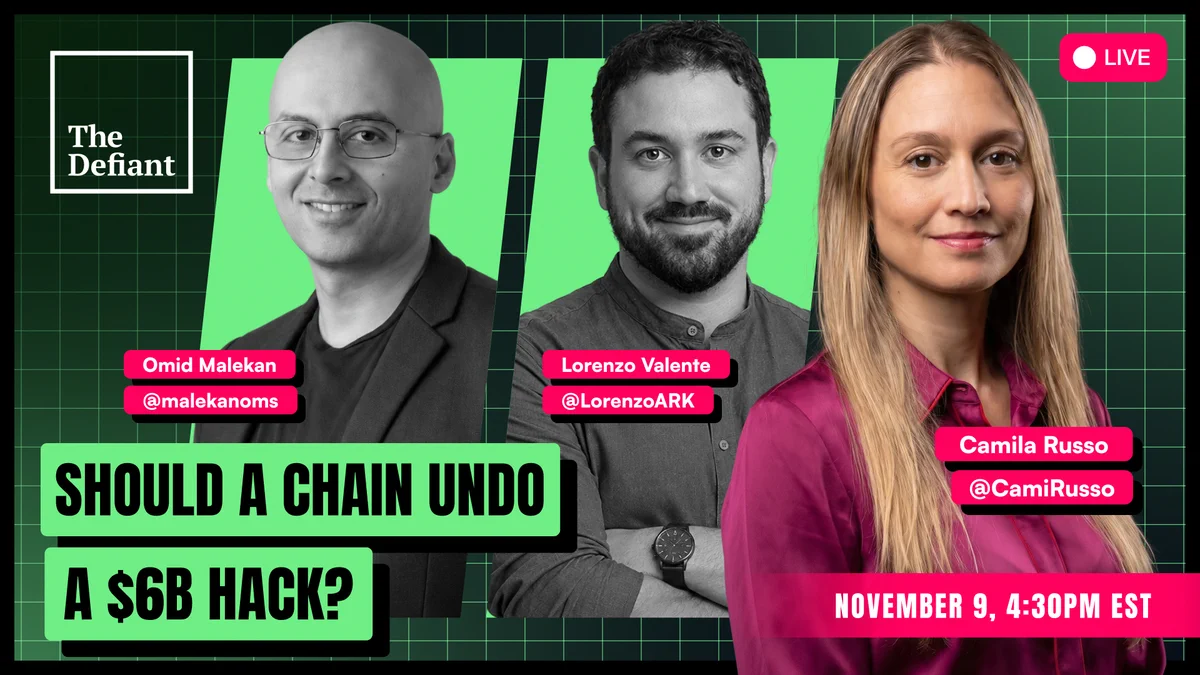
Live debate with Omid Malekan and Lorenzo Valente on whether chains should allow rollbacks in the context of the Binance hack 👇

Should a Chain Be Able to Undo a $6 Billion Hack? Lorenzo Valente and Omid Malekan Disagree nitter.cf/i/broadcasts/2QnlnYmZz…
Camila Russo retweeted
Should a chain be able to roll back a $6B hack?
“Neutrality isn’t a product -- Not getting drained is.”
That’s @LorenzoARK of ARK Invest, arguing chains need a rollback option after the $6.3B Binance hack.
@malekanoms says the rollback button is a new vulnerability, and that no institution would want to touch that kind of infra.
They agreed to debate this out with us.
Join us at 4:45pm ET 👇
nitter.cf/i/broadcasts/2QnlnYmZz…
Camila Russo retweeted

Building in public / Update #10
Mood: Inspired
Just finished The Infinite Machine by @CamiRusso , the story of how Ethereum was built.
Somewhere along this journey I realized that building in DeFi isn't just about the product. Education is part of the job. I'm spending a lot of time learning, reading and absorbing everything relevant.
Reading The Infinite Machine, I understood one thing:
The founders behind one of the biggest projects in crypto faced the same kinds of challenges we face today. Doubts. Setbacks. Things breaking. Just at a much bigger scale.
Turns out the struggle isn't a sign you're doing it wrong.
It's a sign you're building something worth the struggle.

DeFi book taking shape!!
Interviews down:
@StaniKulechov
@haydenzadams
@rleshner
@RuneKek
more 🔥 interviews lined up
it's been incredible to listen to the backstories of these founding protocols and I cannot wait to put them into paper and bring them to life for all of you.
such an interesting experience for me personally, vs writing the infinite machine -- I wasn't around in Ethereum early days. but this time, when people talk about things that happened at edcon 2018 in toronto or devcon prague and osaka, etc etc -- I was actually there! hopefully I can translate that into a great story.
Such a pleasure catching up with @MurielMedard!
I remember meeting her 2 years ago at ETHDenver when she was just starting @get_optimum so it was great to have this conversation right after the project launched.
Through decades of research, she discovered a faster way to get data to validators which means higher APYs. If enough validators adopt this tech, it can improve end users' Ethereum UX too.
For validators, latency is money.
Faster, more predictable block propagation means less risk of missing deadlines, more time to build better blocks, and higher APY.
That's what @get_optimum's mump2p brings to Ethereum, built on RLNC, the network coding tech co-invented at MIT by Optimum CEO & Co-Founder @MurielMedard
Node operators can onboard for free → getoptimum.xyz
Full conversation with @CamiRusso on The Defiant 🔗
Camila Russo retweeted

1/4
I just watched Prof. Muriel Médard's conversation with @CamiRusso on The Defiant, and there's one thing I think every Ethereum validator and anyone interested in blockchain infrastructure should pay attention to.
Speed is money!
And she's not just talking about having a faster internet connection. She's explaining how the time it takes for information to travel across a blockchain network can have a real impact on validators and their rewards.
When a block is produced, it needs to reach validators quickly so they can process it and participate in the network. Every millisecond matters, and when some validators consistently receive information later than others, that difference can affect their performance.
This is one of the problems @get_optimum is working to solve.
For validators, latency is money.
Faster, more predictable block propagation means less risk of missing deadlines, more time to build better blocks, and higher APY.
That's what @get_optimum's mump2p brings to Ethereum, built on RLNC, the network coding tech co-invented at MIT by Optimum CEO & Co-Founder @MurielMedard
Node operators can onboard for free → getoptimum.xyz
Full conversation with @CamiRusso on The Defiant 🔗
First time back at 731 Lex since I left Bloomberg 8 years ago. So weird to have a visitor badge with a different company (my own) under my name. Would never have imagined that when I got there as an intern.
Was there to toast @EricBalchunas and @JSeyff ‘s new book 🎉

Camila Russo retweeted

Tokenization isn’t the hard part anymore.
Using RWAs as collateral still is.
$2B+ redeemed on Stellar last year. Every redemption made holders wait. Lenders won’t accept an asset they can’t liquidate - RedStone Settle solves that.
Thanks @CamiRusso for having me at Meridian.
Over $2B in assets were redeemed on Stellar last year. The median wait was 1.5 days and the longest was 126 days. None were instant.
@redstone_defi is bringing RedStone Settle to Stellar, an RFQ platform where market makers and banks buy tokenized assets on the spot so holders exit right away.
@MarcinRedStone explains it to @CamiRusso
Camila Russo retweeted

In 2014 I went nearly a week without sleep. I was running PayPal and attackers were inside our corporate network. They'd compromised an eBay employee's laptop, got onto the VPN, taken over a domain controller and made themselves domain admins. eBay and PayPal were one company then, on one Windows network. They stole 145M eBay user records, then came for the segregated vault holding PayPal's card credentials. We fought them off. They never got in, but they got close. Too close.
Yesterday Binance lost ~$6.3B in what looks like the same way. A DevOps engineer's laptop, then a service inside the withdrawal stack, then withdrawals the signer approved because they came from a trusted source. Hot wallets emptied in under four hours. No key was stolen.
Nobody broke cryptography or a ledger. They found someone with access and used the trust that came with it. Banks get hit exactly the same way.
2016: attackers inside Bangladesh Bank used its own SWIFT access to send $951M of payment orders to the NY Fed. $81M was lost. The rest was held because an unrelated sanctions filter tripped on the word "Jupiter". That was luck, and it only worked because wires took days to settle.
June 2025: an IT employee at C&M Software, which connects Brazilian banks to Pix, sold his credentials for about $2,700. Attackers used them to send fake Pix transfers out of six institutions' reserve accounts at the central bank. ~$140M in under three hours.
August 2025: stolen vendor credentials at Sinqia, another Pix connector. ~R$710M out of HSBC and one other institution in a single afternoon. The central bank froze most of it, after it had already moved.
Same attack every time. Speed is what changed. When settlement took days, a filter, a correspondent bank or someone in ops could catch a bad payment. Pix, FedNow, SEPA Instant and blockchains settle in seconds. Payment security was mostly built for the slow world.
PayPal's card and user data survived 2014 because domain admin on the corp network couldn't unlock it quickly enough, and our alerting caught the unusual activity on the network. That's the model. Approval policy no laptop or vendor login can reach. Velocity and anomaly limits enforced outside the system that sends. Dynamic caps on what any one wallet, account or service can move per hour. All of it in real time.
About $3B of what left Binance has been frozen, almost all of it stablecoins. The $1.4B in bitcoin is sitting in 19 wallets and nobody can touch it. I don't think that's the problem. For decades the ability to reverse a wire or a card charge let a lot of weak security slide. You either stop the transfer before it's signed or you eat the loss.
Nothing about the technology failed here. The chains processed exactly the transactions they were handed. Binance's own systems handed them the wrong ones because an engineer's laptop was compromised. That's operational security. eBay in 2014, Bangladesh Bank and two Pix connectors all failed at it on their own rails.
In 2014 the attackers never reached the vault. If they had, the fraud losses would have been the small part. PayPal existed so people could pay without handing their card details to every merchant on the internet. We held those details so they didn't have to. Losing them would have broken the one thing the company was built on, and I'm not sure we would have recovered.
I expect blockchains and digital assets to become the standard way money moves. Every custodian of digital assets, or of fiat on a real-time rail, is in that position now. The controls have to adapt to settlement in seconds, crypto or not.
this is some optimistic accounting from cz
frozen funds doesn't mean recovered funds -- only 0.8% of stolen crypto funds are actually returned to victims, according to @blockaid_
thedefiant.io/news/security/…


Again the pooled vs segregated lending model debate comes up
In this case, Aave acted quickly to freeze markets and protect all users but also calls into question the decentralization question
Morpho doesn’t intervene in market, losses are contained to individual vaults, but in past hacks vault lenders have been rekt.

By design, a Morpho Blue market can't protect its users: it can't freeze the market to mitigate risk, act on the interest rate curve or implement rate limiting, and it has no Umbrella junior tranche to protect deposits.
When an isolated market breaks, its lenders take 100% of the loss.
If you're a Morpho user facing an adverse event, they will just tweet and let you sink, as they did during the dozens of vault blowups that led to dire user losses. Ask anyone who was in a curator vault during Stream/Elixir.
Users won't trust an infra with real size if it doesn't care about them or support them.
That's why, even with infinite VC funding, deployed incentives, a competitor that lost its best contributors and paid partnerships, Morpho only added a pathetic +$2.15B in active loans this year.
For comparison, I did as much in one week at the Plasma launch.
Camila Russo retweeted
ARKHAM ESTIMATES $6.01B @binance HACK AS WITHDRAWALS STAY SUSPENDED
About $2.9B remains movable, @arkham says. Binance separately estimates a $6.3B impact and pledges to cover all losses.
Read more here:
thedefiant.io/news/hacks/ark…

Camila Russo retweeted
Binance withdrawals remain paused after a suspected hack, with no restart time as of Oct. 29, 2026, 7:08 p.m. ET.
Binance says user funds are safe. Token freezes restrict movement; they do not establish recovery or final losses.
thedefiant.io/news/hacks/bin…

ALT Chronological timeline distinguishing wallet transactions from issuer and exchange statements on Oct. 29, 2026.
Camila Russo retweeted

Reminder for @aave users who aren't sure what asset/market freezing means
Right now - the LTV (Loan-to-Value) ratio for collateral assets is 0. Technically, that means collateral assets are no longer able to back any of the debt.
If you have an existing position - things might look a bit weird as you won't be able to do any additional borrowing.
However - that doesn't mean your current debt isn't backed, or that you're gonna get instantly liquidated.
It simply means your position is unable to generate any new debt while the collateral asset's LTV is 0 (frozen)
So - definitely worth noting that you're still able to protect your position against liquidation. Whether that's repaying debt directly from your wallet, or using your collateral to clear debt with a tool such as @DeFiSaver
Happy to answer any concerns/questions for those who haven't experienced this type of situation with their position before


DeFi exposure to the Binance hack:
No DeFi protocol was exploited. The theft hit @binance custodial hot wallets.
@Tether_to says it froze over $1.6B USDT and @circle over $800M USDC.
~195k ETH can’t be frozen and it’s already moving.
@ethena is potentially the most exposed DeFi protocol bc its hedges sit on CEXs including Binance. Its collateral is held off-exchange by custodians, not on Binance.
wBETH (the Binance token used in DeFi) was among the 60+ tokens drained. It’s holding its peg so far.

@aave just froze some markets, it said as a precaution. Reports said hackers were borrowing ETH against stolen stables

We’re aware of reports of a potential incident affecting Binance-affiliated wallets.
Aave’s contracts are unaffected, and positions remain overcollateralized. As a precaution, all DAO-operated markets across V3 and V4 have been frozen.
The freeze pauses new deposits and borrows, and users can still withdraw and repay their existing positions.
2
7
1,171


