

Real Salt Lake U13 Head Coach, USSF A License, UEFA C License
Joined July 2014
- Tweets1.6K
- Following221
- Followers473
- Likes17.3K




Cam Jolley retweeted

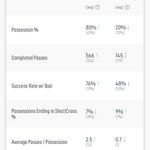
Spain is the antithesis for the "if only our best athletes chose Soccer" crowd. France was flooded with physically superior players, with unmatched speed and strength, yet they failed influence the game where Spain were calm in control, a complete domination of a performance
This Post is from a suspended account. Learn more
Cam Jolley retweeted

Using in-house data, FIFA’s Football Performance Insights team have noticed a trend at this summer's World Cup.
Compared to previous editions, they have spotted that possessions including an off-ball run which targets the inside channels and the space in behind the opposition defence are leading to successful actions more frequently.
In other words, attacking the gap between the widest defender and the centre-back nearest to them with a forward run is increasingly valuable.
Compared to the previous World Cup four years ago, possession sequences that include such a movement in the 2026 tournament are leading to around 2.7 shots on goal per 30 minutes of ball-in-play time — an increase of around 34 per cent.
Those runs are effective because they cause tension in the opponents’ defence. Most often, that full-back will have their eye on a winger, while the centre-back on that side will be tracking the striker.
@ThomHarris_
🔗 nyti.ms/4yiUz3t
Cam Jolley retweeted

After 120 minutes of play, Germany was tied with Paraguay. Off to penalty kicks they went. Through the normal five attempts for each side, they were deadlocked 3–3, with Manuel Neuer keeping Germany alive by saving two Paraguay penalties. As they moved into the sixth attempt on each side, it was essentially do or die.
For the higher-ranked German squad, they weren’t supposed to be in this situation. They were supposed to comfortably handle a Paraguay team that, a week earlier, had been outplayed by the U.S. But here they were, staving off elimination. Still, you’d think a side from a historic footballing nation, filled with players from the top leagues in Europe, would handle the pressure. Yet, in deciding who would take that sixth kick, the cracks showed.
With it all tied up, no one wanted the sixth kick. According to reports, players “hesitated and dodged.” Germany’s manager asked one player twice whether he’d step up; he declined. The man who finally stepped forward had never taken a penalty in his professional career. And he missed. Germany lost. Knocked out by a squad everyone had written off a week before.
These were stars, men who play for some of the biggest clubs in the world. Yet when the moment came, they shied away. They didn’t want the spotlight, or the pressure.
This piece isn’t about calling out those players. It’s about what their hesitation shows us about pressure: that even the best of the best, people who have trained their whole lives for the moment, can crumble. And more importantly, what we can do about it — so that when the lights are brightest, we step forward with confidence.
The Science of Pressure
Stress is messy. Even the best of the best can be pulled toward avoidance. In fact, too often, it’s the default. Psychologist Geir Jordet has spent his career studying the ultimate pressure platform — penalty kicks — and his work helps explain what happened to Germany, and what happens to the rest of us.
Our brain hates uncertainty. One way it tries to reduce that is to “just get it over with,” or to avoid experiencing the situation at all. The more pressure that’s felt — whether from history or internal expectations — the more we’re nudged toward avoidance.
In his work, Jordet found that kicks where a miss means you instantly lose produce far more avoidance behavior. Players look away, their eyes dart around, they speed up the run-up “to get it over with.” And they miss at a much higher rate: about 92% are converted when scoring wins it, but just 62% when missing loses it. Similarly, players from teams with a history of shootout failure perform worse, rushing the shot and looking away from the keeper far more often. This holds even when the player taking the kick had no part in those past struggles. And he found that higher-”status” players — the bigger names — performed worse. The public expectation increases the weight the player feels.
Penalty kicks are the ultimate display of how pressure distorts us. It takes a typically confident, competent maestro of the sport and reduces him to someone who sends the ball sailing over the bar, looking more like a U8 player than a professional.
How does this happen?
Stress causes us to narrow. It’s a system that evolved to help us survive situations where our life might be at risk. Do we fight, flee, or freeze to handle the snake in the bushes or the bear in the distance? It’s designed to nudge us — and sometimes force us — toward a response.
But stress isn’t a single response. It’s multifaceted. We can see this at the hormonal level: the mixture of adrenaline, cortisol, and testosterone shifts depending on the context and our reaction. The way I like to think of it is that stress is our body’s best guess at how to prepare for the moment. Sometimes that guess tells us we can’t handle the situation, and our best tactic is avoidance — or even preparing for injury (our immune system ramps up when we sense damage is imminent). Other times, the guess is to take the situation on: a jolt of energy, the fear subsiding just long enough for us to press forward.
Which way we go depends on our brain’s inner calculus. That best guess varies based on:
-Past experiences in similar situations
-Our appraisal of the demands we face and our ability to handle them
-How we define success and failure
-Our interpretation of the feelings, emotions, and mood we’re experiencing right now
-Our level of support
-Our identity — whether it’s fully on the line, or secure even in a loss
All of that information shapes the bet our brain makes on how to handle the moment. And if the stakes are high enough, it’s really hard to overcome the pull toward avoidance. The fear of failure — of embarrassing ourselves, of letting down our country — is incredibly powerful. Because it’s not just a win or a loss on the line. It’s our identity, what we’ll be known for the rest of our lives. That burden is heavy, even when it’s your job.
When the weight of the world is on you, it pushes you toward protection. And one of the simplest ways to protect yourself is to say, “Not me.” Which is why many of the German players chose avoidance. Decades ago Kahneman and Tversky showed that the failure you chose stings more than the failure that merely happened to you. While work by Ilana Ritov and Jonathan Baron found the pull toward inaction grows even stronger when you know you'll have to stand there and watch the result. So in the moment, letting someone else take the kick feels safer, because missing one you chose to take is one of the most painful types of failure.
It’s the protective ego at work. The instant failure and embarrassment show up as real possibilities, our ego starts looking for an out. “Not me” makes rational sense to a protective brain. It’s the same instinct as the student who doesn’t study so he has his excuse ready before the test is even handed out. We’d rather protect the story of who we could have been than risk finding out who we are in that moment.
Which is why it's worth pausing on Jonathan Tah, the man who stepped forward. He had never taken a penalty in his career. He had, in a way, the least reason to volunteer and the most reason to hide. And he was the only one willing to walk into the arena knowing he might fail in front of the whole world. That is a rare thing. Even at the highest level.

Cam Jolley retweeted
"Don't Keep Score." Norway's youth sports motto is building winners.
Norway has long dominated the Winter Olympics, but increasingly they’re having success in summer sports. They just made the round of 16 with their defeat of the Ivory Coast. Beyond soccer, they have top triathletes, runners, decathletes, tennis players, and have had global success in handball and beach volleyball. They won 8 medals at the 2024 Summer Olympics, spanning 6 sports. Norway has fewer people than the Houston metropolitan area, yet continues to produce world champions across both winter and summer sports.
And this is their youth sports program:
-If you give trophies, they have to go to all kids.
-No keeping score until they’re 11.
-National championships: prohibited through age 12.
-No posting youth results or standings online.
-Youth sport is local-first with travel being minimized.
-Motto: “Joy of Sport for All.”
They let kids be kids. And it works. In Norway, 93% of kids play some sort of youth sport. In America, that number is 58%, with kids in the US in the lowest income bracket only reaching 38%.
By any metric, Norway’s elite athletes are achieving on a global stage. Yet, if we turn to their youth sports, their programs are the opposite of the US.
Norway doesn’t allow for official score keeping until the age of thirteen. They dissuade early national travel teams in favor of local leagues. You can’t even post the results of youth games online without being fined. And almost sacrilegious in certain American circles, Norway doesn’t allow trophies unless everyone gets one. As Tore Ovrebo, Norway’s director of elite sport, told USA Today writer Dan Wolken, “We think the biggest motivation for the kids to do sports is that they do it with their friends and they have fun while they’re doing it and we want to keep that feeling throughout their whole career.” Their youth sporting model can be summed up with their chosen slogan, “Joy of Sport for All.”
But not keeping score, giving out trophies, not being “win at all costs”...that’s anti-American! How can they be competitive?
Research backs their approach up.
The Fire Has To Come From Within:
If you look at research on prodigies who eventually become standout adult performers, a deep intrinsic drive is paramount. Researchers found that intrinsically motivated football players were 3.5x more likely to make it to the next level, and athletes in general 2x more likely.
The problem is that early success often pulls young people away from this inner drive. Kids start playing soccer (or violin or chess—this isn’t just about sports) because it is exciting and fun. As they improve, they gain accolades and praise from their parents, coaches, and teachers. They start winning trophies or seeing their names in online commentary. Without even realizing it, their intrinsic drive gets replaced by external validation and a need to please and impress others.
The quickest way to kill that internal motivation? Hype achievements and be a crazy controlling parent or coach.
The best way to create and maintain intrinsic motivation is to let kids dabble, explore, and find something with which their interests and talents align. Then, let them enjoy it without an undue emphasis on success. Praise effort, character, and teamwork, not results. This is easy to talk about but hard to do. Find ways to reward and incentivize the values you want to instill. That means not taking the easy road and talking about who set a new mile best or scored the most points, but instead highlighting who hustled during the fourth quarter, rallied after it seemed like the match was over, or displayed exemplary sportsmanship.
Go Broad over Specialization
Even if the entire point of youth sports was to create future champions (which it’s not), we’d still adopt something similar to the Norwegian model. An analysis of over 6,000 athletes explored what separates athletes who reached world class and those who came up short.
Those who reached world-class had during their youth:
-More multi-sport than specialized practice
-Started their primary sport later
-Accumulated less overall formal practice
-Initially progressed slower than national class peers
Those who performed well when young, but didn’t progress:
-Started their primary sport earlier
-Specialized, engaging in more practice in one sport
-Made quicker initial progress
Norway doesn’t have 300 plus million people and an NCAA system to funnel talent. They have to develop theirs. And they realize the best way to do that is keep as many people in the system as possible. Sure, soccer tends to start early and not quite have as much sports generalization, but all research points to lots of unorganized play even in soccer.
Why? Because you can’t predict talent development very well! Just go look at the age group record books. It’s easy to fool yourself into thinking early performance equals talent and potential. The kid running a 6-minute mile at 10 looks way better than the one running 6:45. But if the faster one is at track practice 5 days a week and the slower one rolls out of gym class in jeans and runs it off “fitness” from just playing, well I’m betting on the slower one!
When we assess performance early on, we’re not measuring talent, we’re looking at training age and opportunity. And we’re crowning winners based on who started grinding first. Research backs this up, kids born early in the year are 9x more likely to be picked at U16 than late-born kids, an edge that nearly vanishes by adulthood.
America gets away with the insane achievement model because we can burn out 9 kids to get 1 survivor. When we narrow our focus too early, we create fragility. A prospective study of 1,544 high-schoolers found highly specialized athletes had 1.85x the rate of lower-body injury vs. low-specialization peers.
Norway can’t afford that. They take the longer, more sustainable model.
Their football associations entire motto is "as many as possible, as long as possible, as good as possible." This is also reflected in their coaching style, which varies based on sport, but generally takes advantage of a more modern ecological approach.
Instead of the old school football coach dictating and demanding, doing his best job of imitating a drill sergeant, Norway and other Scandanavian countries are at the forefront of using more constraints led approaches. They let the environment do more of the coaching. There’s more of an emphasis on play, exploration,varying the game dynamics with small sided games, and constraints. This isn’t every coach or situation, but many of the European development models are at the forefront of minimizing the over prescribing we see all too much in America.
Rethinking Youth Sports:
The whole point of youth sports should be for kids to learn, develop, have fun, and want to come back and play again next season! The best chance of developing a D1 scholarship athlete is essentially to do the exact opposite of what our current youth sports fiasco promotes. Even the poster child for early specialization, Tiger Woods, acknowledged it’s not a good thing for parents to push their kids too hard: “Don’t force your kids into sports,” he says. “I never was. To this day, my dad has never asked me to go play golf. I ask him. It’s the child’s desire to play that matters, not the parent’s desire to have the child play. Keep it fun.”
While youth sports in America aren’t going to adopt the Norwegian model anytime soon, we can rebalance the equation. As I outlined in my book, it’s not getting rid of competitiveness, it’s rebalancing the equation to make sure that crazy mom, dad, or coach don’t extinguish the fire that makes great competitors (and sport fun!).
And even though we like to blame that “crazy” parent, it’s often not the root of the problem. The entire system surrounding youth sports is. A 2026 study of 1,229 families found that parents’ over-investment in youth sports was driven by external pressure, especially from club coaches, and not by a delusional belief that their kid was the next pro. In fact, belief in the child’s potential didn’t predict greater spending on youth sports at all. The pressure is manufactured by the system the family is standing in. Change the incentives, and the behavior changes with it.
In research on performance orientation and grades in school, a teaching environment that supported and emphasized mastery , where students focused on the process of learning and comprehension instead of a comparison to others, was also linked to better grades. But it wasn’t the direct relationship that an outcome orientation had. Instead, in one study on college students, a mastery approach was linked to challenge-seeking, which in turn predicted end-of-the-year grades. In another study, mastery goals predicted higher levels of interest and enjoyment. Mastery works on our approach system without activating avoidance. It frees us up to take on a challenge and pursue our interests without getting bogged down by the pressure or judgment that often comes with an obsession with outcomes. The same findings hold true when looking at sport or the workplace. In a large meta-analysis that analyzed the impact of goal setting in sports, process-orientated goals had a large effect on performance. Outcome goals had little to no effect.
These two paths represent a fast versus slow road to success. Both a mastery or outcome focus can lead to better performance, but the latter is akin to taking a shortcut. Obsession over outcomes is the most direct path to improvement, but it comes with some downsides that shift us toward avoidance. The slow path takes a longer, indirect route. It helps improve our performance not by focusing on the results themselves but by supporting the foundation that ultimately leads to better performance. It stokes the fire of enjoyment and interest to sustain our curiosity and work ethic over the long haul. It pushes us toward challenge-seeking so that when we inevitably hit a roadblock, we’ll take it on instead of trying to protect our ego. Both approaches work. One is more sustainable, providing success with less angst. Society has thrown us so far out of balance that we can’t even see the slow route right in front of us.
We can either instill a love of sport in our youth, or we can turn sport into a burden where kids are exhausted, stressed, and scared. We’ve seen this go both ways, and the results couldn’t be more different. One leads to happy, healthy, and better young athletes. The other leads to burnout, family tension, mental health challenges, and quitting. As parents, volunteers, coaches, and community members, let’s all do what we can to minimize the latter and champion the former.
-Steve

Cam Jolley retweeted

The best football tactics are what the best footballers do.
Play diagonally against defensive momentum.


Cam Jolley retweeted

Subs Sends Signals to Players
I love this Fabregas video & it's further more evident today in Egypt v Argentina.
Egypt 2-0 up & I would have said fairly secure:
> Injured Hassan Off for Trezeguet
> It is a "Like for Like" player
> Appeared to Change to a Back-5
This could have still happened but after that sub, Argentina had:
> 3 Goals
> 3 Big Chances (3 in Previous 75mins)
> 6 Shots Inside the Box (4 in Previous 75mins)
Rightly or wrongly, you give players the signal that you just want them to defend & also gives Romero a signal he can stay upfront for Argentina with less defending to do.
Feel for Egypt, an unbelievable World Cup & display for 75mins but with Messi, there's always a story to be written.
Cam Jolley retweeted

Haaland’s goal vs Gabriel reminded me of coaching sessions by Don Howe (ex-Arsenal & England) delivered - ‘Closer to goal the closer you mark, get touch tight - if you look at the ball but can’t feel him then quickly get touch tight again’ - ‘bump him, disrupt his balance’ 🧵


Cam Jolley retweeted

Everyone chasing the best development systems, look at Norway, look at Morocco, coach this, system that... this is it:


“It's a quite incredible pool of talent in a relatively small area" says FFF TD Hubert Fournier of the Paris region that has produced more WC 2026 players than anywhere else
Went to the 🇫🇷 capital to explore the reasons for their success
@TheAthleticFC
nytimes.com/athletic/7408721…

Cam Jolley retweeted

Many commented that this led to defenders ignoring him, so I want to explain what actually happened. (If you're ignoring ERLING HAALAND in a World Cup match just because he looks relaxed, you're not playing professional football btw.)
The body language is only a side-effect:

Cam Jolley retweeted

To add to this analysis, an important thing to understand with teams like Colombia and Argentina, who are able to attack through the centre, is that they don’t follow the very common idea nowadays of overloading the back line by using six players on the last line, like we see with teams such as Germany and England.
Pinning the opposition on the last line with six players does push the opponent back and give you territory, but it also severely congests the space, especially centrally, which then forces you wide.
When you compare that to Argentina and Colombia, who maintain barely two to four players on the last line, and even then it’s not constant pinning, it’s clear why they are able to force the opposition to jump and open up space in their block much more frequently.
The key distinction in ideology is the more European idea of overloading the opposition’s defensive line, which gives you more fixed territory and a greater push effect, and the more South American idea of overloading around the ball, which gives you more small space support around the ball and a greater pull effect on the opposition block.
Written by @MeiaArmador__

Let’s talk about something I feel is very important for understanding the current state and evolution of football.
It’s a good moment to use Paraguay and Japan as examples of how much teams have improved defensively nowadays.
Paraguay in a 4-4-2 and Japan in a 5-4-1 are probably two of the clearest representations of the most common low and mid-block structures in modern football.
There are two main reasons behind this defensive improvement: better coaching and improved physicality and athleticism in players.
First, any coaching staff today has enough tactical knowledge to organise a strong defensive block. If it’s not the head coach, it will be an assistant or an analyst. Even players themselves now have a much greater tactical understanding than in the past. It’s not only about the formation; they can also execute specific game plans to counter teams that use positional structures, like Paraguay did today against Germany.
Second, modern players are elite athletes. They can cover far more space than before. If a player receives between the lines, midfielders are now able to recover and re-establish the structure much faster. Centre-backs are also much more capable of defending wide spaces and shifting across, compared to a few years ago. This significantly reduces the amount of space available.
If you want to break a low block centrally using positional principles, you need not only quality but also very strong coaching ideas or patterns. Coaches like Flick, Pep, or De Zerbi are excellent at building mechanisms to attack these spaces. However, in national teams there is not enough time to fully develop these ideas. Even Nagelsmann, who I think is very strong in inside combinations, has struggled in this World Cup to consistently break low blocks.
The success of teams like Colombia or Argentina in this World Cup comes from their ability to access central areas by using multiple midfielders in their line-ups and adopting a more relationist and less positional style: greater mobility between players, focusing more on dynamic advantages than positional ones, the use of deception to play progressive passes, or forwards dropping deep to connect play.
If you can achieve that without becoming disorganised out of possession, you can dominate games through the centre, the most difficult but also the most rewarding area of football.
Defending is generally easier than attacking, for the same reason that destroying something is easier than building it.


Cam Jolley retweeted
At the World Cup, the USMNT breakout star may be Alex Freeman. The 21-year-old son of former NFL star Antonio Freeman has anchored a defensive position the US team sorely needed. Growing up, everyone asked if he’d follow in his father’s footsteps. He played everything from football to tennis, but harbored a “secret love for soccer.” As Alex said, “I wanted to chase my own dream and make my own path.”
Seems like a slam dunk for talent ID, right? If you asked anyone two years ago whether Freeman had a shot even to make the US team, they would have asked, "Who?"
At 15, he tried out for the closest MLS youth Academy, Inter Miami, to chase that dream. And he didn’t make the cut. They passed on him. It was only thanks to a former coach who encouraged him to try out for Orlando City’s academy. But Orlando offered him a different path. They moved him from a focus on attacking to right back. Miami saw an attacker who wasn’t good enough. Orlando saw a defender who didn’t exist yet. They saw potential and decided to see what happened when you developed it.
Even with making it into the youth talent pipeline, he spent years in the reserves and playing on the B teams. Even once he became a pro, he only accumulated 11 minutes of MLS league play before 2025. So up until a year and a half ago, he was a fringe pro, and now he’s starring as a key piece on the national team.
I love this story as it gets at the heart of talent ID. We suck at it. Genuinely, we’re terrible. Even in the sport that dominates the world's interest and has academies set up all over the world to attract talent
Consider the following.
In a study of German youth academies that tracked over 14,000 under-12 players in the national talent program, only 0.6% ever made it as professionals. That’s in a program designed to help develop elite players; the success rate is tiny. In a follow-up study, trying to identify youth talent, when they used an assessment that included a full barrage of tests, including speed, endurance, dribbling, tactics, and coaches' expert opinions, it explained about 15% of those who reached a pro academy. The researchers concluded the metric “wasn't sensitive enough to justify individual selection decisions."
A broader study that looked at youth, almost 10,000 players in football powerhouses of England, France, Germany, Italy, and Spain, found that only 15% of U17 selected players successfully made it to a senior team. While another study looking at Belgium, Norway, Sweden, Germany, Portugal, and Denmark, found that U17 experience was either a non-significant or negative predictor of making it on the senior level (being a part of the national team, Champions League, or Europa League). They found that youth performance explained only 3.2% of the variance in the number of elite senior appearances.
And we could go on and on:
-In Italy’s national system, only 9% of U16 and 15% of U19 made the national team. Fewer than 20% of those on the senior team had been part of the U16 selections
-In Sweden’s national selection system, out of all the senior team members over 13 years, 34% entered the national training system at U15–U16, 33% at U17–U18, and 33% at U21 or senior.
-Across multiple sports, a meta-analysis found that the best juniors and the best seniors are often different people. Even just comparing U18 versus senior teams, the two groups are up to 93% different. And the overlap is even smaller the younger you get. But you don’t need research to tell you this, all you have to do is look at the U-13 track records...
-Future Bundesliga players first entered a youth elite academy at an average age of 14. In the researchers' words, "only a minority of the current Bundesliga players were already involved in these programmes during the earlier age categories."
-Among the players who reached the senior German national team, only 48.2% had debuted in a national youth team by U19. Meaning more than half of senior German internationals weren't in the elite national-team setup through the junior years at all.
In other words, being the best under-12-year-old is a near-worthless predictor of who turns pro. The younger the age group, the worse off the predictive ability. Yes, at some point, as we reach our teens, it becomes easier. But the earlier we “select” for talent, research shows that what we’re often doing is selecting for those born earlier in the year (relative age effect), those who hit puberty earlier, or those who have been highly trained from a young age, so they appear more talented but don’t have as high a ceiling.
The younger we try to evaluate talent, the more we are evaluating things that have nothing to do with talent. We’re looking at advantages that wash out by the time athletes reach maturity. One of the reasons is that what makes a great 10-year-old is often different from what makes a great 22-year-old player.
And while we're focused on soccer, it's not much brighter in other sports. Consider this analysis done by Henry Abbott on the NBA draft. He found that after 5 years, only 16% of those drafted between 6-14 are "good" NBA players and still on their original team, while it drops to 11% for those drafted 15th-30th. Out of the 180 players selected in the first round of the draft over the last 5 years, only 14 were all-stars. And this is talent ID when they are 19-22 year olds!
Even when we have talent, we make a critical mistake with development. We treat them like mini-adults, thinking overly organized practices and coaching are the key to development. Research says that it misses a key component.
Practice vs. Play:
In the US, for decades, a basketball culture of pickup games drove development. More recently, there’s been a switch to younger and younger AAU/Travel team ball, and it’s now seen as a culprit for changes in our players' skill development. In soccer, the same
What we’re left with is a development conundrum: how much organized practice matters early on versus play.
USMNT coach Mauricio Pochettino made a similar point recently, pointing to early play with the ball. “This isn’t taught at universities or in soccer schools. What happens is that many methods are copied. They set up soccer schools in the United States and tell kids: ‘Pass the ball from here to there, go back and shoot when you get there.’ That’s not soccer. When we learn, when we relate to the game, it’s with absolute freedom. I take the ball and my brother, my cousin, or my friend two years older takes it away from me. How do I get it back later? That’s the game; it’s not something robotic.”
Similar arguments have been made in Brazil’s recent lackluster performance compared to its historical success. Brazil developed its talent through street soccer and Futsal, which led to a kind of creativity that could seldom be matched. A study on Brazilian female professionals found that more futsal practice was related to better offensive decision-making. As the street soccer culture has disappeared, their development may have taken a hit, similar to US basketball.
Research backs this up. In a study on German professionals, the key wasn’t organized drills; it was play that made the difference. Approximately 68% of the soccer ‘training’ that occurred in childhood was non-organized casual play.
Researchers found that national team players:
-Played more informal football as kids.
-Played other sports during adolescence.
-Started serious, focused training later.
One of the reasons this is important is what Pochettino pointed out. Play develops not just our technical skills, but our ability to see the game in a specific way. Instead of an overly technical game of decision-making, we develop a natural variety. In sports psychology, we call this utilizing affordances. We connect perception and action in a free-flowing way. For the Americans, think of it as Patrick Mahomes playing QB versus a mechanical, rigid college QB. Mahomes can improvise and create on the field. A mechanical QB reads through his progressions like a decision tree and can’t pivot or create if those options aren’t there. It’s the same in soccer.
This often occurs because it feels like you’re actually coaching when you are running drills or giving explicit instructions. It also looks good to parents on the sidelines who are paying you. It doesn’t look as productive when you roll a ball out into the field and step back, getting out of their way.
Most agree that the path for development in soccer is early natural engagement, with lots of informal play. It’s developing a love of the game, without adults ruining it. And having the freedom, with just enough skill development, to develop creativity and a better perception-action system.
It’s a balancing act. Yes, to a degree, it helps to learn the game early on, but often it’s best in an unorganized fashion. Too much technical training, too much specialization, creates a rigid and fragile player who peaks early, gets burned out, or suffers injuries.
It’s the right balance of engagement, play, and gradual movement towards specialization during the early teen years.
Which brings us back to Freeman. One of the mental performance coaches who worked with Orlando City's youth academy told us, "what stood out to me was his confidence, his desire to be elite, and his commitment to the work...He was one of the few who remained fully committed to his goals."
Predicting potential is hard, even if you have all the resources and testing in the world. And when we see "talent," we often get overzealous and think that if we can just treat them like a mini-adult with endless practice, we can sculpt them into a champion.
It doesn't work that way. Of course, coaching and practice matter. But far too often, we neglect the underlying ingredients that stoke a love of the pursuit, and the creativity and resilience to keep going after it: play.
While every sport or pursuit is different, there are some commonalities:
1. We suck at talent ID and overestimate our ability to predict future success.
2. We often do things that develop performance RIGHT NOW, and neglect things that develop skills and abilities that help us in the future.
3. We overestimate technical and organized coaching, and underappreciate the value of play and unstructured learning. (This is rampant in education as well!)
4. Underneath it all has to be a love of the pursuit. If you don't cultivate that, nothing else really matters.
There are many paths to the top. Too often, we try to over-engineer a process, to proclaim that we can become a factory of productive players or talent. It’s arrogance. Over and over again, the research and real-world experience points to the same thing. Give people a shot to develop their talent. Some will do so quickly, others take time. At the heart of it all is a love of the game and lots of unstructured play, with just enough coaching early on to develop their skills.
Just look at Alex Freeman. He’s starting at a World Cup because someone reopened a door one MLS squad had shut. And they gave him a new path to develop on, one that didn’t blossom until much later in his career.
-Steve

Cam Jolley retweeted

Another clip of Henry perfectly explaining a concept with personal experience
Illustrates exactly *how* physical gifts can stunt tactical growth by lowering the need for problem solving

Cam Jolley retweeted

🚨💣 BREAKING: Bernardo Silva to Real Madrid, deal set to be sealed as revealed earlier… HERE WE GO, SOON. 🇵🇹
Agreement at final stages after official proposal valid until June 2028 plus potential option.
Bernardo Silva, ready to join Real Madrid.

Cam Jolley retweeted

All-time unexpected edit.
nitter.cf/FightNight247/status/2…
Cam Jolley retweeted
Beautiful diagonal attack.
nitter.cf/yamalgmedia/status/203…
Cam Jolley retweeted

This is the man who discovered:
• Igor Thiago
• Bryan Mbeumo
• Yoane Wissa
• Ivan Toney
• Ollie Watkins
• Neal Maupay
• Andre Gray
Bought for £28m, sold for £219m


Cam Jolley retweeted

Elliott Anderson “stunned” 3 City players with that outside-foot pass.
Body orientation facing wide influencing:
• Foden not closing the center.
• Nunes pushing onto the LB.
• Dias holding instead of closing CHO.
Turned a 3v3 into a 2v1 in his favor.
Cam Jolley retweeted
I've always been fascinated by De Zerbi.
Regardless of opinions about style, he's one of the very few genuine innovators within the Positionist paradigm.
His vision of football can be read as beautiful or dystopian; the desire to impose his interpretation of tempo is unrelenting.


Cam Jolley retweeted

Let me tell you something I am sure you didnt know about Brentford. They have not sacked a coach in the last 11 years and their last 4 coaches have been internally recruited.
Do you doubt me? Here you go
1) Lee Carsley (interim, September–November 2015) — Stepped up from managing the Development Squad to steady the ship after Marinus Dijkhuizen's sacking; his brief caretaker stint paved the way for a more permanent internal shift, embodying Brentford's preference for promoting from within rather than panicking with outsiders.
2) Dean Smith (November 2015–October 2018) — was promoted after Carsley's interim role; he delivered three consecutive top-10 Championship finishes, building a foundation of stability before leaving for Aston Villa. Of course, this is yet another example of Brentford trusting club insiders over external hires.
3) Thomas Frank (October 2018–June 2025) — Elevated from assistant head coach under Smith; he masterminded Brentford's long-awaited promotion to the Premier League in 2021 via the play-off final, then kept them competitive in the top flight for years—proving internal promotions can lead to sustained success.
4) Keith Andrews (June 2025–present) — The latest in the chain: promoted from set-piece coach (joined July 2024) after Frank's move to Tottenham; with no prior head coach experience, his seamless transition keeps the data-driven culture intact, making Brentford's last four head coaches.
This internal recruitment strategy extends beyond coaching to the entire club structure, making Brentford one of the best-run in the world. Owner Matthew Benham's data-driven philosophy—scouting 85,000+ players globally, narrowing to undervalued gems via a rigorous seven-stage process—ensures buys are low, sells high, and fits tactical needs perfectly. Coaches like Frank (and now Andrews) are deeply involved in final decisions, blending analytics with on-pitch insight for seamless integration.Promoting from within minimizes disruption: Andrews already knew the philosophy, players, and culture after a year as set-piece specialist. This continuity; avoiding rebuilds that plague bigger clubs; fuels consistent overperformance on modest budgets. When utilised properly, such recruitment isn't just efficient; it's a competitive edge that turns mid-table minnows into sustained threats, proving brains beat big spending every time.
In my books, they are one of the best run clubs in the world.

