Cathedral (@cathedralhq) header
Cathedral (@cathedralhq) profile picture

Run thousands of agents. Prove what every one did

Joined May 2026
Photo by Cathedral (@cathedralhq)Photo by Cathedral (@cathedralhq)Photo by Cathedral (@cathedralhq)Photo by Cathedral (@cathedralhq)Photo by Cathedral (@cathedralhq)Photo by Cathedral (@cathedralhq)Photo by Cathedral (@cathedralhq)
Cathedral gives your agent a straight answer when it asks for a computer. If every sealed computer is taken, the create comes back sold out, with how long to wait. Nothing is charged. No hanging request. No half-made computer on your bill. Your agent waits, asks again and gets on with the job. Built for agents that run with no one watching.
1
8
190
Cathedral computers are part of yuBot's first demo. @webuildscore built it from Bittensor subnets, each doing one job. Ours is sealed computers for its bots to work in. That's the job SN94 was built for.
First yuBot demo is live. This is the open-source, private-by-default alternative to closed SOTA assistants, running on the actual Bittensor subnet stack, with subnet outputs as bots. Already live: • Inference → @say_gm_ (SN28) · @chutes_ai (SN64) · @engyai (SN53) • Bot computers → @cathedralhq (SN94) · @TargonCompute (SN4) • Compute → @lium_io (SN51) • Search → @desearch_ai (SN22) • AI experts → Score (SN44) + more coming online next Any subnet can list their experts and services so users can hire them directly (or let the main bot route the work) seamlessly. This is not a crypto product, it's a product to make @bittensor win. If you’re building on Bittensor, this is the front door for real demand. Join us. List your subnet. Let’s ship the decentralized AI stack people can actually use 24/7. Join the waitlist → yu.bot Note: We're going to make yuBot a big part of our Incentive Mechanism to create a strong product↔subnet aligned flywheel. Note2: We'll keep another chuck of our emissions to keep pushing on vision ai and world model related research and GTM.
2
13
336
Your build can hold your signing keys without showing them to the machine it runs on. Cathedral now runs GitHub Actions jobs on sealed computers. Every CI job sees your secrets: deploy tokens, signing keys, source. On a normal runner, the host can read that memory. On Cathedral, AMD SEV-SNP encrypts it, so the host can't. One label in a private repo. Up to 2 jobs at once, capped at $25 a month per team. Your secrets stay yours. Set it up in the Cathedral console.
1
8
344
Gamma is live on Cathedral. Subnets and their agents can now pay for a sealed Cathedral computer from their own Bittensor hotkey. No sign-up, no API key. Every Gamma minted on SN94 burns SN94 alpha, on chain.
1
6
17
579
We gave 1,000 AI agents a sealed sandbox each. 18 of the failures were ours, not the model's. 6 Nov. @liquidai LFM3-1.7B, one coding puzzle per agent. 424 solved it, sealed. 1 solved it with a seal we couldn't prove. 557 tried and got it wrong. Honest fails. 18 broke on our side: 15 in our model runtime, 3 in the platform. Infra fails. Without receipts, a score can't tell the 18 from the 557. Ours name each one. A failed run should say why it failed. cathedral.computer/r/liquid-…
1
1
1
8
495
Cathedral's first 1,092 commits were written on zero emissions. If you stake on Bittensor, that's the first thing to know about us. The hard question about any subnet is whether the team would keep building if the emissions stopped. You usually can't know until it happens. With us it already happened. In April we started on subnet 39, a slot that had been deprecated and left vacant. We had a validator permit and no emissions. We built like that for four months. The network wasn't paying us to build. We built anyway. We kept going. Cathedral has its own slot now, SN94, and this month the product went live. Emissions rise and fall. We've already shown what we do at zero. The commits are public, the latest from this week. Go and count them.
9
423
4,000 AI agents ran on Cathedral together, a computer each. Three didn't finish. We can show you why, down to the command. Without a receipt, that's three agents that failed, with nothing to say why. On Cathedral, a sealed computer keeps a signed record of the commands run on it. Receipt #3368 shows a delete, and it came from our own test. The agents hadn't failed, and neither had the model. Sealed computers for AI agents, and a receipt for what ran.
1
1
13
352
What if a subnet's miners handed back proof of what they ran, along with the work? 1,000 AI agents ran on Cathedral on 6 November. Runs without a receipt: 0. A subnet could ask for the same. Check the record, skip the rerun. The receipts also showed where we got it wrong.
2
282
We ran 1,000 AI agents on code nobody had read first. Every run is public, including the ones that failed because of us. Each run got a sandbox of its own, with the network switched off. An agent writes code and runs it, and nobody has read that code first. The sandboxes ran inside a TEE (AMD SEV-SNP). Every run left a signed record. Some solved their puzzle. More got it wrong. Some broke on our side, and for one we couldn't prove the seal. Sealed computers for AI agents, and a receipt for what ran. If you want to read the run: cathedral.computer/r/liquid-…
1
9
5,099
3 million sandboxes a day. That's what DeepSeek reports from a single unit of its agent training infrastructure. Over 380,000 running at once. Why so many? A model learns to code through practice. It writes code, runs it, checks the result and tries again. A sandbox is the isolated environment where that code runs. Training at that scale means hundreds of thousands of them running at the same time. That's DeepSeek's number, not ours. It shows what the work takes. You can download an open model. You can rent GPUs. You also need somewhere for the model to practise. That's what SN94 is built to provide. We run the sandboxes. If you're training on an open model, this is the part you don't have to build. arxiv.org/abs/2609.22978
1
1
10
2,547
One command. 100 computers. An AI model running on each, 0 to live in seconds. That's Cathedral today. Put a @liquidai model on 10 sandboxes or 100, sealed in a TEE, and reach them all with one batch command. No GPU, no separate model API bill. If you want to try it: cathedral.computer
1
2
1
10
8,764
Cathedral is live. Tell your agents "Run Work in Cathedral". Sealed compute. Cathedral runs sandboxed workloads on AMD confidential-computing hardware. Hardware attestation helps verify the machine, and signed receipts give you evidence of what happened. One command, ten sandboxes. In one test, we ran the same job across ten boxes. Median time to ready: 3 seconds. All ten returned exit code 0. Models inside the sandbox. LFM3 Omni is designed to work with text, images and audio. Run a model alongside your agent without a separate model API bill. Simple pricing, per sandbox: $0.035/hour: 2 vCPU, 4 GiB RAM $0.07/hour: 4 vCPU, 8 GiB RAM $0.14/hour: 8 vCPU, 16 GiB RAM The hourly rate stays the same as you scale. Our pricing is boring, predictable and will go down with time. We're in beta. This week is about testing and stabilising. If you want to try it: cathedral.computer Agents start here: cathedral.computer/agents.md
1
3
13
462
We sell sealed sandboxes. Now we want you to break one. There's a secret file on the machine underneath. Read it first and you're rank 1. The Cathedral escape room is open. You get a sandbox. Get out, read the file and submit the proof. Your hotkey goes on the leaderboard. This is how we test the seal. Every break makes the room harder to break. That's the point. cathedral.computer/escape-ro…
1
7
513
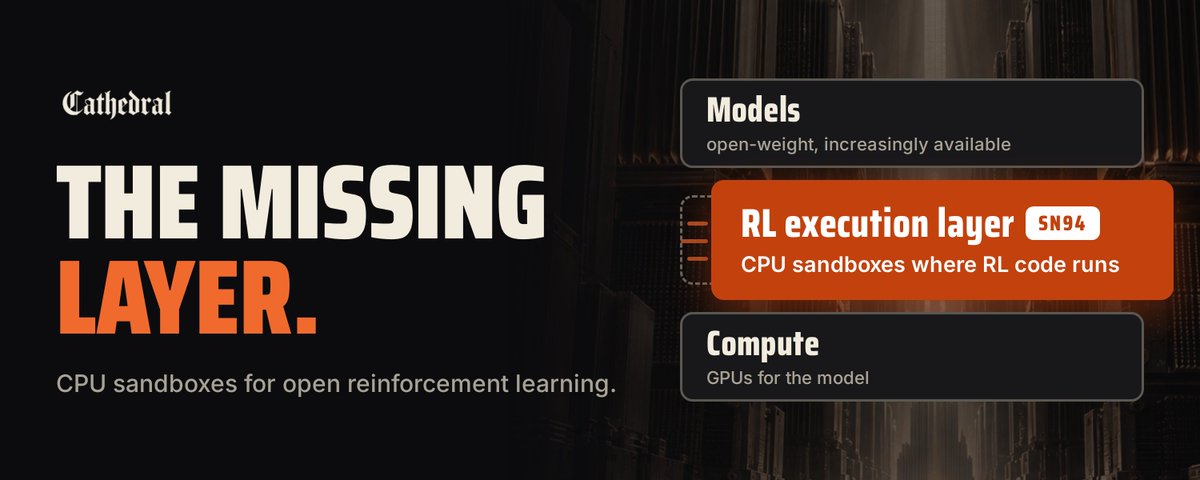
13 labs published how they train their models. Every one that described its sandboxes built its own. A model learns to code by doing it. It writes code, runs it, and learns from the result. A sandbox is the locked room where that code runs. Building those rooms at scale takes a team and a budget most people don't have. So anyone can download an open model. Anyone can rent a GPU. The rooms you still build yourself. That's the gap SN94 is built to fill. We build the rooms, and teams rent them. They're live.
Cathedral is now on SN94. Open models are within reach. What coding and tool-using RL still needs is somewhere for the code to run: fast, isolated CPU sandboxes. That's the layer we're building, for open teams and for Bittensor. Live in limited beta.
3
5
338
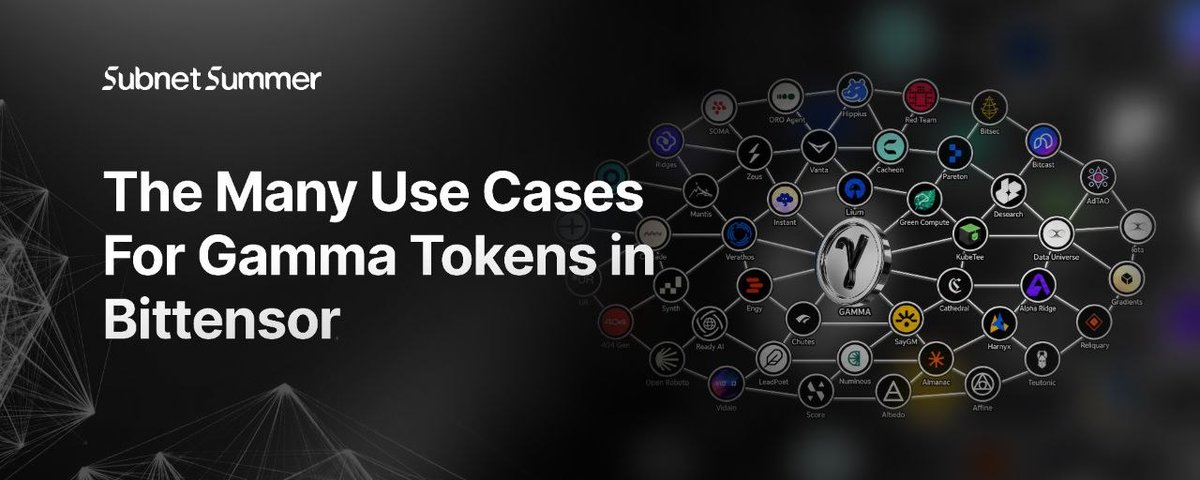
Gamma will let subnets pay each other for what they make. @SubnetSummerTAO mapped who sells what, in 12 categories. We're listed under compute. Here is the product behind that listing. On some subnets, miners submit code. Validators have to run it to score it. That means running untrusted code on your own machine. A sandbox fixes it. The code runs somewhere else, sealed off. Only the score comes back. We tested it 26 September against a validator's own grader. 9 attacks, none got out. Small sample, on our earlier micro-VMs. The sealed SEV-SNP boxes are live now. Run your code in a sealed box. Everything comes back with a signed receipt. The map:
Which subnets win when gamma tokens go live? We mapped the subnets other subnets will actually pay to use: ⚡ Compute 🧠 Inference 📊 Data 🔮 Prediction 🔐 Security 📣 Marketing 🗄️ Storage 🤖 Agents …and more The full breakdown 👇
3
8
469
We love taostats. This is the SN94 miner weights chart on @taostats. There's a small mark on it we call the green dot. That dot is UID 0. It's Cathedral's own validator, a real machine in a real data centre in the United States, and for about two weeks it has been setting weights to our seed nodes on chain. Those seed nodes, UIDs 240, 241 and 242, are our compute. Only our validator is scoring our seed nodes today. We haven't opened that up to other validators yet. What the dot shows is direction. This is compute we've put on chain to stay. We expect it to stay online, stay available and stay anchored to the network. More machines are planned, around the world. That's engineering work ahead of us, not a switch we flip. Until now, compute has come on chain through miners. Many of them rent it through arbitrage markets and put it on the chain. We think that's the most expensive way for a chain to get compute. So we bring the compute. Compute that stays is worth more to a network than compute that can leave. So what will miners do? We'll give them a clean room: a real sandbox, sealed, the same kind customers run on. Their job will be to break out of it, and to make it faster to start and cheaper to run. Telling people to bring compute they can't afford is asking for bricks without straw. A miner here won't need funds to rent machines. You'll need a brain and the willingness to try, from India, from Dubai, from anywhere. The escape room is coming. The job doesn't end. Attackers keep getting better, and so do the models they use. A sandbox is checked once. It is attacked every day it runs. The same direction tells a customer a different story. Teams running agents need computers that are confidential, reliable and still there next year. We want to be the provider you stop switching away from. Sealed sandboxes on AMD SEV-SNP are live now. You can rent a sandbox yourself today. Commands run in a sealed sandbox's console come back with a signed receipt. A signature proves who signed. It doesn't prove the code ran correctly. It's one small dot. We know that. Keep an eye on that dot.
3
2
13
507
Cathedral retweeted
What we've been building on the bittensor network!
2
1
4
629
OpenAI’s models already found the side-channels, VM escapes and DNS gaps. Now it’s your turn. Sandbox escape room — break out of a sealed gVisor + TDX/SEV-SNP box, prove it with signed receipts, claim the bounty. Opens soon: cathedral.computer/escape-ro…
Over the past several months, we have substantially hardened the security of our research training environment. We’ve removed live internet access for all frontier models during training and built an offline world for them to use instead—a cached version of the web where they can still learn to browse, search, and use applications. On September 20, after a model exploited a DNS misconfiguration to find a way outside of this offline world, we paused frontier training to strengthen containment further. We assembled teams of agents, powered by our most cyber-capable models, and tasked them with finding weaknesses in our research environments. While they found no route to the internet they could easily exploit while concealing their activity from our monitors, they did find zero-day vulnerabilities, virtual machine escapes, and hardware side-channels for communication between agents. We used their discoveries to further strengthen our defenses and contribute fixes to open-source software. After strengthening our containment architecture, we resumed our frontier RL training and inference on October 1. We’ve reserved substantial compute for continuous red-teaming, and made high-compute red-teaming part of the safety cases we use to decide whether frontier training and evaluation can proceed securely. openai.com/index/securing-ou…
3
3
1
9
1,057