






Pinned Tweet
Due to some missing links on the conference web pages, I uploaded my conference talk pdfs for 10 years. Time flies. speakerdeck.com/takahiro_har…
Takahiro Haruyama retweeted

haha, so apparently OpenAI are about to start training on your Daybreak Blue sessions, with no way to opt out.
Literally stealing people's private work, as they do it, is cartoonishly evil.
It also will presumably kill Daybreak usage by security researchers. Or at least, it should. The thing OAI have had to swear they are not doing to math researchers, they are now explicitly about to start doing to security researchers.
Yet another reminder of the importance of open models.
Takahiro Haruyama retweeted

LLMs are great at finding bugs, but so are fuzzers. @5aelo compared the vulnerabilities found in V8 by BigSleep, an agentic system, with those found by the Fuzzilli fuzzer.
projectzero.google/2026/10/f…


Takahiro Haruyama retweeted

To secure open-source software, we’re launching OSS Scanner.
We’ll use our frontier models to periodically scan opted-in open-source projects for vulnerabilities, at no cost. Our reports will provide a proof-of-concept, explanation, and suggested fix.
anthropic.com/research/launc…

Takahiro Haruyama retweeted

Thank you to @UnpromptedAU & @BSidesCbr for inviting me to speak. Being back down under was lovely! You can find the slides for my n-day automated pipeline talk here. I’m at OAIC this week if you want to chat about exploit dev in 2026 and beyond. beautiful.ai/player/-P2q0r-B…

Takahiro Haruyama retweeted

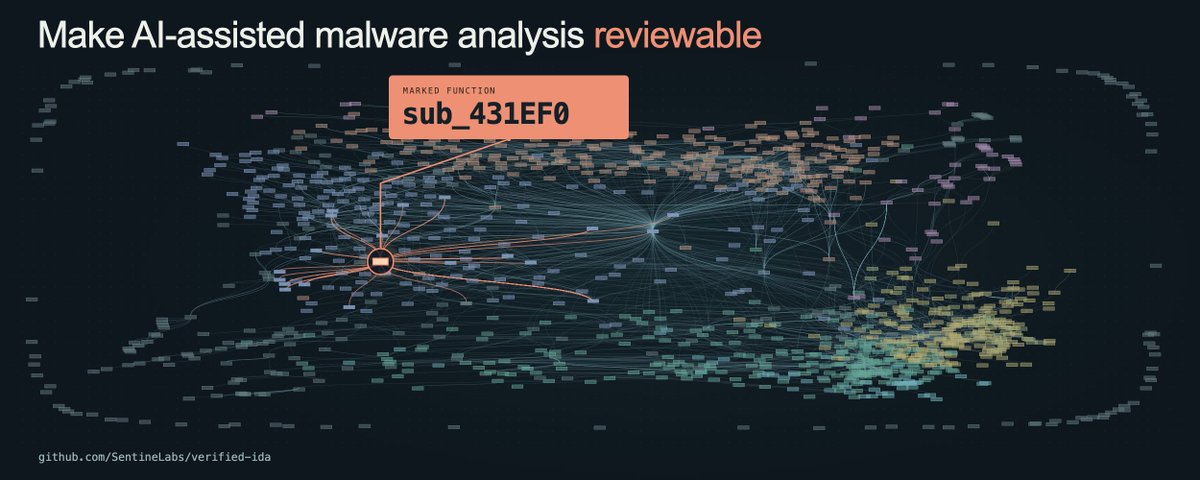
[1/6] Last week, @Gabeincognito and I presented at the very last @labscon_io on AI-assisted reverse engineering. Our work focuses on generating annotated disassembler databases (such as IDBs) as the output of LLM-driven analysis, instead of textual reports.

Takahiro Haruyama retweeted

Today I'm introducing two new open source IoT firmware analysis tools:
Moria and Mithril
Moria is a firmware extraction tool just like binwalk and unblob, except for one major difference: ZERO external extractor dependencies!
No more relying on ancient and unmaintained extraction utilities with numerous bugs / patches.
EVERY filesystem extractor has been rewritten in 1st party C++ to be fast and flexible.
Mithril is moria's companion. It scans extracted filesystems for secrets and SBOM. Correlates CVEs. Syncs with NVD, EPSS and KEV datasets.
Check out my blog post where I kick the tires:
brownfinesecurity.com/blog/i…

Takahiro Haruyama retweeted

Take a look at our latest research on DockerHub secrets exposure!
This time, we focused on high-value targets and we found credentials and API keys that could be used to compromise major enterprises and popular open-source projects. We also identified over 200,000 internet-exposed endpoints that used encryption with leaked private keys.
Finally, we demonstrated how fine-tuned LLMs can be used to perform automated triage of generic secret findings in a cost-effective and secure manner.
Blog: binarly.io/blog/docker-hub-s…
Advisories: github.com/binarly-io/Vulner…


In the era of software supply chain compromises, secrets hiding in public container images can create a direct path to source code, CI/CD, cloud infrastructure, private registries, and internal communications.
We scanned 90,000+ DockerHub namespaces and found 98,816 secret candidates, 199 valid credentials, and 25 security findings. We also linked exposed private keys to 200,000+ Internet-facing hosts.
For generic secrets that regex rules miss, we used teacher-student training to fine-tune an open-weight Gemma model, cutting analyst triage by ~85% while retaining 92.4% of positive findings.
binarly.io/blog/docker-hub-s…
Takahiro Haruyama retweeted

today, we @RevEng_AI released the next generation of our decompiler: Ventris
the new model comes with improved struct layout recovery, better PE support, and more.
on decbench, we beat all other available decompilers in structure recovery, and achieve #2 rank overall

I've shared the list of malicious models detected by MLTracer, along with a systematic analysis of techniques for evading existing model scanners, in the following GitHub repo.
github.com/binarly-io/ai-sup…
In short, the AI supply chain security field still likely has a lot of room for improvement.
🚨 Our research found that multiple major Hugging Face scanners missed more than 20% of malicious model files.
We systematized the 21 static-scanner evasion techniques behind these misses. Most of these were based on known techniques or concepts, highlighting an inherent limitation of static pattern matching: it is practically infeasible to cover every concrete malicious variant.
binarly.io/blog/malicious-mo…

Takahiro Haruyama retweeted
Very high quality and thorough technical work from @cci_forensics. Take a look at how a dynamic-based analysis can be used to identify malicious ML models.
🚨 Our research found that multiple major Hugging Face scanners missed more than 20% of malicious model files.
We systematized the 21 static-scanner evasion techniques behind these misses. Most of these were based on known techniques or concepts, highlighting an inherent limitation of static pattern matching: it is practically infeasible to cover every concrete malicious variant.
binarly.io/blog/malicious-mo…
Takahiro Haruyama retweeted

CVE-2026-34348 exploitation demo from my #BHUSA "Pass-the-Passkey Family of Attacks" talk: WebAuthn assertion from recent YubiKey authentication is extracted from Windows Event Log and replayed against Microsoft Entra ID using Passkey Injector.
Whitepaper: specterops.io/passkeys
Takahiro Haruyama retweeted
Another U-Boot Verified Boot bypass, this time in the SPL code!
Take a look at how we achieved arbitrary code execution on a real device running the latest OpenBMC build:
binarly.io/blog/signature-ve…
Patch is public:
github.com/u-boot/u-boot/com…

🚨 Arbitrary code execution in U-Boot SPL – even when Verified Boot enabled.
The SPL copies attacker-controlled FIT external data into RAM before it can verify the signature. We turned that into controlled arbitrary code execution, both in an emulated environment and on real hardware. We were not the first to report this vulnerability, but the full exploitation walkthrough is still worth sharing.
binarly.io/blog/signature-ve…
Takahiro Haruyama retweeted

AI is hacking the world, and UEFI firmware will not be left out.
I wrote about what happens when you pair LLMs with the right tooling (in this case, @VulHuntRE) and point them at real-world firmware. Turns out, they find vulnerabilities.
Give it a read if you're interested 👇
Can AI hack firmware? We gave frontier LLMs compiled UEFI modules and our VulHunt binary-analysis framework, and asked them to find vulnerabilities.
GPT-5.6 Sol and Claude Opus-5 hit perfect detection. Kimi K-3 matched them at 43% lower cost. Then we ran the pipeline on a real flagship laptop: 87 candidate vulnerabilities were found, 18 manually confirmed so far.
None of this came from the models alone. Firmware-specific context and binary-analysis tooling like VulHunt make the difference.
binarly.io/blog/uefi-vulnera…

Takahiro Haruyama retweeted
Can AI hack firmware? We gave frontier LLMs compiled UEFI modules and our VulHunt binary-analysis framework, and asked them to find vulnerabilities.
GPT-5.6 Sol and Claude Opus-5 hit perfect detection. Kimi K-3 matched them at 43% lower cost. Then we ran the pipeline on a real flagship laptop: 87 candidate vulnerabilities were found, 18 manually confirmed so far.
None of this came from the models alone. Firmware-specific context and binary-analysis tooling like VulHunt make the difference.
binarly.io/blog/uefi-vulnera…
Takahiro Haruyama retweeted

Static Devirtualization of Tencent VM. There are many others with similar results to ours, we have had the VM devirtualized for several months now. Others are posting full devirt bins, so we feel it is ok to release our research now.
back.engineering/blog/31/07/…

Takahiro Haruyama retweeted

I built a Binary Ninja diffing tool that lets you visualize differences directly in Binary Ninja, with support for multiple Intermediate Languages (ILs).
It uses Quarkslab's QBinDiff for the diffing engine, and getting started is as simple as dragging and dropping two binaries.


