

@ctaylor463
Account based inUnited States
About this account
- Account based in
- United States
- Connected via
- Web
Account-level information from X, not a live location or the device used for a specific post.
environmental economics, agriculture, climate, satellites, ancient dna, fiction. past @columbia, @areberkeley. asst prof at harvard @kennedy_school.
Cambridge, MA
Joined June 2017
- Tweets100
- Following554
- Followers1.1K
- Likes157



Charles Taylor retweeted

Analyzing the 1930s Great Plains Shelterbelt, a large-scale forestation program across the US Midwest, from Florian Grosset-Touba, @annapappp, and @ctaylor463 nber.org/papers/w35695

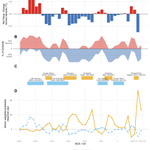
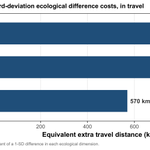
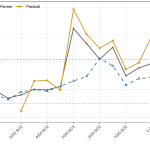
1/ What moved people before states, markets, or borders? We turn ancient DNA into a direct measure of prehistoric migration. When two ancient individuals share a long segment of inherited DNA (identity-by-descent, IBD), they share a recent ancestor, so someone in that lineage moved between their burial sites. Counting these links between places, and dating them, gives a directional map of migration across 10,000 years of western Eurasia.


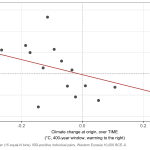
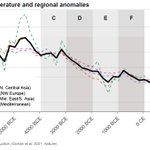
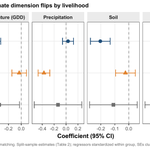
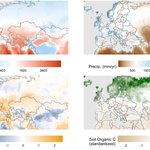
Using ancient DNA data to measure migration over the past 10,000 years shows that human mobility followed climate corridors and migration acted as adaptation to climate change, from Peter Huybers, Marco Tabellini, @ctaylor463, and Francesco Toti nber.org/papers/w35371

9/ People even migrated to stay in their climate. When home warmed, later generations tended to settle somewhere cooler, partly offsetting the shift. Migration kept their environment roughly constant as the climate moved underfoot.

10/ Finally, suggestive signs migrants reshaped where they landed. Using fossil pollen records, we find that destinations that drew migrants from a given origin saw vegetation drift toward that origin's, with cereals rising under farmers and the tree–grass balance shifting. Movement may have nudged ecology, not just followed it. [drive.google.com/file/d/1GeE…]

Charles Taylor retweeted

Very much enjoyed moderating last night’s panel discussion on the topic of “Frontiers in Climate-Economics Research: Dynamics, Uncertainty, and Policy Implications,” featuring Charles Taylor (Harvard Kennedy School), James Rising (University of Delaware), and Olivier David Zerbib (CREST, ENSAE, Institut Polytechnique de Paris).
The conversation covered a broad range of important issues and the panelists brought perspectives that were distinct yet complementary, which made for an engaging discussion and no doubt a valuable one for our @MFRProgram Modeling Climate-Economic Dynamics workshop participants and the young scholars in attendance. #EconTwitter #ClimateEconomics #ClimateDynamics #ClimateUncertainty #ClimateChange – at Chicago, IL


I started this paper early in grad school after staring at a map of global irrigation. Irrigated land roughly doubled since 1960 — but unevenly: India and China saw huge gains, while the western US, parts of Europe, and the former USSR lost ground. What explains the variation?


ALT Data from Siebert et al. (2010)

📢 Just accepted in #JAERE! 📢
"Irrigation and Climate Change: Long-run Adaptation and its Externalities" by Charles A. Taylor (@ctaylor463).
📖 Read it here: buff.ly/nVW6zqn

Using soil/sediment thickness as a proxy for groundwater potential, I find drying raises irrigation only where water is reachable below. Recent climate drying explains up to 8% of global irrigation growth since 1960 — a pattern that holds both worldwide and across US counties.

ALT Global soil and sedimentary deposit thickness (Pelletier et al., 2016)
But adaptation carries a cost. Where irrigation expands, aquifer levels drop and soils grow saltier — both visible from satellite. Adapting to climate change today can erode the future resource base [drive.google.com/file/d/12dx…]


ALT Gravity Recovery and Climate Experiment (GRACE) satellite (NASA)
Cool funding opportunity for climate adaptation research from the great folks at Stanford

Charles Taylor retweeted

This year's Bozeman Applied Micro Conference is June 16-17, 2025
Paper submissions open now through March 7 -- see below for link

We're having our annual Bozeman Applied Micro Conference this summer! Dates are selected: June 12-13. Website up, and submissions will be open soon!
montana.edu/econ/summerconfe…
Photo from last year!
