

Prof at @DukeFuqua. Studying how crisis R&D, science & tech policy, automation affect firms & economies. Often seeing past as prologue. https://nitter.cf/t.co/XaRIkkC5wF
Durham, NC
Joined June 2013
- Tweets772
- Following392
- Followers1.7K
- Likes1.2K



Daniel P. Gross retweeted

On bottlenecks: 1) economists have been exactly right about little extra growth despite very fast tech change. They thought a group of econs I organized were crazy >2 yrs ago at the AI labs when we said "1pp extra growth/yr through 2030". 2) bottlenecks *still* not understood 1/8
Daniel P. Gross retweeted

Take from the trenches:
AI produces amazing "improve this paper" feedback.
Its judgment about big-picture "what matters and why" is currently, imho, terrible.
That’s why @RefineDotInk focuses on making the argument better, not deciding whether the study is worthwhile.
1/

New paper: "AI Article Reviews Dominate Human Peer Reviews at Their Best: Evidence and Policy Choices" See: GaryKing.org/peerless. with Steven Worthington. Comments welcome!

This. It shouldn't be surprising, but it's clearly visible at a much more granular level now.
@NSF, in particular, plays a *huge* role in the training ecosystem across all STEM disciplines.

Out today at Research Policy, with @DShvadron, Lee Fleming, and @HansenZhang13, "Measuring the production of scientific human capital: New data, methods, and evidence on the U.S. scientific training ecosystem."
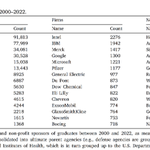
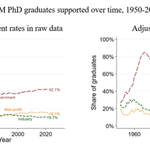
We parsed acknowledgements from 1.2M US STEM dissertations since 1950 to get the most detailed reading yet possible on who funds PhD training, down to specific firms or funding agencies and offices (hint: overwhelmingly it's federal agencies, but philanthropies and firms also important at certain times, fields, or programs), who is funding PhDs in critical & emerging tech areas (CETs) which are national priorities + where they're getting trained, and provide evidence of crowd-in from federal support.
Link: sciencedirect.com/science/ar…
(Ungated: dpgross.com/papers/measuring…)
Hard to escape the massive role the USG plays in supporting the training of the future scientific workforce, which is clear in these data. And the level of support is for various reasons probably underreported already---so this is just a lower bound.
This is the starting point for a broader agenda on renewed measurement of the US PhD population. More to come--incl. detailed evidence on international mobility (coming soon), rapidly growing use of AI in dissertation writing (posted), reporting of the graduates different US fed agencies have supported and what they're doing now (in the hopper), and more.
Huge credit to Dror and Hansen for cracking the technology needed to make this possible!


Daniel P. Gross retweeted
Econ of science folks - this position via FAS is really interesting if you want policy impact. Essentially, it's a metascience/econ of science position embedded quite high up at places like DOE. They allocate *billions* to R&D, w/ big changes due to AI/Genesis/OSTP doc/etc.

Very much enjoyed this synthesis of a range of historical examples of large-scale automation and a recent surge in analyses of their impacts using modern methods. Especially liked the quotes from contemporary economists of a century ago and the digging into reporting of that era - many of which read shockingly similarly to the concerns of today!
Happy to see the telephone operator case covered (@jamesfeigenbaum) but more exciting to see attention flowing to other insightful cases like bootmakers (@hillaryvipond), teamsters (@lang_econ), and others (@brunocaprettini, @benmschneider).
Thanks for engaging with the theme and bringing it to the masses @bencasselman!

Like every other econ reporter, I've spent much of the past couple years trying to understand what A.I. will mean for the economy and for workers. But it's been frustratingly hard to reach any firm conclusions, because so much is uncertain -- how the technology will evolve, how quickly it will be adopted, how policymakers will respond.
Not just economics: almost 30% of STEM PhD dissertations now have AI-generated abstracts.
To me that's pretty startling. These are 300-1000 word summaries of someone's work, and AI writing there predicts more AI writing in the body.
We just updated this paper with info we've collected on AI disclosure and universities' AI policies too. Almost nobody discloses their AI writing (that we can detect through targeted searches of dissertations' full text) unless their university makes it part of the dissertation template, and only 25% of R1's have a policy we can find that governs AI writing in dissertations specifically.
NBER draft:
nber.org/papers/w35859
Updated (and ungated) copy here:
dpgross.com/in-progress/PHDA…


Around the corner!
If you want to be a top scholar in innovation strategy or innovation economics, Fuqua is THE place to be.
Join our info session on Thursday morning (Oct 22, 9am ET) to see what your oppty's could be. And please share!
Register here:
go.fuqua.duke.edu/spa/phd/st…

📚 PhD application season is around the corner!
On Thu, October 22 I'll be hosting an information session on @DukeFuqua's Strategy PhD program.
Please spread the word to anyone you know considering a PhD in strategy, economics, or related fields interested in the study of innovation and entrepreneurship.
Our faculty include several of the top scholars in the world in innovation and entrepreneurship-related themes, and we typically focus our admissions on applicants with these interests. Recent grads have placed at top U.S. and international business schools including @Wharton, @UofT, @NYUStern, and others.
In the info session I’ll give folks a quick overview of our program, offer tips, and take Q&A.
Sign up here! And please re-post!!
go.fuqua.duke.edu/spa/phd/st…
Daniel P. Gross retweeted

Nearly one-third of US STEM PhD students now write their dissertations with AI. Rarer at top programs, more common for non-native English speakers. AI users are more likely to enter industry, from @daniel_p_gross, @DShvadron, and @HansenZhang13 nber.org/papers/w35859

📚 PhD application season is around the corner!
On Thu, October 22 I'll be hosting an information session on @DukeFuqua's Strategy PhD program.
Please spread the word to anyone you know considering a PhD in strategy, economics, or related fields interested in the study of innovation and entrepreneurship.
Our faculty include several of the top scholars in the world in innovation and entrepreneurship-related themes, and we typically focus our admissions on applicants with these interests. Recent grads have placed at top U.S. and international business schools including @Wharton, @UofT, @NYUStern, and others.
In the info session I’ll give folks a quick overview of our program, offer tips, and take Q&A.
Sign up here! And please re-post!!
go.fuqua.duke.edu/spa/phd/st…
Daniel P. Gross retweeted

Also, I’m still hung up on the type of problems these tools seem to be good at: 1. Well-posed, 2. Structured, 3. Verifiable. When presenting our AlphaFold paper, I often used solving math proofs as a similar “AI-shaped” problem. Most other domains of science are not that
Daniel P. Gross retweeted
In both cases, humans should get a ton of credit! We invented LLMs. We did centuries of math by hand to facilitate this progress. We developed rudimentary algorithms to understand protein structure, and spent billions of dollars to generate experimental data to train them.
This is an outstanding thread providing perspective on the flood of new @OpenAI produced proofs and AI in science more broadly.
I agree with most of what's written here - thanks for putting the words on digital paper @RyanReedHill.

Daniel P. Gross retweeted
🚨 The NBER I3 Fellowship is now taking proposals!
**Outstanding oppty for PhD students in economics and adjacent fields working on innovation studies.**
Pros: Funds + networking, mentorship, opportunities to attend & present your work at NBER confs.
Cons: None!
Main expectations are that (i) you develop a new public data product and (ii) you join us at the December NBER meeting to share your progress.
Proposals must be submitted by Nov 1, 2026 using this Google form: docs.google.com/forms/d/e/1F…
Please share w/ students and colleagues!


i3 Open Data Fellows Program - 2027
The NBER Innovation Information Initiative (i3), a data collaborative for open innovation data and related analytics, tools, and metrics, will run the fourth cohort of Open Data Fellows.
The i3 will award five or more fellowships of $1500 each to graduate students in economics, innovation, entrepreneurship, or related fields. The fellowships aim to broaden the range of datasets, tools and documentation accessible to the research community, support a new generation of researchers in producing and sharing high-quality, reusable research data and code, and provide a network of support for these researchers, including through opportunities available to current and former fellows to attend and present this work at future NBER conferences.
Specifically, i3 fellowships will support students to contribute new datasets, tools, code, and/or metadata to the innovation research community. These contributions may come in the form either of a new project, or an existing project under development. We intend for this program to include a diversity of work. Our primary requirement is that your project is developed with the intention of public dissemination in mind.
The fellowships will run from January to December 2027. Fellows are expected to present their project at the end of the fellowship period at the annual i3 Technical Working Group meeting in December 2027. The program is intended to be supportive, collaborative, and not a major time commitment, with periodic one-on-one and group meetings to share progress and provide guidance.
This call is open to current graduate (Masters or PhD) students or those who graduated in the past six months. International applicants, including those on US student visas, may have specific considerations that could affect the payment process. We recommend consulting your international student office prior to applying to determine your eligibility to receive fellowship stipend payments and travel reimbursement from the NBER.
Please submit your proposal using this Google form (docs.google.com/forms/d/e/1F…) by November 1st, 2026.
We will announce the selected fellows in November, and fellows will be invited to attend this year’s i3 Technical Working Group meeting December 4-5, 2026.
Convergence!
Our goal here was to corral some data we'd collected in concurrent projects into a set of results that will make clear how much PhD students are writing with AI, who's doing it, what the trends are, and elevate questions around what are the essential skills of a PhD grad, potential degradation of expertise (an open question!), and the future of scientific training...
These are questions that a majority of other faculty I talk to are very concerned about.
@DShvadron @HansenZhang13 will post a thread on this short paper soon.
@cremieuxrecueil I'll DM you


🚨 The NBER I3 Fellowship is now taking proposals!
**Outstanding oppty for PhD students in economics and adjacent fields working on innovation studies.**
Pros: Funds + networking, mentorship, opportunities to attend & present your work at NBER confs.
Cons: None!
Main expectations are that (i) you develop a new public data product and (ii) you join us at the December NBER meeting to share your progress.
Proposals must be submitted by Nov 1, 2026 using this Google form: docs.google.com/forms/d/e/1F…
Please share w/ students and colleagues!
i3 Open Data Fellows Program - 2027
The NBER Innovation Information Initiative (i3), a data collaborative for open innovation data and related analytics, tools, and metrics, will run the fourth cohort of Open Data Fellows.
The i3 will award five or more fellowships of $1500 each to graduate students in economics, innovation, entrepreneurship, or related fields. The fellowships aim to broaden the range of datasets, tools and documentation accessible to the research community, support a new generation of researchers in producing and sharing high-quality, reusable research data and code, and provide a network of support for these researchers, including through opportunities available to current and former fellows to attend and present this work at future NBER conferences.
Specifically, i3 fellowships will support students to contribute new datasets, tools, code, and/or metadata to the innovation research community. These contributions may come in the form either of a new project, or an existing project under development. We intend for this program to include a diversity of work. Our primary requirement is that your project is developed with the intention of public dissemination in mind.
The fellowships will run from January to December 2027. Fellows are expected to present their project at the end of the fellowship period at the annual i3 Technical Working Group meeting in December 2027. The program is intended to be supportive, collaborative, and not a major time commitment, with periodic one-on-one and group meetings to share progress and provide guidance.
This call is open to current graduate (Masters or PhD) students or those who graduated in the past six months. International applicants, including those on US student visas, may have specific considerations that could affect the payment process. We recommend consulting your international student office prior to applying to determine your eligibility to receive fellowship stipend payments and travel reimbursement from the NBER.
Please submit your proposal using this Google form (docs.google.com/forms/d/e/1F…) by November 1st, 2026.
We will announce the selected fellows in November, and fellows will be invited to attend this year’s i3 Technical Working Group meeting December 4-5, 2026.
Everywhere Millionaire = one of the books of the year. Good stuff in here for entrepreneurs, managers, academics, policymakers, anyone else. Hard to miss the outstanding reception it's gotten in business/popular press. I'll be highlighting it to my MBA students for starters.

Hi Friends,
Thanks for all the support for the Everywhere Millionaire. Based on bookscan sales data, it looks like we are right on the bubble of the best seller list in business for September, so if you could pick up a copy at a local bookstore *in the next few days*, suggest the book to friends, retweet this message, or post about it - we’d greatly appreciate it!
bookshop.org/p/books/the-eve…

🚨 Last call to submit for NBER's annual innovation data workshop. Please get your work in and spread the word!
Novel data are now more important than ever, especially for studying innovation. We're seeking work which will push this frontier. Come join us.
conference.nber.org/confsubm…
Friendly reminder to submit to the next meeting of the NBER Innovation Information Initiative (I3) Technical Working Group will be held on December 4 and 5, 2026 immediately following the NBER Place-Based Policies and Entrepreneurship meeting.
There will be an in-person meeting in Cambridge, MA along with a virtual component on Zoom for those who are unable or choose not to attend in person. Presenters are encouraged to attend in-person.
This meeting is supported by the Alfred P. Sloan Foundation.
The aim of I3 is to support the production and dissemination of open data for research on innovation, science, entrepreneurship, and related fields. The Technical Working Group will feature "deep dive" presentations of novel datasets or research tools (including efforts in progress that would benefit from community feedback or collaboration) that are or will be made openly available.
We are primarily interested in presentations on new data and tools rather than research findings. Please submit either (a) an extended abstract of five pages or less describing the new dataset or tool you propose to present, its potential value to the research community, and your plans for public dissemination, or (b) a research paper that fully describes data construction (or has a comprehensive data appendix) along with a short cover note describing the value of the dataset (or tool) to the research community, what you would focus on in your presentation, and your plans for dissemination.
If you have a paper you would like considered for presentation, please upload it here lnkd.in/d4xiayQz by 11:59 pm EST on September 23, 2026.
On behalf of the i3 Steering Committee (@inaganguli @daniel_p_gross @DShvadron @Econtoole @metasj)
It seems fitting that this lands during the 4th @OECD Blue Sky Forum, the once-a-decade gathering on measuring science, themed this year on "Better data for policies and better policies for data".
We think there's significant potential in dissertation science for future workforce capability measurement.
Link: event.fourwaves.com/oecdblue…
Tagging a few I know on the agenda...
@DietmarHarhoff @dashunwang @gderasse @JMateosGarcia

🚨 Forthcoming at Research Policy: "Measuring the Production of Scientific Human Capital: New Data, Methods, and Evidence"
Every PhD leaves behind one common artifact: a dissertation. We read 1.2 million US STEM PhD dissertations from 1950-2022 and use them to measure new features of the US scientific training ecosystem.
Want to know where expertise is embodied? Who's training grads in critical technology-related science? Who's providing the funding?
This is just the start of what one can do.
Details below 🧵
joint w/ @DShvadron, @HansenZhang13 & Lee Fleming

There is a European author team developing similar data for European graduates. See the Doc-Track project here: doc-track.eu/
@CataB_Martinez @alb_corsini @michelepezzoni @morrisonXandrea @emiguelez @visentinf79