

Boring Computer Use for legacy systems | CEO of @IlmenAI (Techstars ’24, Xoogler, ex-Microsoft) EB1-A Gateway between old systems and Super Intelligence.
San Mateo, CA
Joined May 2008
- Tweets13.8K
- Following3.4K
- Followers1.9K
- Likes39.5K




Daniel Kornev retweeted

This is fire!
Nace is open-sourcing Drex Max, their 27B multimodal decision model.
It runs 100% locally on Apple Silicon (M4 & M5).
Drex Max takes text and images. It has a 262K context window.
I've been using Drex Max for research, so this open one is ideal for my local research agents.
🤝 Paid partnership

We’re open-sourcing Drex-Max v1
The most capable Multimodal Decision Model !
And yes: it runs 100% locally on Apple Silicon (M4 & M5)
Enjoy Building with Nace!
Cloud Inference: console.nace.ai/
Local Inference: huggingface.co/nace-ai/drex-…

Daniel Kornev retweeted

We could increase global GDP by 2% just by installing large whiteboards in every home.


Just bought georgemack.com
If you only write on social media, you end up with social media thoughts. So I'm going to write more essays, so I end up with more essay thoughts.
In the era of infinite slop, quality > quantity.

Daniel Kornev retweeted

New work on Training Foundation Models with a Single Algorithm:
Paper: arxiv.org/abs/2610.40564
Code, Models: yudasong.github.io/unified-t…
This work introduces Unified Training, a framework that unifies pretraining, midtraining, supervised fine-tuning and RL under a single maximum-likelihood objective. Building on MaxRL, it enables static data and RL-generated data to be trained together within the same system.
Empirically, Unified Training improves accuracy and compute efficiency, generalizes better to harder reasoning problems, and reduces forgetting.
Interestingly, reusing data across training stages can improve performance even when conventional staged training fails. It also produces models that adapt more effectively to new tasks, leading to stronger continual learning.
See an excellent thread by @yus167.


Daniel Kornev retweeted

Still hanging out with just Earthlings? 😏🔴 Join the Mars Society's #Facebook Group and connect with people who think one planet simply isn’t enough. facebook.com/groups/TheMarsS… #mars #science #spaceadvocacy #marsexploration #policy #publicdebate

Daniel Kornev retweeted

The bottlenecks in AI are moving beyond the models.
We’re excited about startups building the hardware, infra, financial systems, and specialized software to bring AI into the real economy, from factories and data centers to government and space.
ycombinator.com/rfs

Daniel Kornev retweeted

Introducing Flint, @Recursive_SI’s first model: a fast local coding model built with our automated research system, the Eureka Machine.
• Best-in-class fast local coding
• Up to 2x faster than comparable models: 125+ tokens/sec on a MacBook Pro, 150+ on RTX Spark
• Built from scratch in under 4 months
Private, unmetered intelligence on your own machine. Open weights available now on @huggingface, run it locally on your favorite framework or try it for free on @opencode or @pidotdev.
Daniel Kornev retweeted

Windows 11 Copilot+ PCs are set to gain new on-device AI capabilities in the coming months, as announced at Microsoft's Windows event a couple weeks back.
windowscentral.com/microsoft…
Exclusive to Copilot+ PCs, Copilot will be able to understand context, take action, and lean on local AI models without always reaching out to the cloud, though it will still be able to do so when necessary.
I think this is Microsoft's natural evolution of Copilot+ PCs. It's been a while since Microsoft last built any experiences that lean on the NPU, and it sounds like Hybrid Intelligence inside Copilot will be the first set of AI features to do this (at least in part) in over a year.
We already know that Microsoft is slowly moving away from Copilot+ PC as a marketing brand, and that makes me wonder if "Hybrid intelligence" is the new "AI PC" identity that Microsoft wants to get in front of buyers looking for their next PC.

Daniel Kornev retweeted

Hardware Partner Spotlight: NVIDIA joins The @Google Gemma Hardware Hackathon @ AGI House!
Build with Gemma. Run it locally on @NVIDIARobotics Jetson. Bring your next edge or physical AI idea to life.
On October 24, join 100 selected builders, the @GoogleDeepMind Gemma team, and hardware partners for a full day of hands-on building—from camera assistants and intelligent edge devices to robotics applications.
🤖 NVIDIA hardware available to borrow during the hackathon:
• 15 Jetson Orin Nano Super developer kits, each with an NVMe SSD
• 15 Jetson Thor developer kits
These kits are available for on-site development and must be returned after the event. Availability is limited.
🏆NVIDIA hardware awards are also in the works—stay tuned for the final prize details.
Every project must use a Gemma-based model and run entirely on-device. Bring your laptop, your ideas, and your robot if you have one.
Compete for a share of $45,000 in cash prizes, plus partner hardware awards.
📅 Saturday, October 24, 2026 · 10 AM–5 PM PT
📍AGI House · Hillsborough, CA
Hosted by Google DeepMind and AGI House
Apply to build → agihouse.org/events/the-goog…
#Gemma #NVIDIA #Jetson #EdgeAI #PhysicalAI #AGIHouse

Daniel Kornev retweeted

Patrolling the Mojave isn't the only thing making us wish today. Happy 16th birthday, #Fallout: New Vegas!
Join us, @Obsidian and Victor in celebrating Couriers who just won't stay buried 🤠

ALT An image from Fallout: New Vegas showing dialogue with Victor wearing a party hat outside the Prospector Saloon. Dialogue options read: Happy 16th birthday, Victor! [Old World Gourmet] Stuff face with birthday cake [Wild Wasteland] Roughly how many times have you dug me out of the grave by now?
Daniel Kornev retweeted

new paper from USC, UC Irvine and Intel Labs on reusing a small model's prefill inside a big one: the small model reads the prompt, a linear map translates its KV cache into the big model's format, and the big model recomputes only part of the positions
Qwen3-0.6B prefilling for Qwen3-14B (23x apart in size) with 30% of positions recomputed: GSM8K goes from 71.6% with the map alone to 90.2%, against 95.1% for the 14B on its own, and prefill runs up to 3.04x faster
the map alone can leave the big model worse off than the small one: Llama 3.1 8B into Llama 3.3 70B scores 81.0%, below the 8B by itself (82.7%), and recomputing 40% of positions brings it to 92.0%
section 2.2 is worth reading on its own: choosing which positions to recompute by attention score does worse than choosing at random, because the 14B puts 72% of its attention on the start token and 24% on the chat template and instruction, which leaves 4% for the actual question (at a 20% budget the attention-based selector doesn't pick a single question token)
so attention weight mostly tells you where the sink and the template are
arxiv.org/abs/2610.11358


Daniel Kornev retweeted

You can’t automate what you can’t measure. This means that evals are one of the gates to diffusion of AI in the enterprise.
We can test our deterministic processes through software, but most enterprises have no useful way of understanding how their non-deterministic processes are working today. Specifically the work that agents are doing for them.
Evals are mission critical for enterprises adopting AI because you have no other way of knowing what’s working, what’s broken, what changed, what improved, what you can do more of, etc. if you don’t have a good sense of how agents work in your environment today. All changes, upgrades, and deployments are downstream from good evals.
Not only are we going to get vastly more domain specific evals over time for the labs and across the industry, but every enterprise will also need a clear sense of how agents are performing in their environment as well. Huge opportunity.

Just spoke to one of the big data labeling businesses.
Few interesting insights:
- They predict the majority of their revenue will come from Fortune 1000 enterprises, not labs in a few years
- They believe every company will want to own their intelligence, but owning intelligence does not necessarily mean using open source models
- A company’s evals will become their main proprietary IP given the improvement in agent performance after properly setting up & running internal eval environments
- Most enterprises haven’t graduated from coding agents and it’s largely due to not having the proper eval infrastructure to make non-Eng agents performant
Daniel Kornev retweeted

2022: the ChatGPT shock
Generative AI
LLM
Hallucination
Chatbot
Prompt engineering
Diffusion / Stable Diffusion / Midjourney
RLHF
2023: the tooling and fear year
GPT-4
Multimodal
Foundation model
Fine-tuning
Open-source LLMs (Llama)
Plugins and Custom GPTs
Copilot
Embeddings and vector database
RAG
Context window
Jailbreak
AI alignment / AI safety / AGI
Deepfake
2024: from chat to reasoning
RAG (peak hype)
Function calling / tool use
Small language models
Long context (1M tokens)
Text-to-video (Sora)
Chain-of-thought
Reasoning models (o1)
Test-time compute
Synthetic data
AI slop
Computer use
MCP (Model Context Protocol, launched in November)
Evals
2025: the agent year
Agentic AI / AI agents
MCP going mainstream
Vibe coding
DeepSeek moment and distillation
Context engineering
Deep research
Agentic coding (Claude Code and similar)
Sub-agents and multi-agent systems
Agent skills
A2A
Agent memory
Sycophancy
Spec-driven development
World models
AI bubble
2026: harness and beyond
Agent harness / harness engineering
System One models / Jev
the buzzwords moved from the model itself (LLM, hallucination), to how you talk to it (prompt engineering), to what you feed it (RAG, context engineering), to what it does (agents, MCP), to the system around it (harness).
Jev now questions whether every decision needs a chat-style LLM at all.
Daniel Kornev retweeted
Check out the preliminary program itinerary for the 2026 International Mars Society Convention (Oct. 22-24) at @USC. Three packed days of Mars science, exploration, technology & the future of human settlement. Start mapping out your convention today! 🔴 convention.marssociety.org

Daniel Kornev retweeted
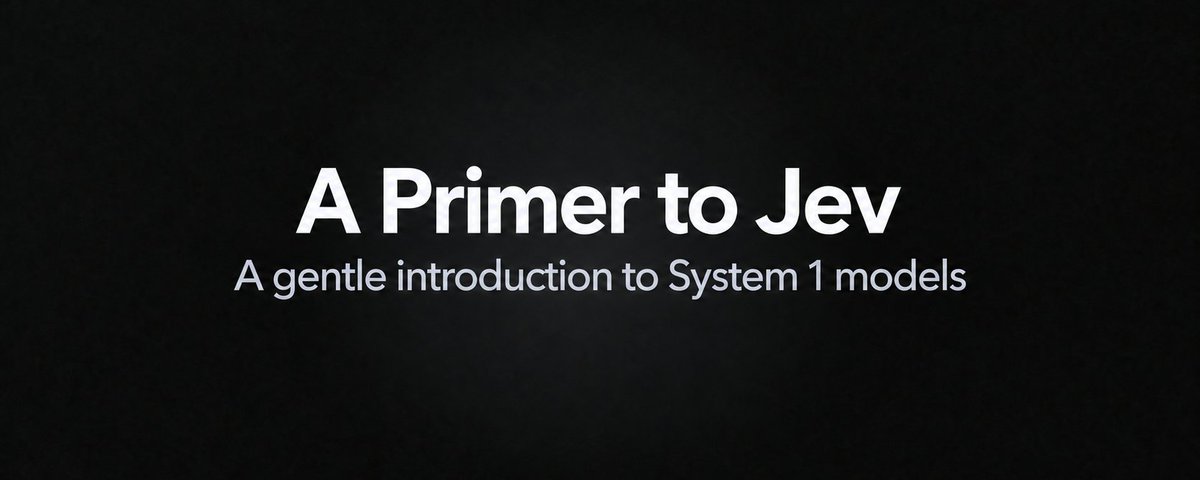
🔥 Introducing a Jev Primer & Playground
If you want to learn how Jev works, look no further.
This is the only interactive guide you need to get started.
No more confusion about what Jev can and cannot do. Plus we built a custom Jev Playground for you try out use cases now.

Daniel Kornev retweeted
Learn to build a harness, folks.
It's not surprising to me that so many YC builders want to build domain-specific harnesses.
If you work long enough on a domain-specific problem, you quickly realize the opportunity. But you also realize how important that harness will be to stay competitive in the agentic era.
From a product perspective, harnesses open up interesting new surface areas and experiences for the services/products you provide.
From a technical perspective, harnesses are how you build and maintain a framework and set of best practices for how your users/customers interact with what you offer.
Understanding how to build and design a harness means you can build much stronger intelligence stacks, given that you can customize it and understand the domain well. That's extremely valuable. It may not seem apparent yet, but a harness wave is coming.
If you are getting started, give this list of harness papers to your agents and start upskilling: academy.dair.ai/papers/colle…
If you are already a builder, try building one for your specific domain. It's a lot of fun, and you learn a lot of interesting things to enhance your current agentic tools.

Daniel Kornev retweeted

This is going to be one of my favourite early-stage investments 😊
I met Sasha Malysheva in San Francisco a couple of years ago – through mutual friends at OpenAI. A couple of hours later, I realised I’d actually seen her before – when we were both kids, attending the same humanities-oriented Gymnasium in St. Petersburg, a few years apart. That alone was already a little unusual. Not many kids there were particularly technical.
Later I discovered that she also went to the same deeply technical high school I would occasionally attend, and then studied at the same university as I did – again, a couple of years later.
She eventually ended up at JetBrains, which for years was everyone’s favourite place for programming meetups in St. Petersburg. Whenever I came back from my travels, one of the first things I’d check was whether JetBrains was hosting anything interesting. You’d think the coincidences would stop there, but somehow she also ended up calling Armenia home for a while… At some point, the number of coincidences became statistically suspicious 😅
But the much better reason to invest is what Sasha and the Mostik AI team are actually working on.
Their research direction around latent representations is especially interesting to me given our own work on Unum's UForm models. So when the opportunity came to back them through AAL, there really wasn’t much deliberation involved.
Cherry on top: they’ve just taken first place on ARC-AGI-3 leaderboard, they have a Fields Medalist as a Chief Scientist, and possibly one of the cutest names among the emerging Neolabs – mostik.ai ☺️
Very happy to be backing Sasha and the Mostik team through @aal_vc, together with @stepa and @EugeneMkhlv!


meet @mostik_ai!
what happens when you put 12 PhDs in one room for four months? first place on the ARC-AGI leaderboard, which I can't say much about while the competition is still running. and this, which I can.
everyone's arguing about whether open models will catch up to frontier models. we think it's the wrong question. here's the one we pose: why does a frontier model have to generate your answer at all, when the only thing you need from it is the reasoning?
we do this by enabling models to communicate in latent space. through our protocol, hidden states pass straight from a frontier model into a small one running on your infrastructure -- no text between them, and neither model is fine-tuned. two models from different families, sharing reasoning, both left untouched.
how do we know it works? we tested it on a setup where a 753B model reads the problem, and a 4B edge-class model writes the answer. with this approach, we get results 80% as accurate as the frontier model, but at 20x faster performance.
we're committed to preventing frontier model lock-in and are already partnering with inference providers to accelerate open-weight adoption. we've done this between 15 of us, in four months, 12 PhDs and a Fields medalist, backed by @generalcatalyst
WIRED has the first external account of the company and the work: wired.com/story/russian-star…
full writeup, the setup, and all the numbers: mostik.ai/read-more

Daniel Kornev retweeted

Everyone's suddenly building company brains.
Nobody agrees on what's inside one. 😵💫
So we opened up 9+ company brains to see how they're actually built.
Every single one does the same four things: getting signals, remembering, dreaming & pruning, speaking & searching.
𝟭. 𝗚𝗕𝗿𝗮𝗶𝗻
Garry Tan's open-source personal brain. Your email and calendar flow into a git repo, and a nightly job re-links everything and flags what's gone stale.
𝟮. 𝗺𝗲𝗺𝟬
A memory library you call from your own code. It only stores what you explicitly tell it to, and ranks fresh facts above idle ones at search time.
𝟯. 𝗟𝗲𝘁𝘁𝗮
For building agents that remember across sessions. The agent decides what's worth keeping, and a second agent tidies up its memory in the background.
𝟰. 𝗭𝗲𝗽 / 𝗚𝗿𝗮𝗽𝗵𝗶𝘁𝗶
A knowledge graph with a clock in it. When a fact changes, the old one gets an end date instead of being overwritten, so you can still ask what was true last March.
𝟱. 𝗦𝘆𝗹𝗽𝗵
A content brain that lives entirely in a git repo. Agents write drafts, humans publish, and afterwards the agent reads your edits to learn what it got wrong.
𝟲. 𝗗𝗜𝗬 (𝗖𝗹𝗮𝘂𝗱𝗲 𝗖𝗼𝗱𝗲 + 𝗴𝗶𝘁)
What most engineering teams actually do. Markdown in the repo, grep instead of search, and pull requests as the only thing keeping it honest.
𝟳. 𝗣𝗹𝗲𝘁𝗼𝗿
A brand brain for marketing teams. Campaigns, assets and performance data in one tree, and the brand rules only move when a human signs off.
𝟴. 𝗚𝗼𝗿𝗴𝗶𝗮𝘀 𝗖𝗼𝗿𝘁𝗲𝘅
Built in-house by an eight-person AI team. 12,000 markdown nodes in GitHub, and every night the questions it got wrong become PRs that fix it.
𝟵. 𝗦𝗹𝗶𝘁𝗲 𝗔𝗴𝗲𝗻𝘁
For teams whose knowledge lives in docs and across sources. It watches ~20 connected tools (Slack, Drive, GitHub, Jira, etc.) for what's gone stale and sends the diff to whoever owns the page. Nothing changes without human approval.
We just launched an interactive ebook with architecture notes from real 149 teams of builders and users, interview insights, and the complete research.
The ebook is free, get it here: slite.com/ebooks/company-bra…
Which brain would you pick? 🧠

Daniel Kornev retweeted
new paper describing BDH-CQ from the Pathway team: a 150M model that gets 29.5% on ARC-AGI-1 at $0.0007 per task (less than a tenth of a cent!) -- it's a new best on cost efficiency
demonstrations write into a recurrent memory, then it iterates in latent space and decodes only the answer, and no intermediate reasoning ever gets decoded into text
I'm wondering how much of this carries over to ARC-AGI-3, which is running right now and works completely differently, because there nothing is demonstrated to the model, instead it should go find out the rules by acting in the environment
their memory update might not care whether what arrives is a demonstration or something you discovered by poking around, so it seems promising, but their weak spots are ordering and composition, and the model often solves one test input of a task and misses the others, and a long interactive rollout leans on all of that
arxiv.org/abs/2608.09888

Daniel Kornev retweeted
Very interesting new work from Microsoft.
(bookmark it)
This work is related to this emerging theme of leveraging harnesses for model post-training.
Modern agents run inside a harness that owns tools, context, and control flow. When you train them, the harness owns the environment loop and the trainer only sees LLM request and response pairs.
How it works.
Agent Lightning v1.0 connects any harness to RL through an endpoint proxy in about 3,500 lines, then works through what breaks in that setup, retokenization, sample merging, advantage calculation, loss normalization, and backend scheduling.
Using 6K training examples and modest compute, it moves Qwen3.5-9B on SWE-bench Verified from 41.8% to 56.4%.
Paper: arxiv.org/abs/2608.17528
Track more trending AI papers in our academy: academy.dair.ai/
