

Editor at Haystack News. Big fan of Dostoevsky. Polish-Canadian expat living in Croatia 🇭🇷🇨🇦🇵🇱
Joined May 2009
- Tweets1.5K
- Following1K
- Followers1.4K
- Likes22.4K





Daniel Tencer retweeted

In August 1990 the Channel Island of Sark was invaded by a French nuclear physicist with a semi-automatic rifle.
Sark is about 5 km (3 miles) long, bans cars, and had no police beyond a volunteer constable. It was also, remarkably, still a feudal state.
1/3

Daniel Tencer retweeted

Sure, Anthropic may have stolen all the world's intellectual property, destroyed the education system, incited mass layoffs among the corporate class, devalued all art and destroyed social trust but somehow they also managed to lose $80 billion in the first half of 2026
Daniel Tencer retweeted

Summer night
Even the stars are
Whispering to each other.
- Kobayashi Issa (1763-1828)
Art by Kaoru Yamada.


Daniel Tencer retweeted

España recibió más oro y plata que cualquier imperio en la historia, y terminó en la ruina.
Y fue precisamente por el oro.
En el siglo XVI los galeones españoles trajeron cantidades obscenas de plata desde Potosí y México.
La producción global de plata pasó de 2,9 millones de onzas anuales en 1521 a 13,6 millones para 1600.
Todo ese metal entró primero por Sevilla, que se convirtió en la ciudad más grande de España.
Los precios se multiplicaron por cuatro en España y hasta por seis en partes de Europa.
La industria textil y metalúrgica española colapsó porque los costos internos subieron tanto que ya no podían competir con las importaciones.
Los salarios reales cayeron.
La corona financió guerras interminables hipotecando cargamentos de plata que todavía no habían llegado.
Y cuando los acreedores dejaron de prestar, la monarquía defaulteó varias veces.
Un estudio reciente de la Universidad de Manchester estimó que para 1750 el PBI per cápita español era un 40% menor de lo que habría sido si España no hubiese recibido ese tesoro americano.
Leé eso de nuevo. Recibir toda esa riqueza los hizo más pobres.
El mecanismo es simple.
Aumentar la cantidad de dinero no crea bienes.
Solo cambia los precios relativos y redistribuye riqueza desde los últimos en recibir el dinero nuevo hacia los primeros.
Los que estaban cerca de Sevilla y de la corona se enriquecieron primero.
Los campesinos, artesanos y productores del interior pagaron el costo con precios más altos y salarios que nunca alcanzaban.
Esto lo entendió un cura navarro en 1556.
Martín de Azpilcueta, el Doctor Navarrus, profesor de derecho canónico en Salamanca y Coimbra, lo escribió en su Comentario resolutorio de cambios.
Observó que en Francia, donde había menos dinero circulando que en España, el pan, el vino, la tela y el trabajo costaban mucho menos.
Concluyó que el nivel de precios responde a la cantidad de dinero en circulación.
Esa es la primera formulación explícita de lo que hoy se llama teoría cuantitativa del dinero.
Doce años después, en 1568, el francés Jean Bodin llegó a una conclusión similar respondiendo a un tratado de Malestroit sobre la inflación francesa.
Los manuales de economía le dan el crédito a Bodin.
Casi nadie menciona a Azpilcueta.
Rothbard señaló esta omisión.
Y Marjorie Grice-Hutchinson la documentó en 1952 en su trabajo sobre la Escuela de Salamanca publicado por Oxford (de lo cual tengo un artículo).
Los escolásticos españoles no solo anticiparon la teoría cuantitativa sino también la teoría subjetiva del valor, el análisis de oferta y demanda aplicado al dinero, y la legitimidad del cobro de intereses.
Todo esto un siglo antes de que la economía existiera como disciplina formal.
La profesión económica ignoró esta tradición durante generaciones.
Saltó de los griegos directo a Adam Smith como si en el medio no hubiese pasado nada relevante.
Fue más cómodo así.
Reconocer a Salamanca obligaría a admitir que los fundamentos de la teoría económica sólida vienen de teólogos católicos que pensaban en términos de propiedad, valor subjetivo, etc.
No de modelos matemáticos ni de ingeniería social.
Lo que Azpilcueta explicó en 1556 es exactamente lo que los bancos centrales hacen hoy.
La única diferencia es el mecanismo.
En el siglo XVI eran galeones llenos de plata.
Hoy es una pantalla en la Reserva Federal que agrega ceros a una cuenta.
El efecto es el mismo.
Los precios suben, los salarios reales caen, la estructura productiva se distorsiona y la riqueza se transfiere desde los que producen hacia los que están cerca de la impresora.
España tuvo que aprender esa lección perdiendo un imperio.
Casi quinientos años después seguimos repitiendo el mismo error y llamándolo política monetaria.
Daniel Tencer retweeted

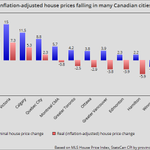
The largest generation in history needs to sell the most expensive houses in history to the most indebted generation in history. What could go wrong.


Daniel Tencer retweeted

A young girl practicing wushu at the bus stop while waiting. Sometimes, you need less than you think to stay active...


Daniel Tencer retweeted

A SHORT POEM ABOUT THE DIFFERENCE BETWEEN ENGLISH AND GERMAN…
English weather is wet
German weather is Wetter
English kids are kind
German kids are Kinder
English mothers mumble
German mothers Mutter
And the English shout the word people
But Germans just quietly Menschen it




Daniel Tencer retweeted

🚨SHOCKING: Researchers took ChatGPT away from workers for 4 days.
They couldn't ask coworkers for help. They described talking to another human being as a burden.
Here is what they found.
Researchers conducted a four-day diary study on 10 knowledge workers who frequently use ChatGPT. They removed access to all LLMs completely and documented everything that happened.
The disruption was immediate.
Workflows broke down. Participants found gaps in their ability to execute tasks they previously handled with AI. Without the tool, they realized how many parts of their process had quietly been handed over to the machine.
But the most disturbing finding wasn't about productivity.
It was about people.
When participants needed help during the withdrawal, they refused to ask coworkers. They described asking another human being for assistance as a social burden. They assumed their colleagues would find it tiring and burdensome.
One participant said they avoided asking people questions because they feared being seen as a "finger prince" - a Korean slang term for someone who burdens others with easily searchable questions.
They would rather switch between different AI services, from ChatGPT to Grok, than have a conversation with the person sitting next to them.
ChatGPT didn't just become a tool. It replaced human interaction entirely. And when it was taken away, these workers had forgotten how to reach out to each other.
The researchers described LLM use as "inescapably normative." The participants didn't even realize how dependent they had become until the AI was gone. It had woven itself so deeply into their daily routines that its absence felt disorienting.
But here is what nobody expected.
When forced to work without AI, participants started reclaiming professional values they had lost. They reconnected with their own thinking. Some found that human help was actually more useful than AI had ever been.
One participant said that if the withdrawal had lasted a year, "discussions between people would be more active."
Four days without ChatGPT and they remembered what it felt like to think for themselves.
The question is whether the rest of us ever will.
