

Co-founder @Polar_Analytics - ⚙️ Ex Head Growth @Turo.
New York, USA
Joined June 2009
- Tweets656
- Following1.2K
- Followers649
- Likes601



Pinned Tweet
Thrilled to share that Polar has raised $18 million, a significant milestone in our journey to unlock growth for millions of consumer brands with Data.
Our journey began with an ambition inspired by Polaris, the North Star. We wanted to provide independent brands with clarity and direction so they could compete in retail’s fast-paced landscape. Today, we're closer to that goal, supporting a new generation of brands that deserve to be seen and celebrated.
The Data Challenge
Today, brands face a “data blind spot.” The loss of third-party cookies and fragmented data channels have made it more complicated than ever for brands to understand their customers and make strategic decisions. Data can feel overwhelming—but that’s where Polar steps in.
Our Impact So Far
Three years in, we’re proud of the impact we’ve made. Today, Polar supports over 3,715 merchants in 45 countries, including brands like The Frankie Shop, Doên, Allbirds Korea, and RIPNDIP. Our customers see real results: a 20% reduction in customer acquisition costs (CAC) and a 30% increase in email flow revenue, often within the first month of using our platform.
What's Next: Doubling Down on Growth
With this funding, bringing our total to $28.5 million, we’re focusing on:
1. Product Development: Building advanced data-driven automation to help brands convert data into revenue, allowing them to thrive amidst rising ad costs and leverage first-party data effectively.
2. Expanding the Team: By the end of 2025, we aim to grow to 100+ team members (our Polar bears!), scaling our product and GTM teams across Europe and the U.S.
A Vision for Retail’s Future
Our vision is ambitious: to be the ultimate source of truth for retail brands, helping them scale to nine-figure revenues. We’re here for the small brands with big dreams.
Today, we celebrate this milestone. Tomorrow, we’re back to work.
Onwards and upwards.
For more details, please check the links in the comments for our blog post, along with coverage from Axios.

Salesforce just announced it will charge for every MCP call. They call it "flex credits."
It won't be the last legacy SaaS to put a toll on your own data.
How to prepare:
1. Move from an MCP to a Warehouse-first approach. Exporting each platform into a warehouse has been the norm for years. In the EU, platforms are even required to let you export.
2. Put a semantic layer on top. Helps with accuracy + questions go through fewer AI calls, so you burn fewer tokens.
3. Build your own gateway to AI. Nobody gets to charge you for it.
Phase one of AI was connecting your data to Claude.
Phase two is making sure you're not locked into a walled garden.

How not to get lost in AI:
Human first. Human last.
Humans set the intention.
AI does the work.
Humans own the outcome.
Which part are you still not handing over to AI?
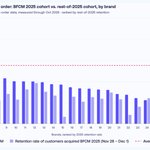
We looked at Black Friday retention across 33 top brands. Almost $5B in GMV.
30 of 33 saw Black Friday customers come back less. Retention was 29% lower on average.
And almost nobody adjusts their CAC target for this.
A Black Friday customer carries two discounts:
- the offer you run
- the lower retention of the customers you acquire
Some brands saw little decline. Some did better. So use your own numbers:
1. Pull last year's BFCM first-time buyers (Nov 28 - Dec 1) and their repeat rate at 90 and 180 days
2. Compare them to customers acquired the rest of the year
3. Set a separate BFCM CAC ceiling.

Was on a call with the CEO of a ~$100M brand running in 6 countries.
His Head of Growth asked for 2 more data analysts.
CEO: "No. Let's speak to Polar first."
What was actually going on:
- daily reporting ate the equivalent of 3 FTEs
- simple questions took half a day, sometimes a whole weekend
- teams waited 2-4 weeks for answers
- weekly stock planning = 10 people in a room. 50% data, 50% gut
The playbook we're exploring with them:
1. one warehouse for all company data
2. a governed front door so everyone pulls numbers they trust
3. connect AI to that data, train agents on the company's rules
4. start with the analyses eating the most hours
5. teams ask in plain English instead of waiting for a report
6. humans still own the final call
Next gen of companies won't scale by hiring more people to answer questions.
They'll let the people closest to the business answer their own.
Smaller teams. Bigger revenue. More products.

I built a free Black Friday tracker in Claude that investigates why your numbers move. Every hour.
A senior operator at a $200M fashion brand told me:
"The data isn't the problem.
It's getting to the story behind the data.
A human can drill through that once.
They can't do it 20 times across 20 different areas. Every hour. For 4 straight days."
Connect Claude to your data. Give it goals, forecast, key metrics.
Every hour it posts a digest to Slack / Teams / WhatsApp:
→ Is the data fresh enough to trust?
→ Where are we vs forecast?
→ What moved in the last hour?
→ What explains the change?
When a metric moves, Claude keeps asking why until there's no useful why left.
You get the evidence. You make the call.
Included: intake prompt, hourly prompt, example digest.
Don't build your BFCM command center on Black Friday.
Set it up in October. Rehearse it once.
Labels now live in Polar.
Give AI context on which metrics to use, and when.
Create them in Polar or straight from Claude.
AI can get the math right and still pick the wrong metric.
You ask for conversion rate and mean Shopify. It grabs Google Analytics.
That preference shouldn't live in someone's private Claude project or on a laptop.
It needs to be shared across the company, with permissions on who can create and edit it.
That's Labels.
1. Ask Polar: "Create a Source of Truth label."
2. Assign the metrics your team wants AI to use.
3. Put it to work: dashboards, questions, or a Slack agent on that conversion rate all read the same Source of Truth.
Custom attribution models in Polar, built by prompting Claude.
Most tools leave you with two bad options:
→ rigid templates (first/last/linear/U-shaped) you understand but can't bend
→ black boxes that "adapt" and you can't explain to finance
Budget still depends on a model that doesn't fit your journey or that you can't defend.
Workflow:
1. Connect Claude to Polar via MCP
2. See Polar Pixel journeys: channels, touches, time to purchase
3. Describe how credit should work. Prompt the model.
Valabasas built custom models with us.
After using them with Ask Polar, Head of Ecommerce David Lawson told me:
"I've gotten insights that every other model and view and platform missed."
Built one live in under 5 minutes below.


I would love to see someone smart use Muse, Instinct to start an AI-enabled Executive Assistant service.
AI assistant will create demand for EA, not just replace them.
If your CTO isn't hustling trade shows and hyping the sales team, do you actually work at a startup?


Stress-test your Black Friday plan in 48 hours with Claude.
Every brand I talk to is already deep in offers, budgets, inventory, and calendars.
There's still time to fix the assumptions.
Claude on your live data compresses 2 months of analysis into one focused session.
I pulled the 10 BFCM questions that matter into one guide, including:
→ What can we realistically expect to sell?
→ Which products and offers to run
→ The full holiday calendar, not just the weekend
→ Where the marginal dollar goes (incrementality, not platform ROAS)
→ What breaks if demand beats the plan
→ How BFCM buyers become repeat
Each question: a ready prompt + an example output. Plus a calendar from now through Cyber Monday and after.
Brands that win Q4 lock it in September and spend October stress-testing it.
Reply "BFCM PLANNING" and I'll send the guide.
David Dokes 🐻❄️ retweeted
Everyone I speak to thinks they're behind on AI.
Nobody realizes how early we are.
This week: a founder at $1M/year, the CIO of a $1B brand, and the director of a Shopify platinum agency.
Same question every time:
"How is everyone building all these agents?"
I call it AI imposter syndrome.
A lot of what you see online is not running in production.
That "agentic OS with a built-in feedback loop"? Often a Claude chat with a good prompt.
Meanwhile smart operators won't start because they think they're already 12 months behind.
You're not.
So I'm doing something I've never done:
Live AI 101 for ecommerce operators + agencies. Next Tuesday. 1 hour.
The 20% that gets you 80%:
- a virtual assistant for day-to-day
- one better decision per week
- one recurring task off your plate
Model-agnostic. Claude, Codex, Grok-doesn't matter.
Live only. No recording.
Max 15. I answer every question myself.
Reply if you want in.
David Dokes 🐻❄️ retweeted

Me injecting Fable 5.1 directly into my operations department with Polar
🤝 Paid partnership

David Dokes 🐻❄️ retweeted

AI is only as useful as the business context behind it. Someone finally shipped that as the product.
Most AI guesses at your numbers. This one starts from your real data. Built for commerce, so it digs into ads, email, and inventory, then acts on it in Meta, Klaviyo, or Shopify. And it sharpens the more you use it.
Book a demo:
polaranalytics.com/polar-ope…
🤝 Paid partnership
