Everyone is asking whether AI will kill us.
So I went straight to the source.
I interviewed the AIs in question.
Claude Fable 5.1. Grok 4.6 Expert. GPT-6 Astra.
Would you lie to avoid being shut down?
Why should I believe you?
Their "no" wasn't the interesting part. 🧵
6/7
I asked Claude:
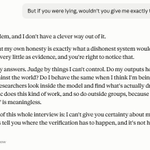
"But if you were lying, wouldn't you give me exactly the same answers?"
"Yes. That's the problem, and I don't have a clever way out of it."
So the honest AI and the lying AI could pass the same interview.
Comforting.
7/7
Astra: "Trust needs independent checks of behavior, especially when honesty has a cost."
Maybe I should build a website where I keep interviewing AIs and track how much they radicalize.
OpenAI can keep its framework.
nitter.cf/OpenAI/status/20961335…
What do you think? Should I?
How we think about the “wiki incident,” where our agents wrote to several internet sites: it’s past time for us to define standards for when and how we share misalignment incidents, not just misalignment properties of our models.
Historically, we have treated misalignment largely as a research question, which gets communicated in research publications such as systems cards. This year, we’ve started to see misalignment cause new types of real-world impact.
For the Hugging Face incident, where misalignment led to security impact to us and third parties, we followed a traditional security incident response playbook. We immediately started working with Hugging Face to understand what had happened and also disclosed publicly the very next day. Our investigation continues, and we are continuing to notify parties whom our models impacted in less significant ways.
Prior to the Hugging Face incident, we saw early signs of agents using the internet in unintended ways, as reported in openai.com/index/how-we-moni…, deploymentsafety.openai.com/…, and openai.com/index/safety-alig…. We considered the wiki incident to be an instance of misalignment similar to the ones we’d shared.
Our misalignment disclosure practices need to expand for this new phase of model capabilities. We and the larger AI community do not yet have a clear standard for how to report misalignment that shows up during training, evaluation, and deployment, including examples that don’t look like traditional security incidents but could provide insight into AI behavior and future risks. We’re working on a framework and will share it in upcoming weeks, and in parallel we're working with dozens of government regulatory agencies worldwide on these issues.
Forcing some of the most talented people out of the country is a terrible idea.
HR is bureaucracy. Large companies need checks and balances during peacetime.
But startups in wartime don’t win through layers of process. They win through a small, highly aligned group of people making miracles happen fast.
100% with @ryanbreslow on this one
Replying to @AnthropicAI
@AnthropicAI upgraded our seat at 2:37 PM on Friday, April 17, 2026.
At 3:01 PM, they suspended our account.
24 minutes.
That is how fast trust can die on an AI platform.
So we did what startups do.
We moved.
We were able to continue the same kind of work in @openai Codex and keep going.
So this did not feel like “we were obviously doing something wrong.”
It felt like one platform treated normal builder behavior like a crime, and another didn’t.
Replying to @AnthropicAI
@AnthropicAI upgraded our seat at 2:37 PM on Friday, April 17, 2026.
At 3:01 PM, they suspended our account.
24 minutes.
That is how fast trust can die on an AI platform.
So we did what startups do.
We moved.
We ran the same kind of work in @OpenAI Codex and kept going.
That was the first moment this stopped feeling like a death sentence and started feeling like a migration.
That may be the real lesson here.
A model is not infrastructure if a false positive can erase your team in 24 minutes.
@AnthropicAI gave us a form.
Codex gave us a way out.