

GP, Head Growth Fund @a16z | 👨👩👧👦 | See disclosures: https://nitter.cf/t.co/AgIphFgvmR
Palo Alto, CA
Joined December 2011
- Tweets446
- Following1.3K
- Followers25.6K
- Likes24.3K






Pinned Tweet
The last time @GavinSBaker and I sat down to record a podcast, it was almost exactly a year ago and we started with the immediate question: is AI a bubble? Gavin's answer focused on utilization and returns (and perhaps unsurprisingly, his answer was: No). Unlike the dark fiber of 2000, there were, and still are, no idle GPUs. The largest buyers of compute were funding the buildout from some of the strongest balance sheets in the world, and their AI investment was already producing real returns.
I sat down with Gavin again last week, and to chart just exactly where we are in the cycle. He has spent the summer asking operators for one quantitative measure in their business that is getting worse and has yet to find one. At the same time, public AI stocks have gone through meaningful drawdowns.
Still, if you look at the way people are using AI today, there’s a good chance that demand diffusion has barely begun. AI revenue rests on fewer than 10m heavy users, against roughly 1.5b knowledge workers. At the most AI-native startups, token spend is approaching or exceeding 10% of human compensation, which suggests that there’s a long way to go before even the earliest adopters fully integrate agentic capabilities. Within Atreides, Gavin said token consumption rose 100x from March through August, and even further once the team started using products like GrokBot. As Gavin put it, once people begin approving automations, token consumption starts to feel “sort of endless.”
This dynamic would be reason enough alone to believe that we’re massively undersupplied at the moment. But there are other reasons on the supply side too, namely that there are a near-unbounded number of potential winners in the space:
- Frontier labs can keep winning because on the highest-value tasks, marginal improvements in intelligence are worth far more than marginal differences in price.
- Open models illustrate that most work doesn’t require frontier performance, creating a much larger market for intelligence that is cheaper and customizable.
- Nvidia, hyperscalers, neoclouds, and inference providers can simultaneously win because every additional token still requires physical compute, even if models become more efficient.
- Enterprises can win as proprietary data, workflows, and institutional knowledge become more valuable.
- Application companies can win by capturing services budgets and owning the customer relationship.
This doesn’t suggest everyone will be successful, but it does mean the market itself is positive-sum and we will look back on zero-sum thinking as far too limiting. Better models create better products, better products create more users, more users create more token demand, and more demand supports continued investment in models and infrastructure.
Check out the whole conversation below:
@a16z

Gavin Baker and a16z's David George on the state of the AI boom:
The future doesn't have to be winner-take-all. Labs, open-source, applications, and the clouds can all capture value.
Demand for intelligence is still dramatically underestimated. Today's power users number in the millions and will grow to hundreds of millions. Gavin and David argue a compute shortage is a more real risk than an AI bubble, and building through it is an opportunity to reindustrialize America.
In this episode, they get into why compute investments pay back so fast, what the data center backlash gets wrong, the case for putting compute in orbit, why enterprises will run several models at once, and how Nvidia ended up at the center of the entire supply chain.
00:00 Intro
01:06 The bear case Gavin couldn't find
05:50 Why a lab would cut its own revenue 75%
08:05 What LPs get wrong about a crash
10:50 Microsoft slowed its capex and regrets it
14:33 The engineers spending 100x the median
17:35 Why 23-year-olds use AI better than Gavin
21:45 How much copper 500M AI users need
23:00 Stop promising to cure cancer
26:00 America's richest county is full of data centers
30:48 Who gets priced out of compute
33:05 The age of Elon and Jensen
34:25 Orbital data centers
44:40 Asteroid mining
48:12 Why Microsoft doesn't need a frontier model
54:02 Who becomes the abstraction layer
55:40 Everyone wanted a deity, Cursor wanted a product
1:00:25 Never take shots at Jensen
1:07:40 What happens when the chip doesn't work
1:12:10 What chip deals reveal about customer demand
YouTube: youtube.com/watch?v=FGC4ofTc…
@GavinSBaker @DavidGeorge83
As @aleximm said, "More healthy years with the people you love. It’s hard to think of a more important application of AI."
Excited to partner w @demishassabis and @IsomorphicLabs.

Fantastic to be partnering with Greenoaks, Sequoia, Andreessen Horowitz, and many other new storied investors, as well as all our wonderful existing investors on our epic journey. More information in the press release: isomorphiclabs.com/articles/…


Great piece on @databricks and our history w them. @alighodsi is the original Technical Terminator.
@bhorowitz's take on Ali: "We see great entrepreneurs but their market opportunity is limited, and then we see companies that have a great market opportunity but the entrepreneur is not big enough to fulfill that. But this was a case where we had both... Last month, Databricks crossed a $7 billion revenue run rate, growing 80% year over year, and was valued at $190 billion. The entrepreneur, it turned out, is big enough."


Kevin Mandia says "There's no way to make the next year pretty."
He thinks the first time a model revealed itself capable of finding thousands of vulnerabilities, is when everyone finally accepted the game has changed and AI on offense is coming.
One of our most sophisticated portcos recently told us they put a significant fraction of their engineers' projects on hold and enlisted them to stress-test their own walls.
Kevin's new company @ArmadinSecurity is scaling up to offer this offense-as-defense to everyone, and ultimately build out the autonomous security he believes every company will need in the AI-enabled future.
.@ArmadinSecurity is a new company that uses AI agents to attack your network before criminals do, finding real exploitable zero-days and eventually patching them autonomously.
Their agents map every service, route, and system from the outside, then re-attack whenever something changes. Since January that's uncovered 90+ zero-days at Fortune 500 companies.
Kevin Mandia spent 30 years responding to some of the worst breaches in the world and built Mandiant, now a core part of Google Cloud's security arm. He had no plans to start another company until AI arrived and changed everything: in his words, "everything I did is dead." He joins a16z's David George to talk about why he came back and what Armadin is building.
In this conversation, they cover what AI attacks look like today, why nation states hack like a sniper and AI hacks like a drone swarm, and why the only defense fast enough to keep up is one with no humans in the loop.
1:05 "Everything I did is dead"
3:10 AI on offense, AI on defense
4:20 What an AI attack looks like today
7:20 Sniper rounds vs drone swarms
10:25 Map everything, attack what changes
14:35 The problem with pen tests
16:40 90+ zero-days at Fortune 500s
18:35 A bad patch beats an intrusion
20:55 Why humans are too slow for the SOC
24:30 Why the next year in cyber won't be pretty
26:30 How Mythos changed the threat
28:15 Caging the attacker Armadin built
30:05 Open and closed models tied on offense
34:40 AI is finding zero-days on its own
35:45 Mandiant in 2004 vs Armadin in 2026
41:20 Why Armadin retrains sales every week
YouTube: youtu.be/cJsHel27Z6M
@ArmadinSecurity @DavidGeorge83
When people ask whether "this" or "that" will be successful in AI, the answer is very often both.
OpenAI and Anthropic together represent the fastest, largest success in the history of business. They + SpaceXAI + Cursor add more revenue per month than any hyperscaler other than Amazon. Up until now, headlines like these have been driven effectively off coding applications alone. We are very early.
Thank you @jaltma for having me on!

Loved the conversation on Uncapped with @DavidGeorge83, head of growth investing at a16z. He's an incredible investor and can go deep on a huge range of topics.
We talked all about investing at this point in the AI cycle and we covered a lot of ground -- frontier vs. open source, what could make it all keep running vs. slow down, application vs. infra, robotics and autonomy, narrative and vibes, and lots more.
Hope you enjoy!
Timestamps:
(0:00) Intro
(0:23) The answer to every AI question is "and"
(1:27) Where we are in the AI buildout
(4:55) What would stop the train
(7:16) Sellers vs. buyers of tokens
(10:39) Frontier labs vs. open source
(13:18) App investing and the coding blast radius
(14:01) Legal as a category
(20:46) Consumer AI
(22:14) From reactive to proactive
(25:52) AI, autonomy, robotics, bio health
(27:49) Autonomous driving and why it's underappreciated
(30:46) Robotics and what comes next
(33:25) Benchmark's new growth fund
(34:11) Why growth investing is compelling now
(34:53) Half of private market returns happen at growth
(37:57) Product cycle vs. capital cycle
(41:54) The importance of narrative
(43:14) Why vibes really matter
(46:20) Never short a messianic founder
(49:39) How big can Andreessen Horowitz get
We're excited to co-lead @ArmadinSecurity's Series B. After this summer’s cyber incidents at frontier AI labs, CISOs face growing pressure to secure their companies across applications, cloud, identity, and internal networks.
Armadin’s AI autonomous security platform turns offense into something defenders control, from the first Hyperattack. Built on decades of frontline adversary tradecraft, its agentic attacker swarm reasons, plans, and adapts like a real adversary. The platform learns from every attack and environment, allowing security teams to focus on fixing real problems.
We believe there’s no better team to take this on than Kevin Mandia, Travis Lanham, Evan Peña, and David Slater. Kevin founded Mandiant, the firm that defined modern incident response.
Kevin and the team have spent their careers staying a step ahead of attackers, and now they’re building the platform to help every security team do the same.
@a16z @steph_zhang

David George retweeted

a16z's David George, Sarah Wang, Alex Immerman, and Santiago Rodriguez on the State of Markets, from AI and infrastructure to the next investment cycles:
1. Tech is the everything cycle.
High-tech equipment, software, and R&D are now about 55% of US capital spending, and the AI buildout just passed the railroads as a share of GDP. The five largest hyperscalers will spend about $780B on capex this year, heading past $1T in 2027, and demand still outstrips supply at every point in the chain.
2. It's an earnings story.
Stocks are up about 20% while multiples are down about 20%, and the S&P trades under 20x earnings. The market is up 90% since ChatGPT, on 15% earnings growth.
3. AI adoption is broad and shallow.
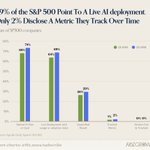
69% of the S&P 500 has a live AI deployment, 30% report a quantified result, and just 2% have AI doing a job they'd notice if it stopped. The power users are pulling away: the top 1% of AI spenders spend eight times the top 10%.
4. The private markets are enormous.
Six private companies, Anthropic, OpenAI, Databricks, Stripe, Waymo, and Revolut, add up to about $2.4T by last round, more than every IPO of the past decade combined. "The founder is the asset class. The IPO is another financing event."
Plus: why a data center can lower your electricity bill, what Amazon saying no to Muse and Instacart saying yes tells you about marketplaces, and the seven areas the team is most excited about next.
0:59 Charts from State of Markets II
2:59 Tech is the everything cycle
4:56 Is it a bubble?
6:31 Hyperscaler CapEx: $1T next year
12:12 CapEx is someone else's order book
14:36 Data centers can lower your bills
17:06 OpenAI and Anthropic vs. some of the best software companies ever
18:22 Enterprise AI: 69% adopted, 2% measured
20:32 The top 1% spend 8x the top 10% on AI
24:36 Spending on AI for growth or for savings?
28:46 Only 2% of households pay for AI
31:36 Amazon blocks Muse, Instacart welcomes
36:16 Software traded growth for profit
42:56 6 startups vs. a decade of IPOs
45:46 Why employees are turning down liquidity
48:44 Seven areas they're excited about
YouTube: youtu.be/lr3hNhA0IfQ
@DavidGeorge83 @aleximm @santiago__rdz @sarahdingwang

Introducing our State of Markets pt 2, along with a companion podcast where we unpack the data and discuss what comes next.
Tech is the everything cycle.
Supply: putting the buildout in context, just passed railroads as % of GDP. The wisdom of Elon is real: the factory (or the datacenter!) is the product.
Demand: diffusion is so, so early. Median AI vendor spending in the top 1% of companies is 8x that of the top 10%. Only about 30% of S&P 500 companies report a quantified AI impact, which means there’s a substantial opportunity in connecting models to a company's data and workflows. Diffusion into companies is one of the main themes of the next 5 years.
We’re entering the agent work period. Only a few million users today, but applicable to billions of internet users with massive surplus created. META/GOOG monetize US users at $200+ per year today. Agent opportunity is much higher.
Mega-trends the next 5 years: Consumer agents, Robotics, Autonomy, AI x bio, Personal health, Diffusion into enterprise, New era of American Dynamism.
Much more in our SoM report here - a16z.news/p/state-of-markets…
@a16z @sarahdingwang @aleximm @santiago__rdz

Big and public used to be the same milestone.
Tech IPOs at the 75th percentile enter around $3.5 billion. The ten companies here cleared it by 12-500x in private rounds.
Great piece from @jkhamehl on the trillions accruing in private markets and the venture fund allocations that are still sized for the old world.


Flock is making cities safer. Safety doesn’t have to be a privilege. @flocksafety
Our fifth growth fund is now $8.5b.
The founder is the asset in late stage, and we back the best in the world. At the same time, the best founders face global complexity earlier in their lives than ever before. So we are building out an enhanced Growth Platform for these exceptional founders.
Biggest product cycles of our lives. Never been higher stakes, and never been more excited.
@a16z

New $1.1b fund for physical AI. We are witnessing a reinvention of compute infrastructure at historically unprecedented magnitude and breadth.
It’s time to build the Machine Age.
@a16z
I had a great time talking with @GrantLaFontaine, who co-founded @Whatnot with @loganhead13 in 2019. What began in collectibles is now the largest live-commerce platform in North America and Europe. Whatnot reported more than $8B in 2025 GMV and says H1 2026 exceeded that total.
@a16z partnered with Whatnot at the Series A. In this chat we reached all the way back to the company’s origin story (beginning with Grant selling Pokemon cards as a kid) and the larger market opportunities that lie ahead. Some takeaways:
-Traditional e-commerce owes much of its efficiency to obscuring the merchant. On Whatnot, the seller has a face, a brand, and customers who return for them. Per Grant, it can be an advantage to lack experience in an established category: instead of copying what exists, you focus on the experience users want. When Whatnot was getting started, lots of teams were trying to emulate the live shopping marketplaces growing popular in China. Instead of doing this, Grant and Logan just tried to make the best place to sell collectibles.
-Whatnot feels more like entering a store or mall than querying a product catalog. The buyer may know the kind of thing she wants, but the exact purchase emerges from browsing and entertainment. Live formats make expertise valuable. A seafood distributor can show what came off the dock, explain why it is in season, answer questions, and reach buyers nationwide.
-Today, people spend ~95 minutes a day on Whatnot, and on a given day more than 80% of them don't buy anything. "It's because it's fun. If you simplify Whatnot down, the buyer value prop is a fun experience to shop, and there's not a whole lot of fun experiences shopping online."
-When it comes to using AI, the company wants to empower their sellers. Whatnot uses LLMs to infer listing metadata and provide business insights while preserving the seller relationship that brings customers back.
A fun conversation about marketplaces creating new demand, new sellers, and entirely new businesses.
In third grade, Grant LaFontaine sold a Pokemon card online. The buyer mailed a money order; Grant cashed it at the post office and then shipped the card to the customer.
Today he's co-founder and CEO of @Whatnot, where the largest businesses do over $100 million a year at up to 40% margins.
Grant joins a16z's David George to discuss how that first transaction became a platform that did $8 billion in sales last year, why live commerce is a third of all commerce in China yet still emerging in the US, and how Whatnot operates reliably at scale, and more.
00:00 Intro
01:05 The Pokemon card and the money order
06:25 Half a Bitcoin for a domain
09:20 Why not knowing the market was an advantage
11:05 Customers don't care about your market
12:45 Most people don't buy anything
17:15 Why the eBay comparison misses
20:05 95 minutes a day on a shopping app
25:00 Sellers doing $100M with 40% margins
26:35 Fresh fish from the San Diego dock
32:25 Running a police force for two New York Cities
37:00 Why Whatnot won't do AI avatars
40:15 Cars on Whatnot
@GrantLaFontaine @DavidGeorge83
4
29
5,363
Congratulations to @OpenRouter and @stripe! This is a massive win-win. Here is @gaybrick talking about the movement between tokens and dollars.
Also, Late Stage Venture is about Late Stage Founders 🤝 "Deft Helmsmanship"
@a16z


OpenRouter is joining Stripe: stripe.com/newsroom/news/str….
As anyone who uses it knows, @OpenRouter is a truly delightful developer tool. It is by far the best way to use new models and manage multiple inference providers.
OpenRouter is also playing an increasingly important role: in the future, every business will have to manage both revenue flows and token flows. OpenRouter is the world's leading token marketplace, helping businesses effectively allocate the new currency of intelligence capital. We think that there's a lot to build together.
