

Developmental Pediatrician @BostonChildrens, Neuroscientist. Interested in learning, language, autism, and helping kids thrive.
Newton, MA
Joined July 2010
- Tweets927
- Following444
- Followers570
- Likes1K





Carol Wilkinson retweeted

New paper alert! A story where secondary findings were perhaps more interesting than our original question. Before I start, I extend deep thanks to the families in the study. rdcu.be/d6LnQ 🧵 1/x
Carol Wilkinson retweeted

Help the Wilkinson Lab at Boston Children’s learn how brain development impacts learning, language growth, & behavior in FXS.
Travel reimbursement is available for eligible families with children 2-6 y/o living with full mutation FXS.
More info: hubs.ly/Q02SnLzb0

Carol Wilkinson retweeted

👀 Slides from my talk today on preparing for the faculty job market are live on our resources page! Advice & tips I've tailored after helping to hire 10+ fantastic colleagues in the last 3 years!
plasticityinneurodevelopment…

Carol Wilkinson retweeted
Notre Dame is hiring an Assistant or early Assoc. Professor in Cognitive/Developmental! You'll be in our new building with a new MRI, TMS, EEG... come work with me! apply.interfolio.com/150332
Carol Wilkinson retweeted

.@drcarolw shares new data on developmental trajectories of EEG activity from 0-3 years—revealing age-dependent, nonlinear changes in periodic alpha and beta brain waves that are suggestive of distinct milestones in circuit maturation.
brain.harvard.edu/hbi_news/w…
New paper out! Great teamwork by research assistants McKena Geiger and @HurewitzSophie.
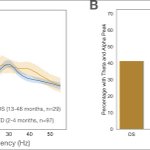
We find striking EEG differences between toddlers with and w/o Down syndrome. In particular we observe two peaks between 4-12 Hz similar to what we transiently observe in 2-4 month olds.

Lots more questions to investigate to understand how these differences relate to alterations in neurodevelopment. Once again finding clues from our longitudinal infant data sets!
1
2
165
Super interesting preprint on a narrow band 30Hz beta oscillations observed in awake resting state and REM EEG data. Children > adults - but still only in portion of individuals. Seems distinct from the broad band beta we observe in toddlers. Do you see it in your data too?

What do you think? Are iota brain waves real? If you’re not convinced, tell me what more proof you need!
biorxiv.org/content/10.1101/…

4
384
Pediatricians please do careful surveillance for autism and developmental delays for your little patients with autistic siblings! Important study led by Sally Ozonoff and Baby Siblings Research Consortium demonstrating stability of findings. @AutismScienceFd
This Post is from an account that no longer exists. Learn more
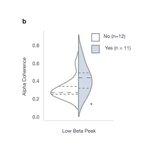
9/ We hypothesized that emergence of a low beta peak could be related to maturation of GABAergic interneuron networks and thalamocortical connectivity that are required for both the generation of cortical beta oscillations and anesthesia-induced frontal alpha coherence.
1
1
176
11/ Finally, we observed a transient high beta peak around 30Hz, which peaks in amplitude at 7-months-old, but has largely resolved by 36 months. This peak is eerily similar to the 30Hz peak we had observed in our studies of Fragile X older kids and others have observed in Dup15.

1
193
12/ We hope these findings will spark discussion and future collaborations. Feedback and suggestions very much welcomed! @BostonChildrens @harvardmed
132
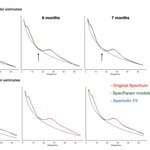
7/ However, this “trough” meant that SpecParam/FOOOF parametrization of EEGs from infants <8 months resulted in poor fits and inaccurate estimates of aperiodic spectra, and periodic peaks. @JeffRhoades helped us make some slight modifications. Code here: osf.io/u3gp4

2
192
8/ Getting back to the emergence of a low beta peak…the timing reminded me of an anesthesia study by Laura Cornelissen and my K23 mentor Patrick Purdon finding that anesthesia-induced frontal alpha coherence is not established under after 10 months.
doi.org/10.1016/j.bja.2018.0…
1
129
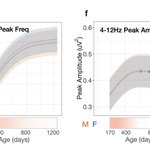
5/ But, we also observe a “mature” 9.5Hz peak at 2-4 months but NOT at 6 months. Could this transient peak represent the timing of transient thalamus-subplate neuron connections critical for thalamocortical maturation? @ZoltanMolnar64 @KanoldLab thoughts?

1
156

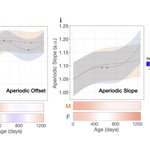
3/ The aperiodic spectra rapidly increases in offset during the first year and then plateaus. This is consistent with increases in neuronal number, synapses, and gray matter volume observed during the first year but not second year in MRI studies.

1
177
