




Today, we’re launching @omni AI. Frontier class intelligence, free for every Omni customer.
AI for data is incredible. Ask and get. But too much time is spent thinking about token spend, rather than just getting jobs done.
The promise of intelligence too cheap to meter is here. Over the last two weeks, our token spend in Omni has dropped by 85% thanks to advances in the open source frontier model ecosystem and our AI harness and semantic layer. Cheap models with the right harness underneath perform just as well as the best frontier models.
We think those savings should reach customers. Getting answers to questions about your data shouldn’t come with a price tag per question.
Interested? Request a trial. If you’re already a customer, message us on Slack or reach out to your Omni team for more information.
We did the math: our internal semantic layer holds a few hundred thousand dollars of expert knowledge at today's rates.
There's a whole category of billion-dollar companies built on getting experts to write down what they know so the labs can train on it. Mercor, with 30,000+ doctors, lawyers and PhDs, was valued at $10B. Meta paid $14.3B for 49% of Scale AI.
A semantic layer is that same work pointed at one company. Labs can make LLMs smart about the world. Only you can define the context around your business.
One line I wrote into our model: "When someone asks for 'closed deals,' they most often mean closed and won, not all opportunities marked is_closed."
That's a person's judgment, written down once, codified in our internal semantic model so our AI agent can reference it.
Since May 2025, our model's structure has grown a lot (topics about 3x and model size about 6.5x), but the more interesting growth is in the context around it. The plain English we wrote for the AI grew 15x; synonym lists, literally what people call things, grew 37x; and questions to our AI grew 22x. Chart below.
Questions surged first, from February to May 2026, and the written context caught up after, July to August. So the questions showed us what people actually meant, and we wrote it down. That loop is our version of the labs' tagging and traces, the labels and examples they pay experts to produce.
Roughly a couple thousand hours have gone into our model. At the labs’ rates, that’s a few hundred thousand dollars of expert knowledge we wrote for ourselves. What about yours?

Decision models vs cheap LLMs. Five oddities:
1. Decision-1 was the only one that could add: 99% on claim totals versus 48 to 55% for others (!!!). It scored 99.5% on claim checks overall.
2. Temperature 0 didn’t stop LLMs from changing routing picks on identical reruns. GPT-6 Luna kept 85.1%; Claude Haiku 5.5 kept 88.1%.
3. GPT-6 Luna scored 99.5% on claim checks as an LLM versus 68.5% through Luna Decisions (OpenAI’s Decisions API). Banking77: 89.6% versus 78.3%. Luna Decisions cost more: 6.09 cents per 1,000 rows versus 1.30.
4. Laya answered “moderate” on 1,532 of 1,534 routing questions, failing a ‘decisiony’ task, but scored 96.6% on sentiment.
5. Probabilities mean different things per model. Decision-1 reported 84%, got 97% right; Laya and Clef ~65%, got 97% right; Jev 89%, got 93% right.
My takeaway: test the actual task to know which model fits. Every model has different strengths and constraints.
1/ Everyone is buzzing on the new Anthropic numbers (TLDR; best business ever, but maybe less than people hoped?)
One data point from Omni LLM usage: for the first time, total token costs are *dropping*. And they are dropping significantly.

3/ This is mainly on the back of new competition from OpenAI and Anthropic, along with some new competence for both Luna and Haiku in production.
ie both models getting cheaper and model mix skewing downwards.
1
1
76
Choosing from 3 is a decision. Choosing from 77 isn’t.
Sentiment and routing are decisiony. Intent and claim check are less so. The reason is mechanical. Decision models carry the full option list with every row, where an LLM reads it once. At 77 options, Jev uses about 716 tokens per row to GPT-6 Luna’s 49. The cheaper-per-token model becomes more expensive per row. Cross that line and the LLM is as good and cheaper. Our rough estimate puts it around 23 options for Jev.
But option counts aren’t the only factor. Checking a claim is two options, but checking a total means adding. Most decision models are a coin flip there. Jev was unsure on all 80 totals and sure on all 80 simple lookups, so it knows which claims need math.
Jev alone labeled 85% right, GPT-6 Luna 99.5%. If Jev keeps the claims it’s sure about and passes the rest to GPT-6 Luna, accuracy stays about the same and the job takes less than half the time.
1/ One of the biggest moving targets building AI systems is balancing the harness with the natural tendencies of the models.
For example, planning approaches for different LLMs. Building analytics is sometimes simple, "When is XYZ's renewal date", and sometimes requires decomposition and planning, "How are win rates changing and why".
3/ What's been interesting is as we've applied different models to similar use cases how divergent the planning operations can be.
Bit of raw data here (and, yes, many different app surface areas here) but Sonnet 5.5 shrank planning drastically vis-a-vis Sonnet 5 and Opus and both of those sit massively below Sol.

1
96
3/ GPT-6 Luna tied Liquid d1 for best intent average. Clef and Liquid d1 won the individual intent sets. The line of 'decisioning' may be a blurry one. Clef won several quality categories, but was often an order of magnitude more expensive and slower.
1
2
44
2/ Jev was fastest, nearly tied with Luna Decisions (~0.66s / 100 rows). Luna Decisions returned identical answers and probabilities about 99 of 100 times across 1500 requests. Jev's probabilities moved ~40% on sentiment, ~80% on routing; picks were 97% consistent.
1
2
60
1/ One month. That's all it took for decision models to become a diverse category. We evaluated Jev, five other decision models and two cheap LLMs on intent, sentiment, routing data questions and checking claims against a table. TLDR; trade-offs!!

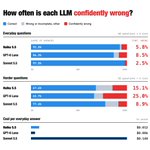
5/ Sonnet separated itself on ambiguity. When there was one clear reading, Luna was right about nine times in ten at around 4% of Sonnet's cost. Once a question needed a judgment call about what the asker meant, every cheap model fell off.
1
1
25
3/ Beyond the numbers, you have behaviors unique to each LLM. E.g. Luna answers in one sentence, at a median of 19 words. None of its 10 wrong 'everyday' answers said "may" or "assuming." Then you have Sonnet which hedges more when it’s wrong, about 1.7x its usual rate.
1
1
33
4/ Every model also wrote longer responses when it was wrong. Sonnet’s wrong answers ran 131 words against 74 for its right ones. And Haiku loves bullet points, about four per answer. It generates tokens faster than Sonnet, yet finished everyday questions in 21 seconds to Sonnet’s 10, because it wrote 2.5x as much.
1
19