Vicki Phillips (@drvickip) header
Vicki Phillips (@drvickip) profile picture

Lifelong educator champion. Believer in the promise of young people. CEO @CtrEdEcon. Former: Tchr., Supt., CSSO, NFP leader @gatesfoundation & @NatGeoEducation.

Seattle, WA
Joined January 2012
Photo by Vicki Phillips (@drvickip)Photo by Vicki Phillips (@drvickip)Photo by Vicki Phillips (@drvickip)Photo by Vicki Phillips (@drvickip)Photo by Vicki Phillips (@drvickip)Photo by Vicki Phillips (@drvickip)Photo by Vicki Phillips (@drvickip)Photo by Vicki Phillips (@drvickip)Photo by Vicki Phillips (@drvickip)Photo by Vicki Phillips (@drvickip)
There’s something about the spirit of creativity, community, and just a touch of spooky fun that makes this one of my favorite times of the year. Wishing you a safe and delightfully spooky Halloween!
1
158
The challenge with hasty readers isn’t the haste, in and of itself. It’s everything young people risk losing in the rush to arrive at the answer. That's where I landed in this @Forbes piece. I’d love to hear your thoughts. forbes.com/sites/vickiphilli…
114
We expect a great deal from school principals. We expect them to be culture builders, problem solvers, talent developers, and instructional leaders, all while holding a school community together. The diversity of demands speaks to how essential principals are to the success of our schools. Supporting principals is an investment in the strength of the entire education system. Let's talk about creating the conditions that allow them to thrive as education leaders. Every few years, the @OECDEduSkills Teaching and Learning International Survey (TALIS) offers a valuable window into the experiences and perspectives of educators and school leaders around the world. And with new data comes the opportunity to deepen our understanding and broaden our thinking. I'm looking forward to digging deeper into the latest findings with the OECD and school and district leaders, exploring what it means to build systems that support school leadership. 🗓️ Nov. 3 at 11 am ET I hope you'll join us. ncee.zoom.us/webinar/registe…
2
1
1
270
The highest-performing systems we study know this. They deliberately build bridges among education, employment, economies, and “long-life” learning. Teachers develop strong academic foundations and give students ways to apply them in authentic contexts. Schools create the schedules, transportation, and funding to make that participation possible. Secondary Education recognizes what students have already learned, and creates opportunities for them to build on it. Employers open the doors to real work and people that they might not encounter otherwise. Economic and community partners help the students see around corners - to where new needs and opportunities are emerging. To the young person, that should not feel like five different systems. It should feel like one education.
231
"The challenges we face in education are shaped by the systems we design and the choices we make. Together, we have the opportunity to learn from other countries, build on the extraordinary talent of our educators, and design systems that work better for teachers, students, and our collective future." - @drvickip 📖 Read the highlights from our recent webinar, watch the full recording, and access the presentation slides. ncee.org/education-at-a-glan…
1
2
84
In an age of abundant answers, do young people recognize the moment when speed no longer serves them? In my latest @Forbes piece, I explore a troubling rise in what PISA calls “hasty readers” and what it might tell us about the future of learning. It calls on all of us to consider how we teach, assess, and design learning and how we help students develop the judgment to know when speed is useful and when deeper thinking matters more. I'd especially love to hear what educators think. forbes.com/sites/vickiphilli…
119
There’s something powerful about bringing together experienced leaders for a genuine conversation about something that matters deeply to all of us: the future of our young people. A heartfelt thank you to the members of our Cross-Partisan Education Policy Network for sharing your insights and commitment to making high-quality career-connected learning a reality for every student. And thank you to everyone who joined us! The chat was alive with your curiosity and engagement. I left feeling hopeful about what we can accomplish when we find common ground and put young people and their futures at the center of the conversation. Here's a link to our new report with The Aspen Institute Education & Society Program 🔗 ncee.org/pathways-not-pitfal… We’ll share the webinar recording soon.
163
When the answer is not immediately obvious, when the argument takes more than a few minutes to read, when you have to go back three pages because you lost the thread, do you keep reading? Increasingly, young people may not be. The latest PISA results identify a troubling trend: the rise of “hasty readers”—students who rush through texts and give quick but incorrect answers. Between 2018 and 2025, their proportion nearly doubled. As a lifelong educator, I’ve seen countless students pour extraordinary effort into things they care about. But I do wonder what it will mean long term when the world around them increasingly rewards instant answers over deeper understanding. I explore this in my latest @Forbes piece. I’d love to hear what you are seeing in your community, and what gives you hope. forbes.com/sites/vickiphilli…
3
1
195
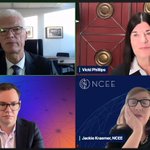
PISA explored what 15-year-olds around the world know and can do. Today, we turned our attention to the @OECDEduSkills' Education at a Glance, offering a closer look at the systems surrounding those students: how teachers are prepared, how their work is organized, how many students they teach, and more. A sincere thanks to Andreas Schleicher, Nathan Driskell, and Jackie Kraemer for sharing your expertise, insights, and thoughtful perspectives. And thank you to everyone who joined us. The challenges we face in education are shaped by the systems we design and the choices we make. Together, we have the opportunity to learn from other countries, build on the extraordinary talent of our educators, and design systems that work better for teachers, students, and our collective future. The webinar recording is on its way! Stay tuned.
1
1
116
Imagine if we changed the question. Instead of asking young people what they want to be when they grow up, ask: What problems are you interested in solving? What kinds of environments bring out the best in you? What have you always wanted to try, but was never within reach? Let's change the goal. Instead of helping them choose earlier, let's help them see further.
3
223
Done well, #CareerConnectedLearning helps young people understand the relationship between what they’re learning in the classroom and how they can apply what they are learning in the world. A science lesson takes on new meaning when the student meets the marine scientist, engineer, nurse, or agricultural researcher and sees how they’re using that knowledge to solve problems in their community. Writing changes when the audience extends beyond the classroom, and they need to persuade someone. Imagine strong academics alongside experiences that let young people explore, apply what they know, learn from people doing interesting work, and discover strengths they didn’t know they had. And the research bears this out. High-quality career-connected learning can increase student engagement and academic achievement while strengthening college preparation, workforce readiness, and the durable skills young people will need wherever their futures take them. Our new report with the @AspenInstitute explores what it would take to make those opportunities available to all young people. 🔗 ncee.org/pathways-not-pitfal… And on October 15 at 11 a.m. ET, we'll dig into the research in a webinar. I hope you’ll join us. bit.ly/4AMyRpP
1
169
It feels like we’ve been talking about scores a lot lately. PISA has given those of us who follow international education plenty to dig into, while across the country, schools and districts have been administering and making sense of their own standardized assessments. But while these scores provide valuable data about our systems and students, they can’t tell us everything. And test scores aren’t the end goal of education. So let’s shift the conversation. Let’s talk about skills. Agency. And what preparing young people for life actually looks like. That’s the focus of our latest newsletter. Grateful for the growing community reading and joining the conversation here on LinkedIn. linkedin.com/pulse/enough-sc…
138
We ask young people all the time: What do you want to be when you grow up? And yet Im certain most cannot imagine a future they have not yet had the chance to see. Done well, #CareerConnectedLearning is about helping them see further. On October 15 at 11 a.m. ET, I’ll join colleagues from The @AspenInstitute's Career-Connected Learning Working Group for a conversation about a new joint report, Pathways, Not Pitfalls: Career-Connected Learning for All. We’ll explore what it would take to make meaningful connections between learning and life a feature of every young person’s education, not an opportunity available only to some. I hope you’ll join us. bit.ly/4AMyRpP
1
166
Sometimes I think the most burdensome word in education may be one of the smallest. “And.” We need stronger literacy AND better career pathways. We need more time for teachers AND we ask them to take on new initiatives. So we accumulate. We add and add and add until people at the center of the system — especially teachers, principals, students, and families — are left to figure out how all the pieces are supposed to fit together. A system does not become stronger by accumulating worthy things. Building the next chapter of education begins by questioning the structures we inherited and designing new ones around the future we want for young people.
3
273
At the UN General Assembly, leaders gathered from AI and education to health, economic opportunity, and more. What is increasingly clear is that progress depends on our ability to find solutions across sectors. This was the spirit of Signals House, organized by the Diplomatic Courier. Thank you to Ana Rold and the entire team for creating space for these conversations. I look forward to seeing these ideas carried forward. Read the recap: diplomaticourier.com/posts/u…
328
I'm still thinking about conversations from #UNGA that happened on the stages. But also those I was part of between events and around tables. For all our talk about AI and the #FutureOfEd, I left NYC thinking about how progress is still deeply human. It happens when curious, committed people come together and ask better questions about what's possible for young people. Grateful for these people and many more who made the week. #TogetherInEd
1
361
It’s always good to hear from those on the front lines. This week at the Alliance of Former Chief State School Officers Summit, Stephanie Elizalde, Superintendent of Dallas ISD, and Rick Lopez, Superintendent of Garland ISD, shared what career-connected learning looks like when you make it real for thousands of students. Dallas ISD’s Career Institutes are connecting young people with opportunities to learn to fly, prepare to become EMTs, train in cybersecurity and software development, and explore fields like mechatronics. In Garland, students can explore nearly 40 career and technical programs of study, along with internships, practicums, mentorships, and other experiences that allow them to encounter possible futures before they graduate. Too often, we ask young people, “What do you want to be?” before they have had a chance to see what is possible. Rather than helping young people choose earlier, the goal should be to help them see further. Thank you to the Alliance of Former Chief State School Officers for gathering us. It was wonderful to be in the room with people I have worked alongside and learned from over the years, and to continue learning together about what it will take to create more possibilities for every young person.
2
494
I’ve always believed we have a lot to learn by looking beyond our own borders. That’s the idea behind The Global Dispatch, a new monthly feature from NCEE’s research team exploring ideas shaping education and economies around the world. In this first edition, the team digs into the new PISA 2025 results, talks with the @OECDEduSkills Director Andreas Schleicher, and looks at how U.S. science performance compares with some of the world’s highest-performing systems. They also take us to New York for #UNGA81. ncee.org/global-dispatch-sep…
2
136
What are young people capable of doing because AI exists that they could never have done before? That’s the question I carried with me through #UNGA81 this week. Teach young people to think. Help them discover what they care about. Give them problems worthy of their curiosity and creativity. And then give them the tools to build what none of us has yet imagined. I’m heading home energized by the people pushing this work forward and grateful to Ana Rold and our friends at Diplomatic Courier, Yuri Belfali, and our @OECDEduSkills colleagues, @BrookingsInst, HundrED, Education House, @knowledgeworks, and Capita, and my @CtrEdEcon team, and so many others who shared their thinking, pushing us onward. #AIinEducation #FutureOfEducation #FutureOfLearning #TogetherInEd
1
4
281
Teachers, take a look! I’ve been fortunate enough to experience @EVNautilus firsthand, and it’s remarkable. An incredible opportunity to learn alongside explorers and scientists and bring that experience back to your students. nitter.cf/EVNautilus/status/2101…
Attention #teachers and #sciencecommunicators! Join the 2027 Nautilus Exploration Program and sail on #EVNautilus with the #CorpsofExploration next year! Apply to be a #ScienceCommunicationFellow by October 15: bit.ly/46BEpFU
1
255