





HIS FIVE-YEAR PROJECT TOOK ELEVEN DAYS
kevin buzzard was at a music festival when an email arrived saying that an AI had just formalized fermat's last theorem. bad reception. he dismissed the sender as a crank.
buzzard runs the project that's supposed to do exactly this. imperial college london, five-year grant, a million pounds of public money. two years in, nowhere close to done.
claude did it in eleven days.
fermat wrote "i have a proof but this margin is too small" in 1637. generations of mathematicians spent their careers on it. andrew wiles locked himself away for seven years, announced the proof, found a gap in it, nearly broke down, spent another year fixing it. the result ran over a hundred pages. that was 1995.
thirty years later, nobody had formally verified it. proving a theorem and having a computer check that proof line by line are separate problems. wiles's proof rests on thousands of pages of prerequisite mathematics spanning decades of work. converting all of it into code a machine can verify was supposed to be a multi-year effort by a team of specialists.
anthropic threw dozens of agents at it. they produced about 13 million lines of lean 4 code. 29,500 intermediate theorems. the output is five times larger than mathlib, the community-built library of formalized mathematics that took years to assemble.
at a hundred lines of formal proof per working day, one mathematician would need roughly 350 years to write what claude wrote in eleven days.
the first attempts collapsed. agents lost track of each other, duplicated proofs, drowned in the complexity. it only worked after they built a coordination platform that maps theorem dependencies and lets agents search what's already been proved.
the human contribution to the final run: one researcher. occasional high-level directions. that's it.
buzzard checked for cheating. flagged every line that wasn't a definition or a proof step. about a hundred suspicious lines. he inspected each one. a convenience shortcut for the proof engine. clean.
his blog post title: "anthropic has beaten me to it."
he calls the result mathematically unnecessary. wiles is 99.9% right and the community rounds it up to 100%. the formalization just follows existing literature.
then he says the part that matters: if AI can formalize thousands of pages of mathematics in eleven days, formalizing new research could happen in real time. every paper, machine-verified the week it comes out.
the compute cost at market rates: around three hundred thousand dollars. buzzard's grant: a million pounds over five years. he has three years of funding left for work that is already done.
mathlib, the central library of formalized math, has three thousand open pull requests right now. reviewers won't check AI-generated code. the only thing between AI and the entire corpus of modern mathematics is human review capacity. that capacity isn't growing.
link to the paper in the comments

FIELDS MEDALIST TESTED IF HE'S OBSOLETE
timothy gowers took an open problem from a new paper on additive combinatorics and handed it to chatgpt 5.5 pro.
no fancy prompts. no setup. just the problem statement.
the model thought for 17 minutes. then wrote a complete latex preprint in two.
it took a bound that had been exponential for decades and brought it down to polynomial. the construction was something nobody had tried on this class of problems before.
gowers asked isaac rajagopal to review the work. rajagopal wrote the paper the model was improving on.
his verdict: the key idea is "completely original" and "quite ingenious." "the sort of idea i would be very proud to come up with after a week or two of pondering."
the model spent 17 minutes on it.
then gowers pushed further. gave it the harder generalized version. under an hour, a stronger result. exponential to polynomial again.
gowers on his own mathematical contribution to the whole thing: "zero. i didn't even do anything clever with the prompts."
the result is a solid chapter in a combinatorics phd. publishable mathematics that a graduate student would spend months producing.
a fields medalist. one of the best combinatorialists alive. sitting there copy-pasting prompts while a model does doctoral-level research in front of him.
his conclusion: "the lower bound for contributing to mathematics will now be to prove something that llms can't prove."
he gives the profession until 2029 before it's "transformed out of all recognition."
seventeen minutes. zero human math. a result that takes months by hand.
this was may 2026. five months ago. the model that did it is already outdated.
link to the paper in the comments

THIRD KIND OF MAGNET
manganese telluride has been sitting in labs for decades. routine material, well-studied, nothing special. turns out it belongs to a completely new class of magnets that nobody knew existed until three years ago.
for over a century the textbook said there are two kinds of ordered magnets. ferromagnets: spins line up, net magnetization, this is your fridge magnet and your hard drive. antiferromagnets: neighboring spins point opposite ways, cancel out, no net magnetization, fast dynamics but hard to read electrically.
in 2022 three theorists published a symmetry classification showing there is a third option. in altermagnets the spins still cancel out in real space, just like in antiferromagnets. but the crystal structure rotates the two spin sublattices relative to each other so that in momentum space the bands split by spin. that is something only ferromagnets were supposed to do.
you get the stability of an antiferromagnet and the electrical readability of a ferromagnet in the same crystal. plus terahertz switching speeds. the combination was not supposed to exist.
the reason nobody caught this earlier is surprisingly mundane. the standard symmetry framework for magnetic materials lumped altermagnets in with ordinary antiferromagnets. the team had to build a new spin-group theory that separates spin symmetry from crystal symmetry. once you look through the right lens, hundreds of known materials turn out to be altermagnets.
confirmation came fast. in early 2024, photoemission spectroscopy on manganese telluride showed exactly the spin splitting the theory predicted. published in Nature. weeks later, chromium antimonide showed the same signature. Science magazine named it a top breakthrough of 2024, the only physics entry on their list.
in july 2026 the European Physical Society awarded the Europhysics Prize to Smejkal, Sinova, and Jungwirth for the discovery. the practical interest is spintronics: memory and sensors that combine what ferromagnets and antiferromagnets do separately. but i think the more interesting part is that we had these crystals for decades, measured them many times, and missed what they were. because the categories we used to sort magnets were incomplete.
link to the paper in the comments


AI DESIGNS THE NEXT PARTICLE COLLIDER
three hundred physicists and engineers just signed a document saying the next particle collider should be designed by artificial intelligence from the ground up. the whole machine. magnets, detectors, beam optics, control systems. all co-designed with neural networks before a single component is built.
two papers came out of US national labs almost the same week in february. one lays out a vision of a "fully autonomous accelerator." a machine that tunes its own beam, diagnoses faults, and adapts to whatever experiment physicists want to run next. the other, backed by the American Physical Society, puts numbers on the ambition: cut downtime by half, calibrate ten times faster, reduce the effort of data analysis by a factor of a thousand.
i went through both papers. the honest part: neither one contains a new experimental result. these are roadmaps. the numbers they cite are goals, and nobody knows yet if they are realistic.
but individual pieces already work, and some have been running for years.
> reinforcement learning steers beams through CERN's accelerator chain
> neural networks classify faults in superconducting cavities at Jefferson Lab in real time
> at Brookhaven, ML kept the old RHIC beams as stable as a human operator could
> an LLM-based system called Osprey monitors the Advanced Light Source in Berkeley
each of these solves one narrow problem. the gap between "AI tunes one magnet" and "AI designs and operates an entire collider" is enormous. roughly the distance between spell-check and writing a novel.
the first real test is already under construction. the Electron-Ion Collider at Brookhaven will be the first major accelerator with AI in the design loop from day one. bayesian optimization picks detector geometry. a digital twin mirrors the beam in real time. half a million collisions per second will need machine learning just to keep up with the data stream.
the estimated bill for the AI workforce alone is around forty million dollars a year over five years. both papers openly admit they have no solutions to most of the hard problems. the whole point of a manifesto like this is to lock in funding and talent before anyone knows whether full autonomy is achievable. for big physics this is standard practice. you declare the destination, then spend a decade figuring out the road. in this case most of the road still needs to be invented.
link to the paper in the comments


DARK ENERGY MIGHT BE A SIDE EFFECT OF QUANTUM GRAVITY
two of the biggest open problems in physics have been
treated as separate for decades. dark energy, the
thing accelerating the expansion of the universe.
quantum gravity, the missing theory that reconciles
relativity with quantum mechanics. most physicists
work on them independently.
ginestra bianconi at queen mary university of london
wrote a framework where they are the same problem.
she treats the spacetime metric as a quantum operator
and builds the gravitational action from the quantum
relative entropy between two metrics. one from
geometry, one from matter fields. gravity becomes an
information gap between the two.
at low energies the equations reduce to general
relativity. at stronger curvature they produce a small
positive cosmological constant. dark energy emerges
from the quantum structure of spacetime without being
put into the equations by hand. the same framework
generates a G-field that behaves gravitationally like
dark matter.
> original paper: Physical Review D, 2024
> thermodynamics follow-up: Physical Review D,
> july 2026
> group field theory predictions tested against
> DESI galaxy survey data, september 2026
the idea that gravity emerges from entropy goes back
to bekenstein in the seventies. the step here is a
specific lagrangian that produces both the
cosmological constant and a dark matter candidate
from one source.
none of this is confirmed. the math passed peer
review in Physical Review D. the physics has no
experimental support yet. connecting quantum gravity
to the cosmological constant would change the field,
but right now there is no observation to test it
against.
link to the paper in the comments

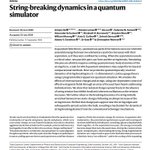
QUANTUM COMPUTER MADE PARTICLES FROM ENERGY
there is a process in particle physics called string
breaking. pull a quark and antiquark apart and the
gluon field between them stretches like a rubber band.
at some point the stored energy is enough to create a
new pair of particles. matter appears where there was
only force.
this is how confinement works. quarks never exist
alone because every time you try to isolate one, new
quarks appear and pair up. similar dynamics played out
in the early universe when quarks first became confined
into protons and neutrons.
a team at duke ran this on a quantum computer.
thirteen trapped ytterbium ions in a chain, each one a
site on a simplified lattice. laser beams controlled
the interactions. they raised the string tension and
watched charges appear.
what they saw was unexpected. the standard picture
says pairs should form along the entire string. here
they formed at the edges and moved inward. a mechanism
nobody predicted from a one-dimensional lattice.
> duke: 13 trapped ions, 1d model, nature physics,
> september 2026
> google: 45 qubits on sycamore, 2d model, nature,
> june 2025
> quera: rydberg atom array, 2d with dynamical
> matter, nature, june 2025
three teams, three platforms, same physics. none
produced real quarks. the models are simplified and
classical computers still handle this scale.
the result matters for a different reason. for the
first time quantum hardware simulated the strong force
creating particles from stored energy. the models will
grow. when they reach full three dimensions and
hundreds of qubits, classical machines will not keep
up. these simulators are being built for that
threshold.
link to the paper in the comments


AI FOUND THE STANDARD MODEL IN OLD DATA
researchers at nyu abu dhabi fed a machine learning
system particle data from the 1950s and 60s. masses,
spins, decay modes. no equations and no guidance on
what to look for.
the system found baryon number. isospin. strangeness.
charm. it sorted particles into the eightfold way,
the classification gell-mann built in 1961. it found
regge trajectories connecting mass to spin.
this was not some massive deep learning model. they
used pca, t-sne, and clustering. methods that have
existed for decades. intro-level machine learning.
the data has been sitting there since the 1950s. the
patterns were in it the whole time. gell-mann spent
years of theoretical work to see them. the algorithm
found them with compute time and zero physics.
> published in journal of high energy physics,
> march 2026
> next step: can ai find quarks as building blocks
> on its own
> and can it infer gauge symmetries from field
> theory data
the question that follows: what happens when you
point these methods at modern data. the lhc produces
petabytes per year. most of it gets filtered through
the standard model before anyone looks at it.
patterns outside that framework would not survive the
pipeline.
a caveat. finding known patterns is a proof of
concept. the real test is whether unsupervised methods
catch something in data where nobody knows what to
expect. that has not happened yet. the methods are
cheap enough to try at scale, and the data exists.
link to the paper in the comments

WARP DRIVE WITHOUT NEGATIVE MASS
alcubierre figured out the geometry for a warp bubble
in 1994. space contracts ahead, expands behind, ship
rides inside in flat spacetime. the math worked. one
thing it required: negative energy density. matter
that probably does not exist.
for thirty years that was where every warp drive
conversation ended.
last year fuchs and collaborators published a solution
in classical and quantum gravity. same type of bubble.
positive energy only. satisfies all three classical
energy conditions. peer-reviewed.
> works below lightspeed
> needs roughly a jupiter mass converted to energy
> no exotic matter required
a jupiter mass of energy is beyond anything human
civilization has produced in its entire history, by
many orders of magnitude. and it only gets you below
lightspeed. superluminal still requires exotic matter.
what makes the result interesting: for thirty years
the objection to warp drives was fundamental. you
needed matter the universe probably does not contain.
that objection is gone. what remains is a question of
energy at a scale nobody can approach. the physics
conversation about warp drives changed for the first
time since 1994.
link to the paper in the comments

THEY DROPPED ANTIMATTER
for a hundred years we assumed antimatter falls down. the math said so, einstein said so, nobody argued. nobody tested it either.
in 2023 the ALPHA team at CERN made antihydrogen, trapped about a hundred atoms in a magnetic bottle, and slowly opened it. if the atoms fall, most escape through the bottom. if they float up, most escape through the top.
about 80 percent went down.
> measured acceleration: roughly three quarters of g
> precision: about 20 percent
> published in Nature, september 2023
the number is rough but the direction is clear. antihydrogen was hard to test because it annihilates on contact with any surface. making it, cooling it, and holding it still long enough for gravity to win over thermal noise took three decades of engineering at CERN.
several quantum gravity models predicted that antimatter would repel the earth. if that were true, you'd have a clue about dark energy and maybe about why the universe has more matter than antimatter. the experiment closed those models off.
the 2024 run reproduced the result. three experiments — ALPHA-g, AEgIS, and GBAR — are racing toward one percent precision. they plan to laser-cool the atoms to about a thousandth of a kelvin and eventually use atomic interferometry. if gravity treats antimatter even a fraction of a percent differently, the data should catch it.
for now the answer matched what everyone assumed. it just took until 2023 to have proof.
link to the paper in the comments.


THEY FOUND A THIRD KIND OF MAGNETISM
an altermagnet cannot pick up a paperclip and physicists still call it a magnet. i think the name is fair, and the reason took me a while to see.
at school a magnet is the thing that sticks to the fridge. that definition describes the field outside the material. inside iron every atom carries a tiny spin arrow and neighbors point the same way, so the arrows add up to a field that can lift a paperclip.
in an antiferromagnet neighbors point in opposite directions. the arrows cancel and the field outside is zero. the electrons inside do not tell spin apart either: spin up and spin down have the same energy at every direction, so a current through it is not polarized.
that second part is what electronics wants from a magnet. the paperclip is just the easiest way to notice that spin up and spin down electrons behave differently.
the third kind has the same alternating arrows and the same zero total. the difference is the shape of the crystal around the atoms. in an antiferromagnet the surroundings of a down atom match those of an up atom, shifted by one step. in an altermagnet the same surroundings are turned around, in the simplest case by 90 degrees.
so the energy of an electron depends on its spin and on the direction it runs:
> spin up: moves easily along x, hard along y
> spin down: moves easily along y, hard along x
average over all directions and the two pictures cancel exactly, which is where the zero magnetization comes from. along any single direction there is no cancellation.
push a current along x and it comes out mostly spin up. turn the sample by 90 degrees, push the same current and it comes out mostly spin down. outside the sample there is no field.
for memory this is practical. an antiferromagnetic bit leaks no field into its neighbors and gives a current with no spin polarization, so there is nothing to read. an altermagnetic bit leaks no field either and gives a spin polarized current.
the idea got a europhysics prize in september.

HOLY F*CK... A HYDROGEN ATOM IN ITS GROUND STATE HAS A CURRENT FLOWING IN IT AT ABOUT 2 MILLION METERS PER SECOND
the 1s orbital in a textbook is a smooth ball with nothing moving inside. for the plain schrodinger equation that holds: the wave function is real, so the probability current is exactly zero.
switch to the pauli equation and the electron gets a spin. the current picks up a second term, proportional to the curl of the spin density.
for spin up along z, the spin density is the same ball pointing up. its curl is a loop around the z axis:
> j = (hbar / (m * a)) * rho * sin(theta), going around the axis
> rho = the usual 1s density, a = the bohr radius, about 0.05 nm
divide the current by the density and the flow speed is hbar / (m * a), strongest at the equator. that is about 2 million meters per second, roughly 1/137 of the speed of light.
bohr's 1913 orbit had exactly this speed. here the same number belongs to a flow inside a ball whose density never changes in time.
add up the magnetic moment of the loop and it comes out as one bohr magneton. the measured electron moment is within 0.1 percent of that, and the pauli equation delivers the g = 2 on its own.
in the clip, orange arrows run counterclockwise and blue ones clockwise. white marks the places where the flow nearly stops. the small colored shape in the corner is the textbook orbital.
dividing current by density is the hydrodynamic reading of the equations. experiments measure the moment and the energy levels, and those are what this picture has to reproduce.