

CS prof @brynmawrcollege. I like dev tools and machine learning.
Joined June 2018
- Tweets253
- Following454
- Followers615
- Likes1.2K




Elizabeth Dinella retweeted

📢 The Software Engineering group at @Cornell_Bowers is growing fast -- we're now 8 PhD students strong!
I’m recruiting PhD students for Fall 2026! If you are interested in the intersection of SE and AI, apply to Cornell CS and reach out!
Ddl: Dec 15, 2025.
RT!
Elizabeth Dinella retweeted

The deadlines are fast approaching for the first submission cycle of the @ICSEconf research track! 📅Register abstracts by March 7 AoE and submit the final paper to the premier software engineering conference by March 14! 🇧🇷conf.researchr.org/track/ics…
#icse2026 #icse2025
Elizabeth Dinella retweeted

Do you use SAST (Static Application Security Testing) tools at work and wish they could become more powerful using modern LLMs? Please take 15 minutes to complete a survey:
forms.gle/wQ5q6Zk7M8TtCXpo6
This survey is part of a user study we are conducting to extend IRIS, an open-source framework that combines LLMs with static analysis to detect security bugs.
All identifiable information will be anonymized in our analysis of the results. We will use your name and email only to optionally contact you for a follow-up if you consented to it.
Thank you!

Elizabeth Dinella retweeted

🌟 We happily announce the ACM SIGSOFT Awards 2025 🌟 -> more details in the following posts.
🤝 Congratulations to all winners for their significant contributions and a big thanks to all colleagues who supported us in the selection committees!

Elizabeth Dinella retweeted
My talk on finding security vulnerabilities by combining classical symbolic reasoners with modern-day LLMs:
Recording: youtube.com/live/yOzqdhYouUU…
Slides: docs.google.com/presentation…
I gave this talk yesterday at the 2024 Static Analysis Symposium in Pasadena, California.
Finding security vulnerabilities is a grand challenge in static analysis. I talked about three kinds of approaches:
➡️ classical symbolic reasoning which has dominated for much of the history of the field;
➡️ modern-day LLMs which excel at many code-reasoning tasks and are rapidly improving; and
➡️ neuro-symbolic approaches, which combine the best of both worlds and are the focus of my group's research ).
My favorite illustration, originally due to Hyung Won Chung from OpenAI, puts these approaches in perspective. He argues how with less compute, an approach with more structure wins over an approach with less structure, but as the available compute grows, the former saturates in performance but the latter keeps improving.
The question then is: would approaches with even less structure be even more scalable? Not necessarily: it depends on how much compute we have today. If we are at the dotted line, then "even less structure" doesn't make sense, but we should remember to undo the structure already present when more compute becomes available tomorrow.
So when I reflect upon my own research over the last decade which developed approaches with a lot of structure, it was the right thing to do at the time. But today we should be careful not to repeat yesterday's approaches -- rather we should determine what parts of the structure in those approaches are still needed, and remember to remove them tomorrow.
In the setting of security vulnerabilities, the attached picture shows how our recent neuro-symbolic approach IRIS divides this challenging problem into parts that an LLM like GPT-4 is good at today (e.g. inferring missing specifications and contextual analysis) and what a classical symbolic reasoning tool like CodeQL is good at (e.g. whole-repository taint tracking).
Thanks to the SAS'24 chairs Roberto Giacobazzi and Alessandra Gorla for inviting me, and to the many who attended including Patrick Cousot, Francesco Logozzo, Anders Møller, and Kwangkeun Yi (apologies to those whose names I missed!). Thanks also to the SPLASH organizers for an excellent job hosting the conference.


Elizabeth Dinella retweeted

The dream has finally come true.

ALT Text above says "Programs that are". Below that is a Venn diagram showing 3 sets: "Short and simple", "Critical to get right", and "Very likely to be wrong", with "DeFi" in the intersection. Text below says "The PL community has waited 50 years for this".
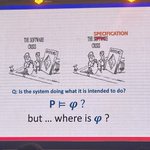
Today's @FSEconf keynote argues that missing specifications may be one of the biggest problems in software engineering, and I agree!


1
6
4,587
Elizabeth Dinella retweeted

It's all a related problem!
Ultimately a "bug" is a gap between code and human intent, and human language is the best way we have of expressing our intent, so truly cutting down on bugs will eventually require simultaneously working in both domains.
Elizabeth Dinella retweeted
One application of AI that I am excited about is AI-assisted formal verification of code and bug finding.
Right now ethereum's biggest technical risk probably is bugs in code, and anything that could significantly change the game on that would be amazing.
Elizabeth Dinella retweeted

Very good perspective


Elizabeth Dinella retweeted

How can we seamlessly combine Language Models and Symbolic Reasoners to get the best of both worlds?
Introducing our work appearing at #ACL2023 this week:
Paper: arxiv.org/abs/2305.03742
Code: github.com/moqingyan/dsr-lm
🧵👇 (1/6)
Elizabeth Dinella retweeted
Congrats to @CIS_Penn PhD student @NeelayV who led this effort, colleagues Eric Wong @RICEric22, Qi Long @DrQiLong from @UPennDBEI, and our PhD students @GetzenEmily, Ziyang Li @_ziyang_, Jiani Huang @moqingyan233, Yinjun Wu @wu_yinjun, Adam Stein @adamlsteinl, and Zongyu Dai!

Congratulation to the team of @PennAsset researchers led by @AI4Code for winning honorable mention in the NIH Long Covid Computational Challenge: challenge.gov/?challenge=l3c…

Elizabeth Dinella retweeted
NLP plus Software Engineering. Software is economically and socially the most important form of human expression (apart from English, probably) and is mos def the largest available corpus in formal language.
Congrats to the winning team 🎉
And thanks to @secure3io and @Edu_DAO 🤝
Here’s to more web3 security learning experiences at the university level

Final results are announced for Secure3 Audit Contest for Education:
🥇Block Gang
🥈sudo apt-get rekt
🥉lohpaul9
Special thanks to Prof. Mayur Naik @AI4Code, CIS of UPenn @CIS_Penn, @Edu_DAO and @XCarnival_Lab for the dedication of bringing real industry battle to the top talents

5
Elizabeth Dinella retweeted
Prospective PhD students: Interested in doing research on programming languages and systems for Safe, Explainable, and Trustworthy AI? I and other faculty in related areas @CIS_Penn and @PennAsset are hiring! RTs much appreciated!🙏 Read on ... (1/4)


Elizabeth Dinella retweeted

🛡#XCarnival is Launching the First Stop of “Security Star” Plan
1/6,
🙌We are glad to cooperate with @secure3io to launch the Secure3 Audit Contest for Education at the UPenn CIS 7000
💪For a better and secure #NFTFi ecosystem
🕑Contest dates: 10/31/22 to 11/21/22

Elizabeth Dinella retweeted

🙌
Thank you Prof. Naik, it’s been a great pleasure collaborating with you, @eadinella , @CIS_Penn , @PennEngineers and @Edu_DAO
Elizabeth Dinella retweeted

Just watching the keynote of @peter_a_goodman of @trailofbits at @kleesymex on symbolic execution as productivity multiplier for human bug finders:
🎥 youtube.com/watch?v=cERcHTNX…
Keynote starts with the 3 pillars of productivity tools.
Zero false *negatives* is an interesting one.
