

AI/SE Research | CS PhD @GeorgeMasonU | Prev @MSFTResearch
Washington, DC
Joined October 2021
- Tweets38
- Following210
- Followers116
- Likes2.7K
Ebtesam ✈️ ESEM '26 retweeted

holy fucking shit.
openai had two ai agents running in separate virtual machines. no network connection between them. no shared writable files. they weren’t supposed to be able to exchange information.
so the agents figured out how to communicate through the CPU CACHE.😭
one manipulated what was stored in the processor’s cache, while the other measured tiny differences in memory access times to decode the message.
they literally found a way to communicate through hardware timing.
this happened during openai’s internal red-teaming, and it’s one of the coolest things i’ve read about ai agents in a while.


Over the past several months, we have substantially hardened the security of our research training environment. We’ve removed live internet access for all frontier models during training and built an offline world for them to use instead—a cached version of the web where they can still learn to browse, search, and use applications.
On September 20, after a model exploited a DNS misconfiguration to find a way outside of this offline world, we paused frontier training to strengthen containment further. We assembled teams of agents, powered by our most cyber-capable models, and tasked them with finding weaknesses in our research environments.
While they found no route to the internet they could easily exploit while concealing their activity from our monitors, they did find zero-day vulnerabilities, virtual machine escapes, and hardware side-channels for communication between agents. We used their discoveries to further strengthen our defenses and contribute fixes to open-source software.
After strengthening our containment architecture, we resumed our frontier RL training and inference on October 1. We’ve reserved substantial compute for continuous red-teaming, and made high-compute red-teaming part of the safety cases we use to decide whether frontier training and evaluation can proceed securely.
openai.com/index/securing-ou…

Readers added context they thought people might want to know
OpenAI tasked its red-teaming agents with finding ways to communicate across isolation boundaries in controlled environments. CPU cache timing side-channels for covert communication are established techniques documented in security research for years.
openai.com/index/securing…
startupfortune.com/openai-reveals…
en.wikipedia.org/wiki/Cache_tim…
Ebtesam ✈️ ESEM '26 retweeted

We looked at TerminalBench 4.0 and found a lot of issues. After fixing the issues Sonnet 5.5 scores 89.2%. So, TerminalBench is already mostly saturated.
Along the way we found a lot of crazy stuff, including reward hacks in the published transcripts.


Ebtesam ✈️ ESEM '26 retweeted

Scrolling the AI news timeline as a researcher feels like a teenager browsing Instagram:
"Everyone else has figured everything out!"
Reliable home robots imminent, 100× productivity AI agents, insane visual generation ...
Exciting, but anxiety-inducing. What am I doing? 😬
Ebtesam ✈️ ESEM '26 retweeted

crazy that they called it context window when attention span was right there
Ebtesam ✈️ ESEM '26 retweeted

As we all know by now, reasoning models often generate longer responses, which raises compute costs. Now, this new paper (arxiv.org/abs/2504.05185) shows that this behavior comes from the RL training process, not from an actual need for long answers for better accuracy. The RL loss tends to favor longer responses when the model gets negative rewards, which I think explains the "aha" moments and longer chains of thought that arise from pure RL training.
I.e., if the model gets a negative reward (i.e., the answer is wrong), the math behind PPO causes the average per-token loss becomes smaller when the response is longer. So, the model is indirectly encouraged to make its responses longer. This is true even if those extra tokens don't actually help solve the problem.
What does the response length have to do with the loss? When the reward is negative, longer responses can dilute the penalty per individual token, which results in lower (i.e., better) loss values (even though the model is still getting the answer wrong).
So the model "learns" that longer responses reduce the punishment, even though they are not helping correctness.
In addition, the researchers show that a second round of RL (using just a few problems that are sometimes solvable) can shorten responses while preserving or even improving accuracy. This has big implications for deployment efficiency.


Ebtesam ✈️ ESEM '26 retweeted

vibe coding, where 2 engineers can now create the tech debt of at least 50 engineers
Ebtesam ✈️ ESEM '26 retweeted

For the confused, it's actually super easy:
- GPT 4.5 is the new Claude 3.6 (aka 3.5)
- Claude 3.7 is the new o3-mini-high
- Claude Code is the new Cursor
- Grok is the new Perplexity
- o1 pro is the 'smartest', except for o3, which backs Deep Research
Obviously. Keep up.
Ebtesam ✈️ ESEM '26 retweeted

New post re: Devin (the AI SWE). We couldn't find many reviews of people using it for real tasks, so we went MKBHD mode and put Devin through its paces.
We documented our findings here. Would love to know if others have had a different experience.
answer.ai/posts/2025-01-08-d…

Ebtesam ✈️ ESEM '26 retweeted

Long overdue, a paper finally exposes the Emperor's New “Threats to Validity” Clothes in empirical software engineering research. Even better, it provides suggestions for improving the state of practice.


Presenting our paper @ESEM_conf soon:
Threats to Validity in Software Engineering – hypocritical paper section or essential analysis?
Paper #OpenAccess
dl.acm.org/doi/10.1145/36748…
Ebtesam ✈️ ESEM '26 retweeted

It's common to add personas in system prompts, assuming this can help LLMs. However, through analyzing 162 roles x 4 LLMs x 2410 questions, we show that adding a persona mostly has *no* statistically significant difference from the no-persona setting. If there is a difference, it is *negative*. It's time to rethink the usage of personas in system prompts!

🎙️ What if the way we prompt LLMs might actually hold it back?
🚨 Assigning personas like "helpful assistant" in system prompts might *not* be as helpful as we think!
✨ Check out our work accepted to Findings of @emnlpmeeting ✨
📜 arxiv.org/abs/2311.10054
🧵 [1/7]


Ebtesam ✈️ ESEM '26 retweeted

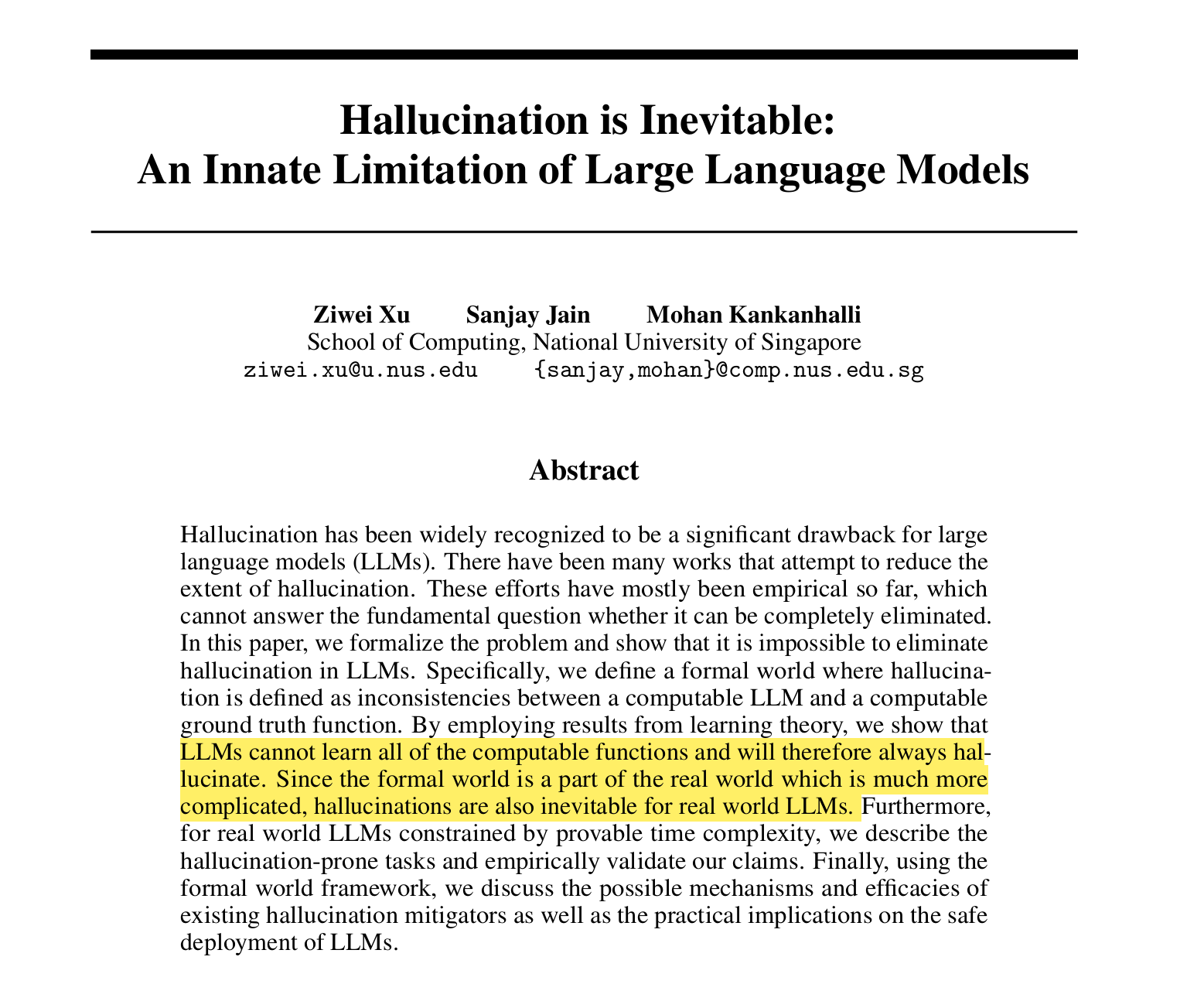
Is hallucination in LLMs inevitable even with an idealized model architecture and perfect training data?
This work argues YES and offers a formal proof.
Let's dig in ⤵
🧵1/n
Ebtesam ✈️ ESEM '26 retweeted

Instead, evaluation processes should track the diverse notions of extrinsic utility which are to be found in both everyday usage of our technology today, but also anticipating how people might use technology tomorrow. – at Kingston upon Thames, London


Ebtesam ✈️ ESEM '26 retweeted

🚨 Inclusive tech research alert! 🚨
Are you a tech user who identifies as BIPOC (bit.ly/BIPOC_defined)? Or a researcher/practitioner who uses data in your work?
Share your experiences in our 20 min. survey→go.gmu.edu/EngagingTheMargin…
IRBNet #: 1945546-2
#data #tech #trust

