

@eccentric_node
Account based inUnited States
About this account
- Account based in
- United States
- Connected via
- United States Android App
Account-level information from X, not a live location or the device used for a specific post.
web developer or something
Phoenix, Arizona
Joined May 2017
- Tweets939
- Following128
- Followers69
- Likes2.2K





Austin Johnson retweeted

I've never seen this before in my career: 28-30 year olds who refuse to use AI coding tools.
You show them what they can do augmented (not replaced) with AI and you see in their eyes that they have no damn clue of what's happening.
You can't work with these people anymore. Time used to pass over older generations slowly. Now it's passing over us at the peak of our careers.
Sadly, adaptability isn't optional at this point.
Austin Johnson retweeted

SpaceXAI engineer, Lauren Tan:
"I was a meat proxy between my agent and my browser. So I fired myself
Now 10+ Chiefs of Staff run my agents 24/7 and I just check the work in the morning"
In 1 hour, she shows exactly how she built that dark factory with GrokBot
Skills → Verification → Loops → GrokBot → Dark Factory
Most engineers still babysit one agent. She fired herself from that job
This talk is worth more than most $1,500 agentic engineering courses
Bookmark and watch it today
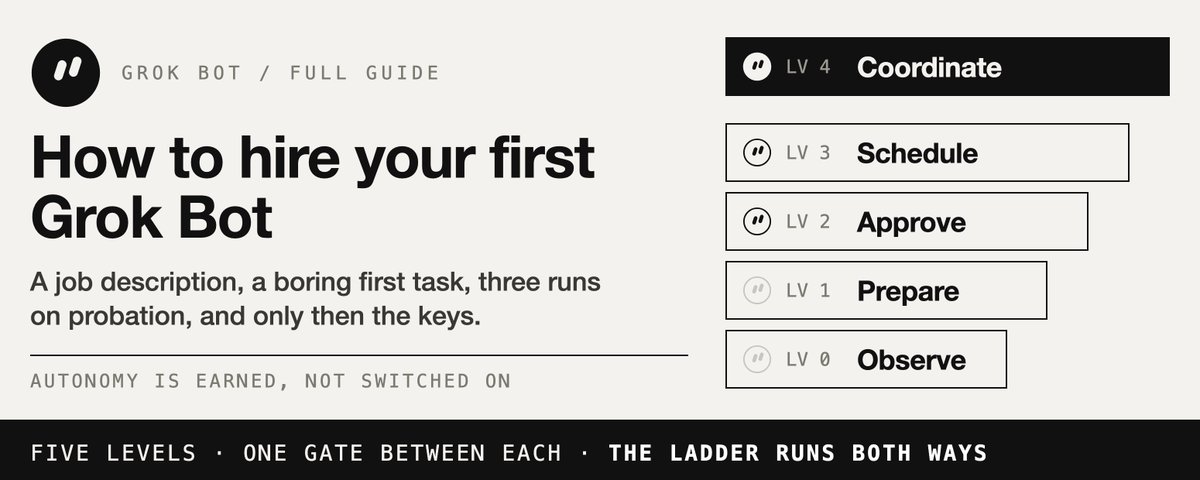
Then read how to hire your first team of Grok Bots in the article below ↓

Austin Johnson retweeted

This is an extremely good watch.
The things that felt novel/interesting to me:
1. Lock down your agents
Humans tend to like 'sharp knife' abstractions - that are powerful, but you can cut yourself if your use them wrong. Lauren says agents perform much better in extremely locked-down environments. Abstractions are designed so they can't screw up, and lint rules enforce it.
They built a whole internal framework (Dune) to keep the agent on track.
That helps optimise agents that don't have a large context window to work productively in your codebase.
2. Create verification infrastructure
To trust the results of any agent, you either need to sit and watch it OR have it provide evidence of its improvement. This has always made sense to me, but Lauren really pushes it hard here:
- Invest in custom CLI's that let the agent drive the app and measure its performance
- Make the app "factory ready" from the get-go - i.e. deployable to an environment where the agent can mess about with it
3. Feature Maps
Lauren's software factory (what she calls an 'outer loop') often requires the agent to break down vague bug reports from users and to turn those into potential fixes.
To aid that, they built a 'feature map' of all the main features in their application, which describe exactly how the app is supposed to function.
This has become essential for helping the agent navigate the codebase, and figure out quickly how things are supposed to work. It's maintained along with the codebase, and kept in sync via automations.
This is the kind of documentation I usually warn against. It goes stale quickly and can confuse agents if it's not kept up to date.
But Lauren's team are using it as critical navigation infrastructure, and it makes it possible for agents to explore faster and better - even on a large codebase. So it sounds like navigation docs like this are worth it if they enable new behavior.
Banger talk - watch the whole thing on 2x.

here's how i shipped 2,500 PRs last month to production
this was originally supposed to be for Cursor Compile in London. i couldn't make it since i was livestreaming for Grok @Bot Galaxy so i'm making it available for free here on X! watch it on 2x speed, i talk slowly


Austin Johnson retweeted

I make more than $20,000 a month from X and Kindle now.
And if someone asks me how to grow on X, the first thing I tell them is surprisingly simple:
Stop writing a diary.
Completely.
This is also the hardest advice for almost everyone to accept.
People naturally think:
I have experience.
I have knowledge.
I have an interesting life.
I have something important to say.
So why isn't anyone listening?
Because none of that matters to the reader.
Imagine you're sitting on a train.
A stranger sits nearby and suddenly starts talking loudly about himself.
His career.
His opinions.
His achievements.
His problems.
His childhood.
His plans.
Maybe he's an extraordinary person.
But you don't know him.
Why would you care?
You'd probably move to another car.
X is basically one enormous train full of people doing exactly that.
"Here's what I did today."
"Here's what I think."
"Here's what happened to me."
"Here's what I accomplished."
"Here's my story."
And then they wonder why nobody stops scrolling.
Because the reader didn't open X to care about you.
The reader opened X thinking about himself.
His family.
His job.
His money.
His country.
His memories.
His frustrations.
His fears.
The things that make him laugh.
The things he misses.
The things he loves.
So stop asking:
"What do I want to write?"
Ask:
"What does the reader want to read?"
That's the entire shift.
I don't begin with myself and figure out how to make my story interesting to readers.
I begin with the reader.
What will make him laugh?
What will make him angry?
What will make him remember his father?
What will make him think about his childhood?
What will make him send this to an old friend?
What will make him stop for ten seconds and think:
"That's exactly how I feel."
Then I write THAT.
My own life is irrelevant unless it helps me create that reaction.
My experiences are not the subject.
I am not the subject.
The reader is the subject.
This sounds simple.
It isn't.
Because the human instinct is incredibly strong:
"I want to tell my story."
And that's why 99 percent of people go right back to writing diaries.
They want the audience to become interested in them.
I do the opposite.
I become interested in the audience.
When one of my posts goes viral, I don't think:
"Wow, people loved my story."
I think:
"I found something that already existed inside a lot of people."
That's the difference.
Don't write something and then ask how to make people care about it.
Start with what people already care about.
Then write for them.
Not about yourself.
Not to express yourself.
Not to prove your value.
For them.
The reader is not visiting your world.
You are visiting theirs.
Austin Johnson retweeted
babe wake up, watch this.
youtu.be/8Xrvyu5tV28?si=qyFK…

Austin Johnson retweeted
some rough draft thoughts as to where 2026 and beyond is going. I know I'm kind of beating my own drum by the fact that I work at the only company (@AntithesisHQ) that has a deterministic hypervisor and fuzzing that's able to stress test a unit of work to see if the properties of a system hold true even in the worst of scenarios.
but
I wouldn't have joined these folks if it my thoughts as to the future didn't align.
The generation of code is solved. I know it may hurts some feelings to say this, but deep down you know it to be true. What is not solved is ensuring that the software is correct, also known as verification.
AI cannot verify itself. It just can't. The state space between your application in development versus running in production is just so massive. Just because it compiles doesn't mean it works.
I'm getting back on the conference circuit again. What follows is a slide that I put together that focuses on definition of agentic back pressure, how do do it and where people should be placing their energy to keep these autonomous ralph loops (or loops in general) on the rails.
Thoughts?

Austin Johnson retweeted

It's out: Meeting Recorder 1.1
It finds speakers with @nvidia Nemotron 3 Diarization: on two real meetings, the wrong-speaker rate went from 17% and 54% to 2% and 6%. What?!
github.com/jankeesvw/omarchy…
Austin Johnson retweeted
At the @aiDotEngineer World Fair, I sat down and dumped my brain on a podcast. Here are my latest ponderoos on these topics…
✨ Why code doesn't need to be readable by a human anymore; it needs to be explainable to one.
✨Why frontier intelligence isn't required for most tasks, and why some of the sharpest engineers I know run 20 concurrent $300/year subscriptions instead of one frontier plan.
✨ Why I haven't hand-written code in over two years, and why Git is perhaps already end of life.
✨ Why porting between programming languages is now nearly free, and what that means for which languages survive.
Austin Johnson retweeted
My most ambitious Omarchy app yet: Meeting Recorder.
It records your mic and computer audio as two tracks and transcribes everything locally with whisper.cpp. No bot in your call, nothing leaves your machine.
github.com/jankeesvw/omarchy…

Austin Johnson retweeted

Chads.. you can now chat and vibe code with Claude while playing WoW Forever.
Open a chat window in game, send Claude a task, go back to leveling. It pings you when it's done. No alt-tab, no /reload. Link below.
#worldofwarcraft @Asmongold wow-claude

Austin Johnson retweeted

Brilliant paper by NVIDIA.
they found a way to make KV cache transferable between models.
the target model skips prefill entirely, and the conversion runs 2.7 to 25x faster than processing the context again.
let's understand why this is so important today.
LLM APIs are stateless, so every turn sends the entire conversation back to the model. the model reads it again before generating a new token, and all of it is billed as input.
prompt caching lets providers hold the KV cache for a stable prefix and bill cache hits at roughly 10% of the base input rate because that compute was already done.
this 90% reduction is one of the biggest levers in LLM serving.
but the cache only works on the model that produced it. since keys and values depend on that model's weights, another model cannot directly reuse them.
this becomes a problem with LLM routing.
if traffic moves to another model for cost or capability reasons, the accumulated KV cache becomes invalid.
the entire context must be processed again and billed at full rate.
NVIDIA's recent paper treats this as a representation problem.
prefill's main output is the KV cache, so transferring it means converting one model's cache into the representation another model expects.
they first checked whether this conversion had enough structure to exploit.
for Qwen3 14B → 32B, a linear regression from a single source layer reconstructed 56% of the variance in the target model's keys.
because models can have different layer counts, there is no natural one-to-one layer mapping.
so, for every target layer, they rank the source layers by predictive power and use the top eight together.
that pushes reconstruction to 79%.
the mapper has three parts:
> each target layer and head gets its own linear map, solved in closed form instead of with gradient descent.
> cross-layer selection chooses the source layers that best predict each target layer. their ablation shows this contributes the most.
> RoPE adds a position-dependent rotation to keys. they remove it, fit the mapping in position-free space, then apply the target model's rotation again at inference.
across six model pairs from Qwen3, Llama 3.1, and Ministral 3, four retain 73 to 98% of the receiving model's standalone accuracy.
conversion is also 3 to 25x faster than processing the context again.
prior cross-model KV reuse methods either train a neural adapter for every pair or require architecturally identical models.
this approach is closed-form and training-free, but there are still important limitations.
every tested pair belongs to the same model family, such as Qwen → Qwen or Llama → Llama.
cross-family transfer is still future work.
the tested pairs also share KV head count and per-head dimension. mismatched configurations remain untested.
and the work currently covers dense full-attention models only, not sliding-window or attention-recurrent hybrids.
link to the paper: arxiv.org/abs/2608.03893
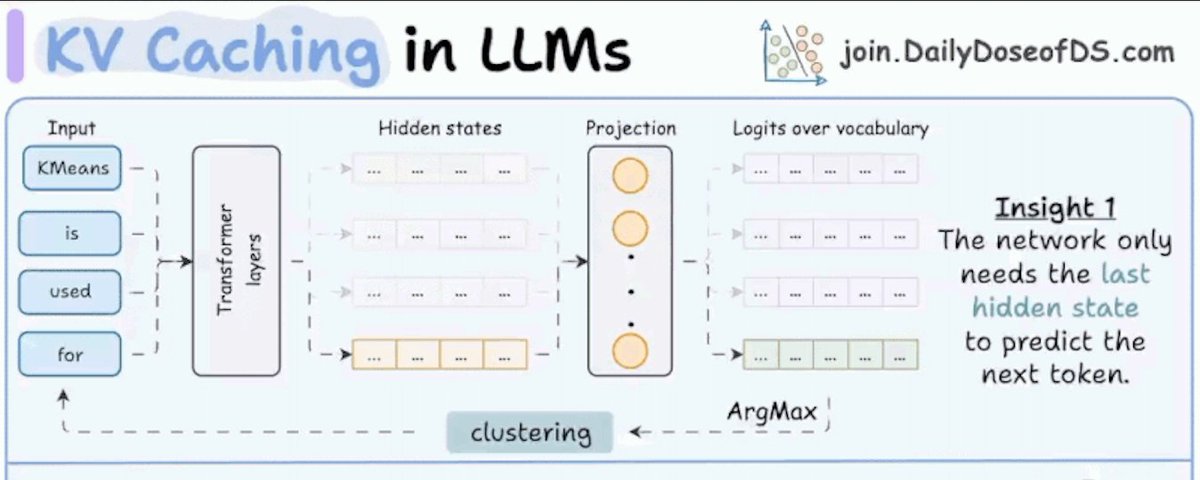
i wrote a first-principles breakdown of how KV caching works
the article is quoted below.

Austin Johnson retweeted
tbh @mikehostetler has built something exceptional over the last year with jido.run/

Austin Johnson retweeted
"If you can build a verification system and give proper direction, AI can produce a highly complex, highly sophisticated piece of software and it can continue to refine it until it just works." - @pauldix
pauldix.com/the-end-of-progr…


Austin Johnson retweeted

The VOD for my BSC2026 talk "The Root of The Root of All Evil" is now available! It's the spiritual successor to last year's "The Big OOPs", so if you enjoyed that one, join me for one more adventure into the history of computer science:
computerenhance.com/theroot

Austin Johnson retweeted

most excellent article about why hosting Git is hard, cheers @vmg
cursor.com/blog/git-at-any-s…

Austin Johnson retweeted

lots of great engineering blogs recently:
- @cursor_ai's git post
- @linear's post on sync + @turbopuffer
- @jarredsumner's bun rewrite post
- whatever @PlanetScale happens to have posted this week
am I missing any?
Austin Johnson retweeted

In my early days, I had to numb myself. There was so much work. The amount of work you can only measure by how much it weighs. And if I stopped to think about how “unfinishable” the amount of work I had to do was, I would’ve quit.
So I did the only thing I could do, I’d take the first thing off the stack and start…without thinking about how shitty & alone I felt. And how everyone I knew was enjoying their life in their perfect bubble of security following the path someone else put in front of them.
There’s a reason race horses wear blinders. Focus only on what’s in front of you.
You’ll get through it. Keep going.