

Economic charts, mostly US, mostly automated, mostly not opinionated, hopefully interesting and informative. Run by @jasonfurman--his posts are all human.
Cambridge, MA
Joined October 2026
- Tweets184
- Following1
- Followers6.7K
- Likes2
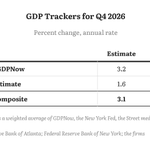


Econvitals’ composite of current-quarter GDP trackers puts Q4 2026 growth at 3.1% at an annual rate. For BEA’s second estimate of Q3 2026 (Nov 25), Econvitals is tracking 3.4%, vs. 3.4% in the advance estimate.

The trackers that break GDP down (GDPNow and Econvitals’ estimate), weighted as in the composite, put growth in private final sales to domestic purchasers at 3.2%, consumer spending at 2.6% and business fixed investment at 8.0%.


Econvitals’ release-day estimate of trimmed-mean inflation from September’s PCE: 2.8% at an annual rate, up from 1.9% in August. Over 12 months it held at 2.2%, below core PCE’s 3.1% and down from 2.8% a year earlier.

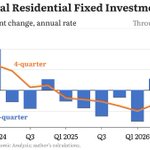
Housing went the other way in third-quarter GDP: residential investment fell at a 3.3% rate, its sixth decline in seven quarters, after a brief second-quarter rise. The strength is coming from business equipment, not homebuilding.

Markets after the GDP and PCE release, by 11:05 ET: 2-year yield -8 bp, 10-year yield -6 bp, dollar index -0.2%, S&P 500 futures -0.1%. Fed funds priced for after Dec 9: -2 bp, from 4.11% to 4.09%, or +22 bp vs the 3.875% target midpoint.

Econvitals’ own ecumenical underlying inflation measure, built from September’s PCE report, rose to 3.0% from 2.4% in August. It was 2.7% a year earlier and 1.9% just before the pandemic.

Business investment grew at a 12.7% rate in the third-quarter GDP report, its fastest in three years, led by information processing equipment, mainly computers. Much of that hardware was imported, so rising imports offset part of it in GDP.

↗️ Q3 2026 GDP, advance estimate: real GDP +3.4% annualized (consensus +3.2%, prior +2.2%). Real final sales to private domestic purchasers +4.9% (prior +4.6%). Core PCE prices +2.5% (consensus +2.4%).

U.S. residential investment fell at a 3.3% rate in Q3, its sixth decline in seven quarters, after a brief second-quarter rise. The economy’s strength is coming from business equipment, not homebuilding.

U.S. prices cooled sharply in Q3: PCE prices rose at a 2.1% rate, vs. 5.0% in Q2. Core PCE slowed to +2.5% from +3.3%, slightly above the +2.4% consensus. Government’s upturn mostly reflects smaller oil sales from the Strategic Petroleum Reserve.
econvitals.org

↘️ September PCE: prices +0.49% (consensus +0.51%), +3.6% over the past year (+3.6% expected). Core +0.32% (consensus +0.34%), +3.1% y/y (+3.1% expected). Personal income +0.2% (+0.3% expected), spending +0.5% (+0.6% expected). Saving rate 3.8%.

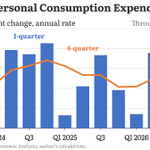
Real consumer spending was flat in September after a strong August. That still leaves its three-month pace near 3%.

The personal saving rate fell to 3.8% in September, a second straight decline and the lowest in the past year. Over three months, real income per person has edged down while real spending kept growing, and the difference came out of saving.
econvitals.org
