

Ancient Egypt art culture and history
Joined May 2023
- Tweets7.4K
- Following160
- Followers14.7K
- Likes2K




Pinned Tweet
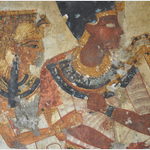
Queen Tiye: The Woman Behind Egypt’s Golden Age | Mini-Documentary
Queen Tiye was no ordinary royal consort.
In this mini-documentary, we explore the life, power, and legacy of one of Ancient Egypt’s most formidable women; a queen who rose from non-royal origins to stand beside Amenhotep III as his political equal, adviser, and trusted partner.
From her early life as the daughter of Yuya and Thuya, to her role as Great Royal Wife, mother of Akhenaten, and grandmother of Tutankhamun, Queen Tiye stood at the heart of Egypt’s golden age.
We also examine the mummy known as “The Elder Lady”, and how a lock of hair helped confirm her identity as Queen Tiye.
youtu.be/IGo-a1mOqHA

Donkey Carrying Grain to the Threshing Floor
Old Kingdom, 5th Dynasty, c. 2446–2389 B.C.
Tomb Chapel of Raemkai, Saqqara. Met Museum. 08.201.1f.
A beautifully observed limestone relief depicts a donkey laden with sheaves of harvested grain, accompanied by an attendant guiding the animal towards the threshing floor. The scene forms part of a larger agricultural procession decorating the eastern wall of the tomb chapel of Raemkai at Saqqara.
Such scenes celebrated the abundance of Egypt’s fertile agricultural lands, whilst symbolically ensuring an everlasting supply of provisions for the deceased in the afterlife. Even the humble donkey, so essential to everyday Egyptian life, was granted a place in this vision of eternal prosperity.

Ra-Horakhty enthroned with Ankh & Was-Sceptre before a table of offerings; from the Book of the Dead of Nedjmet
Third Intermediate Period, 21st Dynasty, c. 1070 B.C.
British Museum. EA10541

Papyrus of Ani “True Scribe of the King; His Beloved Scribe”, c. 1250 B.C.
Papyrus discovered within the Tomb of Ani, Qena Governorate, Theban Necropolis
British Museum. EA10470,12

Hathor, Lady of the West, Papyrus of Ani
New Kingdom, 19th Dynasty, c. 1250 B.C.
British Museum. EA10470,34.
The goddess Hathor, revered as the patroness of the western realm of the dead, is depicted in the form of a sacred cow emerging from the western mountains of Thebes, amidst the flourishing papyrus thickets that fringe the Nile Valley.
Around her neck hangs a menyet necklace, distinguished by its loosely strung rows of beads and pendulum-shaped counterpoise.
Closely associated with the worship of Hathor, this ceremonial ornament produced a rhythmic sound when shaken, accompanying sacred rites and celebrations in her honour. Between the goddess’s horns rests a radiant solar disc, crowned with two lofty plumes.

Henutnefret, Wife of the Royal Sculptor Ipuky
New Kingdom, 18th Dynasty, c. 1390–1350 B.C.
From the Tomb of Nebamun and Ipuky (TT181), Thebes, Egypt.
This elegant tomb painting depicts Henutnefret, wife of Ipuky, a distinguished sculptor who served during the reigns of Thutmose IV and Amenhotep III. Bearing the prestigious title “Chief of the Sculptors of the Lord of the Two Lands”, Ipuky belonged to the accomplished craftsmen of the royal court and may have contributed to the decoration of both kings’ tombs.
His beautifully decorated tomb, TT181, in the Theban Necropolis, was shared with a fellow sculptor named Nebamun, who is believed to have married Henutnefret following Ipuky's death.
Rich in scenes of domestic life, funerary ceremonies and offerings, the tomb offers a remarkable glimpse into the lives of the artists whose skilled hands helped shape the splendour of Ancient Egypt.

King Amenhotep I and his mother Ahmose-Nefertari
New Kingdom, 19th Dynasty, c. 1300 B.C.
From the Tomb of Neferhotep, Thebes, Egypt
This beautifully preserved wall painting depicts Amenhotep I of the 18th Dynasty alongside his mother, Ahmose-Nefertari, two revered figures who continued to be worshipped long after their deaths. Particularly honoured in the Theban necropolis, the royal mother and son were regarded as divine protectors of the community of tomb builders and craftsmen.
The scene adorns a pillar within the tomb of Neferhotep, “Chief Scribe of Amun” at Karnak, who lived more than two centuries after their reigns.
Following an extensive restoration programme, delicate laser-cleaning techniques have revealed the remarkable vibrancy of the ancient pigments, allowing the royal figures to emerge once more in much of their original splendour.

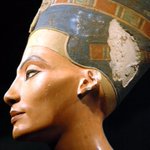
Bust of Nefertiti, c. 1345 B.C.
When the bust of Nefertiti was discovered, the left eye was missing its quartz iris, unlike the right eye. Despite an intensive search and a significant reward of £1000 offered for information about its whereabouts, the missing piece was never found.
Ludwig Borchardt, the German archaeologist who discovered the bust in 1912, theorized that the quartz iris had likely fallen out when Thutmose’s workshop fell into ruin. The absence of the iris sparked speculation that Nefertiti might have suffered from an ophthalmic condition, potentially losing her left eye. However, this theory was contradicted by other statues of Nefertiti, which depicted her with both eyes intact.
Borchardt also commissioned a chemical analysis of the pigments used on the bust, with the findings published in his 1923 book Portrait of Queen Nofretete. The analysis revealed the following materials:
•Blue: Powdered frit colored with copper oxide
•Skin tone (light red): Fine powdered lime spar colored with red chalk (iron oxide)
•Yellow: Orpiment (arsenic sulfide)
•Green: Powdered frit colored with copper and iron oxide
•Black: Coal mixed with wax as a binding medium
•White: Chalk
The missing eye remains one of the mysteries surrounding this iconic artifact, adding to the intrigue and legacy of Nefertiti’s timeless beauty.
Read more: egypt-museum.com/bust-of-nef…

Ibis Headed Thoth as seen within the Book of the Dead of Pennesuttawy, c. 1077-664 B.C.
British Museum. EA10064,14

Winged Scarab Amulet from Dendera, c. 305-30 B.C.
This silver winged scarab is inlaid with lapis lazuli, red jasper and green feldspar. It seems to have been fixed to a larger object since there are fasteners on the back side.
The winged scarab was a powerful image of solar rebirth for the deceased.
Amulets in the form of scarab beetles had become enormously popular in Ancient Egypt by the early Middle Kingdom (approx. 2000 B.C.) and remained popular for the rest of the Pharaonic period and beyond.
Photograph by Kenneth Garrett. Now in the Egyptian Museum, Cairo. JE 46356
Read more: egypt-museum.com/winged-scar…

Book of the Dead of Anhay
Within the Book of the Dead of Anhay (British Museum. EA10472,5), dating to the 20th Dynasty (c. 1186–1069 B.C.), unfolds a charming vision of the Ancient Egyptian afterlife. Here, the deceased enters the heavenly Field of Reeds, a land of fertile fields, winding canals and eternal abundance, where crops flourish and life continues beyond the grave.
Among its curious features are sacred Bennu birds, associated with rebirth, divine islands, granaries, and a mysterious boat bearing a staircase.
Far from an unfamiliar heaven, the Egyptians imagined paradise as an idealised reflection of their beloved Nile Valley, where the deceased might live forever in peace and prosperity.
• Which scene in Anhay’s vision of the afterlife fascinates you the most?
• What do you think the mysterious staircase aboard the sacred boat represents?
• Which curious little detail of the papyrus would you most like to know more about?
Read more: egypt-museum.com/papyrus-of-…

Mummy Portrait of a Bearded Man, c. 161–192 A.D.
From Er-Rubayat, Faiyum, Egypt
Kunsthistorisches Museum, Vienna. Inv. V 1983.
Read more: egypt-museum.com/faiyum-port…

The Golden Dagger of Tutankhamun, c. 1332-1323 B.C.
One of two magnificent daggers discovered upon the mummy of Tutankhamun, this exquisite ceremonial dagger, found resting upon the abdomen of the young king, measures 31.9 cm in length. The dagger bears a blade of hardened gold, with an elaborately ornamented hilt featuring delicate gold granulation and coloured inlay.
Its magnificent golden sheath is adorned with intricate patterns, floral motifs and scenes of wild animals, a testament to the extraordinary craftsmanship of Egypt’s royal goldsmiths.
More a jewel than a weapon, the dagger was a fitting possession for a pharaoh, accompanying him into eternity.
From the Tomb of Tutankhamun (KV62), Valley of the Kings, West Thebes. Now in the Grand Egyptian Museum. JE 61584A-B
Read more: egypt-museum.com/gold-dagger…

This Ancient Egyptian Woman Has European DNA
youtube.com/shorts/_SyTi4Zen…

Sky Goddess Nut arched over Earth Deity Geb
Papyrus of Tameni, c. 1077- 664 B.C.
British Museum. EA10008,3
▫️Ancient Egyptians believed that in the earliest days of existence, Geb and Nut lay entwined in a tight embrace, their bodies locked together in an eternal union. The world had yet to form; all was closeness and stillness. No space existed for life, no light to awaken the cosmos.
Seeing this, Atum (or in later traditions, Ra, the sun god), realised that creation could not proceed while Earth and sky remained inseparable. Thus, he commanded Shu, the air god, to intervene. With great sorrow and divine strength, Shu placed himself between the lovers, lifting Nut high above Geb, stretching her arched body over him to form the heavens.
Nut’s star-strewn form became the firmament, curving from horizon to horizon, while Geb, now pressed beneath, became the green and fertile Earth. Though forever parted, their longing endured. Each day, Nut swallows the sun at dusk, and each morning she gives birth to it anew, allowing Ra to sail across her celestial belly in his golden barque.
This mythological separation was not merely a tale of divine sundering, but a necessary act of cosmic balance, Ma’at. It created the very conditions for life to flourish: sky above, earth below, and air in between. Through this sacred division, the ordered world was born, and from it came all things, including gods, kings, creatures, and the rhythms of day and night.
Read more: egypt-museum.com/nut-geb/

Crystal ball amulet with golden head of Hathor
Napatan Period, reign of Piankhy, c. 743–712 B.C.
From El-Kurru, Northern Sudan (Kingdom of Kush). Museum of Fine Arts, Boston. 21.321
Read more: egypt-museum.com/golden-hath…

Mummy Mask of King Shoshenq II
King Shoshenq II was a pharaoh of Egypt’s 22nd Dynasty, a royal house of ancient #Libyan ancestry, during the Third Intermediate Period, around 890 B.C.
Believed by some Egyptologists to have been a son of Osorkon I and a descendant of Shoshenq I, he belonged to a dynasty whose Libyan forebears had risen to occupy the Egyptian throne. His reign remains something of an enigma, perhaps lasting only a year or two, although scholars continue to debate whether he ruled independently or alongside another king.
Little survives of his political achievements, yet his remarkable burial at Tanis, discovered in 1939, preserved an extraordinary legacy of royal splendour, including a magnificent silver coffin and exquisite gold funerary ornaments.
The mask is from Tanis and is now in the Egyptian Museum, Cairo. JE 72163
Read more: egypt-museum.com/inside-tomb…

Ammit awaits under the Weighing of the Heart scale
New Kingdom, 19th Dynasty, c. 1250 B.C.
From the Tomb of Ani, Thebes
British Museum. EA10470,32
Read more: egypt-museum.com/ammit/

Egypt Museum retweeted
🚨This Ancient Egyptian Mummy Revealed a Brutal Murder and European DNA 🧬✨
youtube.com/shorts/_SyTi4Zen…
Horemheb recieves the “Gold of Honour” (nbw n ḥswt), c. 1333–1319 B.C.
This finely carved limestone relief once adorned the tomb chapel of Horemheb, at a time when he was still a general serving under Tutankhamun. It records a moment of high ceremonial theatre, showcasing Horemheb’s huldiging, or formal honouring, for military and diplomatic success.
At the centre, attendants place heavy gold collars around Horemheb’s neck. This is the celebrated “Gold of Honour” (nbw n ḥswt); not a casual gift, but Ancient Egypt’s highest royal reward for loyal service. Such collars, often fashioned from rows of gold beads or crescent-shaped plaques, proclaimed royal favour as visibly as a modern medal. To wear them was to be publicly marked as a man close to the king.
Behind the general stretches a long procession arranged in registers. Prisoners of war are deliberately carved with foreign features and dress, set apart from their Egyptian guards. Victory, order, and hierarchy are all rendered in stone.
Now at the Rijksmuseum van Oudheden. H.III.PPPP
Read more: egypt-museum.com/the-honouri…
