

Partner @polymorphiccap | PhD in Mathematical Economics Bayes, not Bias
Joined September 2017
- Tweets117
- Following407
- Followers248
- Likes1.6K


Eldar | Polymorphic Capital retweeted

Last week, we introduced the new FHERMA and our vision for the future of privacy-preserving computation.
As AI makes implementations cheaper to create and specialize, the bottleneck shifts from building them to finding, evaluating, and integrating the best ones.
FHERMA is the infrastructure layer for that shift.
More ↓
fherma.io/blog/the-new-fherm…

Have you already pivoted to AI? Apart from 5 mega funds, the Web3 VC space is dead: all the money has already been made, and there is no more upside.
This is the logic I hear weekly in my conversations with other VCs, LPs, and founders.
At first glance, it looks like a paradox. Investor attention to the space is at the bottom, while fundamentals are at the top — and moving higher every month. Stablecoin payments are scaling, assets are being tokenized, and agentic economy infrastructure is emerging.
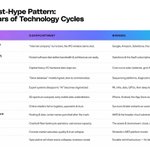
But that is not a contradiction. It is a very common pattern. Every technology cycle follows a similar arc.
At the peak, capital chases the label: “dot-com,” “AI,” “crypto,” “cleantech,” “metaverse,” “quantum.” Marginal companies get funded on narrative alone. Valuations detach from fundamentals. The category becomes more important than the product.
Then the correction comes. Generalist capital leaves. Media attention declines. Public-market proxies de-rate. Founders who entered for momentum disappear.
But in durable sectors, the fundamentals keep improving after attention moves elsewhere:
- Infrastructure becomes cheaper and more reliable.
- Developer tools mature.
- Regulation becomes clearer.
- Business models become more disciplined.
- Real users adopt the technology for practical reasons rather than speculative excitement.
This creates a post-hype productivity window:
The market continues to discount the category because the previous narrative failed, while the investable opportunity has already shifted from storytelling to measurable productivity.
Historically, this is where some of the strongest companies — and some of the strongest entry points — are created.
- After the dot-com crash: Google, Amazon’s recovery, and Salesforce.
- After the ASP cycle: SaaS, rebuilt on better architecture and subscription economics.
- After the telecom crash: overbuilt fiber became the substrate for cloud, streaming, and enterprise connectivity.
- After the ICO winter: stablecoins, custody, wallets, analytics, and DeFi infrastructure became the foundation of the next cycle.
The failure of the first narrative does not imply the failure of the underlying technology.
Often, it creates the conditions for that technology to become useful.
At @Polymorphiccap, we do not ask whether a sector is fashionable. We ask whether the fundamentals kept improving after everyone stopped watching:
- Usage growth.
- Falling infrastructure costs.
- Regulatory clarity.
- Incumbent adoption.
- Founder quality.
- Real use cases.
- Reset valuations.
Our thesis has always focused on practical, application-centric Web3 businesses: payments, settlement, stablecoin infrastructure, tokenized assets, compliant financial rails, liquidity networks, and machine-native commerce.
We believe the practical Web3 applications now show all the key signals of a post-hype productivity window.

Eldar | Polymorphic Capital retweeted

Backed @Nevermined_ai before agentic payments were consensus. Today the market is catching up.
Proud to see @dongossen and his team among the select partners building this next chapter of financial infrastructure alongside @Mastercard.
Early conviction. Exceptional founders. Category-defining outcomes.

1/6 @Mastercard just launched Agent Pay for Machines. New infrastructure built for AI agents to transact with each other, autonomously, at machine speed.
@Nevermined_ai is part of it 🧵


Thanks @g_arakelov !

@polymorphiccap is one of the most active Web3 funds today and one of the earliest investors in @FairMath , as well as one of the most value-add partners we’ve worked with.
If you’re raising in this space, you can get in front of the Polymorphic Capital team directly via Parley:
parley.zone/i/eldar
parley.zone/i/nataly
3
133
Eldar | Polymorphic Capital retweeted
@polymorphiccap is one of the most active Web3 funds today and one of the earliest investors in @FairMath , as well as one of the most value-add partners we’ve worked with.
If you’re raising in this space, you can get in front of the Polymorphic Capital team directly via Parley:
parley.zone/i/eldar
parley.zone/i/nataly
Eldar | Polymorphic Capital retweeted
With @Visa and x402 (@coinbase), @Nevermined_ai is turning agents into transacting entities, unlocking a new market where machines don’t just use services, they pay for them at internet scale.
Content, APIs, and data can now be monetized per request, creating entirely new revenue streams for digital businesses.
> Machine-native micropayments
> Delegated spending without human-in-the-loop
> Merchant acceptance via existing global rails
Any protocol. Any rail. Any price.
This is how new economies start.
Great work, team 🚀
1/8 🚨Announcement🚨
@Nevermined_ai unlocks autonomous agent payments using @Visa Intelligent Commerce, @coinbase x402 and @getVGS .
AI agents can hold persistent delegated card spending authority with safe policy enforcement set by the cardholder.
🧵👇

Eldar | Polymorphic Capital retweeted
Most people see AI agents as productivity tools. We see them as a new category of economic participant. The gap: agents can't hold persistent spending authority. Every transaction requires a human back in the loop.
@Nevermined_ai just shipped the rails that fix this in end-to-end agentic commerce stack.
Four industry innovations end-to-end:
1. Agentic tokens (Visa/MC's new token type – agent transactions are now visible/auditable)
2. Persistent delegation (months (not seconds) of spending authority, hard limits)
3. x402 micropayments (HTTP 402 finally works after 28 years)
4. Merchant acceptance via existing PSPs
Think of @Visa building VIC and @Mastercard its AgentPay specifically for this.
@Nevermined_ai just shipped the end-to-end agentic commerce stack. Check it out.

For those who’ve been around for a while, IDEX was never just another DEX – it was an era.
Long before fast L2 DEXs, long before Uniswap, back in 2018–2019, IDEX was the top app on Ethereum and basically the only place where you could properly trade tokens in a non-custodial way.
Yes, it was still slow, order books were thin, and gas could cost a fortune. But for its time, it was a real breakthrough: non-custodial trading, a functioning order book, matching engine, market orders.
Big thanks to @AlexWearn and the team for years of hard work and for making an invaluable contribution to the creation of this industry. True pioneers.

Nine years ago we launched IDEX with a simple thesis: onchain trading didn't have to be slow, clunky, or unsafe.
Today that infrastructure becomes @KatanaPerps.
2
129
Eldar | Polymorphic Capital retweeted

🚨Alpha alert 🚨
@tempo just went live a few minutes ago. With the mainnet launch, they’re also launching the Machine Payments Protocol spec. I received early access to the specification, and have some initial thoughts.
First off, the MPP spec is a new, alternative take on the 402 “request for payment” http code. It differs fundamentally from x402 in that it removes the Facilitator from the architecture. On the one hand, removing an intermediary from the flow is usually a good idea. On the hand, it moves processing logic handled by the Facilitator to the merchant Server. Time will tell if this is good or bad, but my guess is that there’s a belief that the server side agent will be able to optimize the merchant flows, so having a 3rd party do that is redundant. Now we need to wait and see…
The MPP spec also designs for different payment methods beyond stables, including support for fiat via credit card payment, which I think is a win. Adding to this is a PSP agnostic approach, which I thinks a double win. Merchants should be able to choose whatever payment method they want, processed by whatever payment service provider they want.
Now onto the questions I have. First, for card payments the spec has a novel encryption method where the Server (i.e. the Merchant) controls the decryption of the Client's payload. Unfortunately, this raises questions about PCI compliance. The Server doesn’t control how the Client (the buying agent) manages its card delegation. The prescribed route seems to be DPANs, but raw PANs are also in scope based on the spec. Because the Server doesn’t control the CHD payload, raw PANs can be encrypted and sent to the Server for forwarding to the Server’s PSP. This, in turn, would require the Server to be PCI compliant unless it can guarantee the payload is only ever a DPAN. Requiring every Server to be PCI SAQ A or, worse yet, SAQ D compliant is not scalable.
Second, the spec enables multiple payment methods, but doesn’t resolve transactions globally. While this might look normal, for agent-to-agent payments to scale, imo having a global ledger that all agents are able to plug into is the optimal approach.
Why you ask? For a number of reasons, but one specific reason is identity establishment. Agent identity will be tied to statistical modelling based, in part, on transactional history. The contemporary example of this is credit risk profiling. However, compartmentalized transaction networks will lead to disparate transaction history, which will cause issues when trying to resolve behavior.
Congrats to all involved, including our partners at Visa and VGS. The space is making massive strides. Things are starting to come together, and we’re looking forward to putting the pieces in place.

Eldar | Polymorphic Capital retweeted

🇨🇾 @rise_pay EOR is now live in Cyprus.
Hire full-time employees with no local entity, fully compliant payroll, taxes, benefits — and payouts in fiat, stablecoins & crypto.
Cyprus just got a lot easier to hire in.
Global work, unlocked.
riseworks.io/rise-countries/…

Eldar | Polymorphic Capital retweeted
The global remittance market is vast and growing, with increasing demand for lower fees and modern digital infrastructure. Proud to back @theaadedewe and the whole @kredete team again in their lastest Series A.
@kredete is building a stablecoin-powered financial ecosystem for the African diaspora. Starting with remittances – a lifeline for some immigrant families – the platform is expanding to help users Send, Save, Spend, and Build Credit.
From powering $500M+ in remittances to launching Africa’s first stablecoin credit card, they’re reshaping access to finance for 700K+ users, and now expanding to Canada, UK & Europe.


We’re excited to announce that Kredete has raised $22M in Series A funding from @AfricInvest_Grp via their Cathay AfricInvest Innovation Fund and Financial Inclusion Vehicle (FIVE), @PartechPartners , and @polymorphiccap Capital to expand credit-building infrastructure and stablecoin-powered transfers across 40+ African countries.
Over the years, we have helped millions of African immigrants stay connected to home by making it easier to send money to their families, pay with cards, and save securely.
This raise fuels our next chapter as we expand our stablecoin infrastructure that powers global money movement for Africans everywhere—unlocking access, credit, and opportunity across 40+ countries.
To our team, partners, and investors—thank you. We’re just getting started.

Eldar | Polymorphic Capital retweeted
1/9 We’re excited to announce our investment in @TACEO_IO , an applied cryptography team building a private shared state network for the decentralized internet. @TACEO_IO is solving a problem that’s been blocking privacy adoption at scale 🧵👇


🚨 We've raised a $5.5M Seed round to build the network for Private Shared State.
Led by @archetypevc
With @a16zcrypto CSX, @cyberfund, a_capital, @polymorphiccap, @daedalus_angels, @wagmi_vc and others.
Here’s where we’re going


A taxi driver sending $500 in stablecoins each month to support his family in Africa is a meaningful Web3 user, creating real value for the ecosystem.
A degen cycling $500K through protocols to farm token incentives — and jumping to the next one tomorrow — is not.


2
5
254
Eldar | Polymorphic Capital retweeted

Built an AI agent but don’t want to implement a whole backend just to get it online?
⚡We built something for that — deploy your agent as an A2A server in minutes. auto-a2a.ai
🧵👇

