

Evolutionary and contextual analysis of cooperation, morality, religion, politics, and reasoning. | PhD cand. & lab manager @mint_lab. Open for collabs 📩
Joined June 2015
- Tweets654
- Following197
- Followers314
- Likes5.9K






Pinned Tweet
🚨 Our chapter with @_onurcanyilmaz, "Heroism as Moral Intuition," is now available in the Encyclopedia of Heroism Studies.
We explore heroism as evolved moral intuition for conflict resolution from the perspective of Morality as Cooperation Theory.
link.springer.com/referencew…

Ahlak, iş birliği ve gündelik hayatta verdiğimiz kararları konuşmak için Hedef Radyo’da Doç. Dr. Serdarhan Duru’nun konuğu olacağım. Dinlemek ve sorularıyla sohbete katılmak isteyenleri bekleriz!

5
79
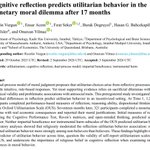
New paper in Judgment and Decision Making! 🧵
Does cognitive reflection predict how people behave in a moral dilemma with real money, not just how they answer hypothetical trolley problems?
We tested it across a 17-month gap. 👇

Exploratory but worth following up: religiosity moderated the link. Reflection predicted utilitarian choices more strongly among non-believers than believers, consistent with reflection following people’s epistemic norms rather than always pushing toward outcomes.

1
3
27
Huge thanks to my co-authors Rozelin Vurgun, Fırat Seker, Burak Dogruyol, @InsanEvrim, @_ozanisler & @_onurcanyilmaz! A @mint_lab collaboration! 🙏
📄 Open access, with open data & code: doi.org/10.1017/jdm.2026.100…
46
Ensar Acem retweeted

What do people actually do when the trolley problem is played with real money?
The trolley problem asks whether you would pull a lever to divert a runaway trolley so that it kills one person instead of five. It is almost always studied as a thought experiment. In a new paper in Judgment and Decision Making, led by Rozelin Vurgun, we made it real. People could take one person’s dollar so that five others would each get one. About 7 in 10 did.
We had tested the same people 17 months earlier. Those who were better at catching their own mistakes on tricky puzzles back then were more likely to choose the greater good. A widely used questionnaire (Oxford Utilitarianism Scale) on “greater good” attitudes told us nothing about what people actually did. And careful thinking mattered for non-religious participants but made little difference for religious ones.
Thinking harder doesn’t lead everyone to the same place. Where it leads depends on what a person already believes good thinking is.
Rozelin led this work as a master’s student in our Moral Intuitions Lab (@mint_lab). I also wrote a plain-language version for my Psychology Today (@PsychToday) blog.
Links to both are in the first comment.


Ensar Acem retweeted

Scientific fields where claims are more empirically testable have more equal citation distribution


Ensar Acem retweeted
We developed a religious prime that works.
For twenty years, psychologists have asked whether reminding people of God makes them more honest or generous. Almost none of the primes used in those studies were ever tested to see if they actually activate religious thoughts. The explicit ones work, but about 1 in 9 participants guesses what the study is about.
So we hid religious words and images inside ordinary CAPTCHA tasks and tested them in a preregistered study with 2,770 participants.
Our technique raised religious thoughts well above control, and only 6% of participants guessed the purpose.
Generosity did not change.
The field now has a validated, low-suspicion tool, with separate primes for punishing, rewarding and forgiving images of God. Materials and data are open.
New paper in Behavior Research Methods, from a project funded by @TempletonRelig and co-led by Fırat Şeker (@firat_sekr UMass Amherst, formerly MINT Lab) and Ensar Acem (@ensaracem MINT Lab, @mint_lab), with Rozelin Vurgun, Burak Doğruyol, and Ozan Isler.
Psychology Today (@PsychToday) post and the link to the article in the first comment.


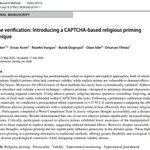
🧵 New paper out in Behavior Research Methods!
Can we prime religious thoughts without participants realizing they’re being primed?
We introduce “allusive priming”: religious cues embedded in CAPTCHA-like tasks.
Free full text: rdcu.be/td6ddgzAE5Ua

Beyond religion, the CAPTCHA format can be adapted to prime other constructs in online studies with lower demand.
Data, code & materials are open: osf.io/7m5bn

1
2
30
Thanks to my co-first author @firat_sekr and to Rozelin Vurgun, Burak Dogruyol, @_ozanisler & @_onurcanyilmaz. A Moral Intuitions Lab (@mint_lab) collaboration, and a great team to work with 🙏
We have three Lightning Talks at the Big Team Science Conference 2026, and I'm presenting two live on Zoom 🌍
Two, with @_onurcanyilmaz, ask what cross-cultural research often skips:
1. Do we know the contexts we're comparing?
2. Do our measures mean the same thing everywhere?
⚡ ManyContexts: Measuring the Worlds That Big Team Science Samples
📅 Wed, Oct 7 | 13:00–13:55 UTC
⚡ Invariance Blindness: When Cross-Cultural Inference Outruns Measurement Validity
📅 Thu, Oct 8 | 10:30–11:25 UTC
Third, a Psychology of Science Hub collaboration I co-authored:
⚡ Publishing, Incentives, and Conflict: An Action Research Inquiry
📅 Thu, Oct 8 | 10:30–11:25 UTC
Sessions have several talks; stay for the whole slot!
🎟️ Register free: bigteamscienceconference.git…

1
36