






No hay que reírse del mal ajeno y todo eso..
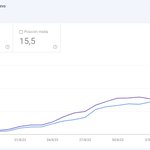
Pero debo admitir que me saca una sonrisa ver el tráfico orgánico en el inframundo en webs que en su día nos la jugaron eliminando artículos patrocinados dejándose aconsejar por "SEOs" o agencias bien gordas que les dio por decir...
1
3
442
cosas de las que no tenían ni puta idea.
Y mira que avisamos y aportamos datos.
El resultado después de años es lo que ya se sabía, sin efecto, los que se dejaron aconsejar y siguieron vendiendo se ahorraron la agencia y mantuvieron una fuente de ingresos grande.
1
1
80
Estoy leyendo mucho estos días a favor de Feijóo argumentos como que "ha gestionado" o "en 30 años no le han pillado nada".
Es muy triste utilizar esos argumentos, pero es más triste todavía que de verdad eso son argumentos super positivos contra el resto.
55
Valentino retweeted

Que los políticos den estas cifras de patrimonio sólo pone de manifiesto o que administran pésimamente sus finanzas personas o que logran ocultar la mayor parte de su auténtico patrimonio. No hay otra. Y ninguna de las dos es motivo para estar orgulloso.

Valentino retweeted

A mí lo más grave es que cobran seis cifras al año pero van a La Revuelta a decir que apenas tienen ahorros y parece que queda hasta humilde. Si con ese pastizal tienes cuatro duros en la cuenta, cómo vas a gestionar un país??? O mienten o son unos inútiles. Seguramente ambas.
Valentino retweeted

En esta red social se habla mucho de Dembelé, Haaland, Mbappé, Harry Kane, Olise, Kvaratskhelia y muchos más.
El día que se hable de fútbol y no de marketing todo va a cambiar. Algun día se va a valorar a Raphinha, el máximo goleador de las 5 grandes Ligas de Europa.

¿No existe software en otros países que podamos comprar en lugar de desarrollar uno?
Necesitamos algo en producción YA, no empezar a desarrollar algo que luego requiere unos testeos fortisimos.
Y la IA, sobra. Palabrería y contratos para gastar sin sentido.

Puente anuncia la creación de un nuevo software para los centros de control de Adif y un agente de IA para detectar anomalías
1
2
137

Valentino retweeted

Es probablemente de los discursos más sensatos, sinceros y sosegados realizados JAMÁS por un deportista a la hora de recoger un galardón. Este hombre es oro.


Valentino retweeted

Capitalism has a win condition. Socialism does not.
Here's why, explained so simply a 10-year-old could get it. It starts with a book written in 1944 by an Austrian economist named Friedrich Hayek: The Road to Serfdom.
Imagine a classroom of 30 kids. One day the teacher says: "From now on, I decide what everyone eats for lunch, which games you play at recess, and who sits next to whom. It's fairer that way."
First problem: the teacher doesn't know what you like. You hate carrots. Your friend is allergic to peanuts. Lucas wants to play football, Emma wants to draw. 30 kids, 30 different wishes. Nobody can know all of that, not even the smartest teacher on Earth. Hayek called this the knowledge problem. The information needed to run an economy is scattered across millions of heads, and it can't be gathered in one office.
Second problem: the kids start fighting. "Why does he get the window seat?" "Why football again?" Before, everyone just chose for themselves. Now every choice is a fight, because every choice is made for everyone.
Third problem: the class can't agree on a plan, so someone says "we need one person in charge who just decides." This is Hayek's key insight. Planning doesn't fail because planners are evil. A plan needs everyone to agree on the same goals, and free people never agree on everything. So the plan needs force to work.
Fourth problem, and it's the scariest one: who wants that job? The kind kid doesn't want it, because the kind kid doesn't want to force 29 people to eat carrots. The job attracts the one who likes giving orders and doesn't mind punishing those who disobey. Hayek wrote a whole chapter on this, called "Why the Worst Get on Top." It doesn't happen by accident. It happens by selection.
Here's the trap. When the person who controls your lunch also controls your job, your home, your shop and your newspaper, they control your whole life. You can't say no, because there's nowhere else to go. Controlling the economy doesn't mean controlling one part of life. It means controlling the means to every goal you have.
That's the road to serfdom. Nobody votes for a dictator. People vote for "someone should fix this," then for "give them more power to fix it," and one day they wake up with no one left to say no to.
The USSR, Maoist China, Cambodia, North Korea, Cuba, Venezuela. These are different countries with different cultures and languages, and the story has the same ending every time. When a script produces the same ending every time, it isn't bad luck. It's the script.
Now capitalism. Back to the classroom. Instead of one teacher deciding everything, every kid can trade. You give me your carrots, I give you my apple, and we both walk away happier. Nobody needs to know what everyone wants, because prices do that job. A price is a message telling millions of strangers what's scarce and what's wanted, with no one in charge.
That's the win condition. In capitalism, you get rich by making something other people freely choose to buy, so your success depends on serving others. In a planned system, you get ahead by pleasing whoever holds power. One rewards usefulness. The other rewards obedience.
And this isn't theory. Two centuries ago, almost every human being was extremely poor. In 1990, about 38% of humanity still lived in extreme poverty. Today it's under 10%. More than a billion people escaped it in a single generation. It happened when China, India, Vietnam and South Korea opened up to markets, trade and private enterprise. The largest reduction in poverty in human history came from letting people trade.
So why do so many people hate capitalism?
Because what they hate usually isn't capitalism.
They hate the bank that got bailed out with their taxes while they lost their house. They hate the giant company that writes the regulations so no startup can compete with it. They hate rent they can't afford because building new homes has been made nearly impossible. They hate the lobbyist who gets a subsidy while the small business owner drowns in paperwork.
Look closely at each one, and you'll find a state handing out privileges. A bailout is not the market. The market would have let the bank fail. A regulation written by incumbents is not competition. It's protection from competition. None of this is capitalism. It's cronyism, which is what happens when businesses stop competing for customers and start competing for politicians.
People see the symptom and blame the wrong cause. They say "capitalism failed" and ask for more state. That gives more power to the same people who created the problem, and it puts us right back on Hayek's road.
The answer to bad capitalism isn't less freedom. It's less privilege. That means fewer bailouts, fewer protected incumbents, fewer permits, and more people allowed to build, compete and trade.
Capitalism has a win condition: make things people want. Socialism has an end condition: someone has to be in charge. And history keeps showing us who ends up in that chair.

Valentino retweeted

El @AFCAjax es uno de los clubes europeos que mejor trabaja los vídeos y el social media. Así anuncian el partido de leyendas Ajax vs Barça del próximo 15 de noviembre.
Valentino retweeted

De los mejores videos que he visto en mi vida.
Honor al autor.
Compartidlo como si os fuera la vida en ello.
Me parece una locura lo que admite aquí cuando habla de qué se podría mejorar frenando, el peor de todos, darles tiempo para ENTENDER los modelos que están sacando o el asumir que los modelos les engañan...
Y entre las propuestas, limitar el uso de IA para sacar nuevos modelos.

We Must Pace the Frontier: I’ve written a new essay on why the AI industry should slow down, with a three-part plan for doing so.
Anthropic is unilaterally committing to the first of these steps. We’ll provide third-party evaluators with permanent, employee-level access to our systems, so that they can verify adherence to our safety measures, report on incidents, and assess models’ alignment during training.
You can read the full post here: darioamodei.com/post/we-must…

1
132


Valentino retweeted

Declaraciones de Raphinha:
"Quiero ayudar a Lamine, Adeyemi y Gordon"
"Sé que los delanteros necesitan goles"
"Intentaré hacer todo lo posible para que marquen. Somos una familia y los miembros de una familia deben cuidarse entre ellos"
Y hay quien quería vender a este crack.
Valentino retweeted

Pro poker player here. I assess risk for a living in situations where outcomes are unknown.
For example, when I call a bet from my opponent, I can't know for certain what two cards they're holding.
The best I can do is think through all the possibilities, assess my risk and reward, then place my bets accordingly.
I've refined this process over millions of hands of poker and 20+ years at the table.
I use a simple to follow risk/reward framework, which can easily be applied to real world scenarios.
For example, like whether to build superhuman AI (AGI) that could help us achieve immortality or end humanity.
How do we decide whether it's worth the risk when we have no clue what the outcome will be?
Well, there's a principle in poker called "asymmetry".
It describes situations where the outcomes are unequal.
For example, you enter a poker tournament for $10,000 where the first place prize is $10M.
Worst case you lose $10K, best case you 1,000x your investment.
It's a great risk/reward and a classic "asymmetric opportunity" that poker pros dream of.
But the knife cuts both ways. There are plenty of situations where the asymmetry is to the downside.
Lots of risk, low reward. Pros try to avoid those.
The most important principle in bankroll management is that you never take a bet you can't afford to lose.
Even if the potential upside is great, a pro never risks it all on one hand, one game, or one tournament, because there is simply too much variance, luck and factors beyond their control.
Too many unknowns.
At a certain point, protecting existing capital is more important than gaining additional capital, because if go broke you not only lose all your money, but all of your future earning potential too.
Arguably the most important and under rated aspect of being a poker pro is managing risk well enough to simply stay in the game.
As I learned the hard way after round tripping a million dollar bankroll before I turned 21, you build up slowly, but can go broke quickly.
This bring us to AI, which is really just a classic hand of poker.
There's massive upside - solving aging, curing all disease, advancing human knowledge, becoming interstellar, etc.
There's also cataclysmic downside – like humans going extinct if this goes haywire.
Thinking over both the risk and reward, it's clear the asymmetry of building superhuman AI is to the downside.
My thesis is simple: no future gain in productivity is worth the risk of ending civilization.
The bulls argue that "the probability is low", but that fails to acknowledge that not all risk is created equal.
The reason it's not worth playing Russian roulette – even if the payoff is high – is because the potential gain isn't worth dying for.
That's true even if the probability of dying is low.
Accelerating civilization to superhuman AI while failing to solve the alignment problem is akin to playing Russian roulette with humanity.
Naturally, this is dumb and should be avoided.
We should continue progressing, of course, but only so long as we don't take on risks we can't afford.
We can literally "go broke" (extinct) in one fell swoop if superhuman AI isn't architected carefully.
One thing poker teaches you is that "bad beats" ( improbable hands that don't go your way) actually happen more often that you'd first expect.
Sometimes there's only one card in the deck that can help your opponent, and sure enough, it comes at the end and you lose all of your chips.
The only reason pros survive is because they manage risk and capital in such a way that they can continue playing the game.
Superhuman AI, if misaligned, is like putting all your chips on the table and risking them in one hand of poker.
It doesn't matter if the odds are favorable. If luck doesn't go our way, we lose everything.
Once we're extinct, we can't play anymore. As I'm sure you'd agree, that's not a great outcome.
We don't get another buy-in at the table, or a second shot at this. As we say in poker, we're all-in!
I hope my poker lens helps clarify the situation in laymens terms.
TLDR; Even though the probability of catastrophe due to AGI may be low, we must first defend against unaffordable risks, and make progress second.
This is arguably the most pressing issue of our time. If this resonates, please share for awarness.
If anyone working in AI at @AnthropicAI, @OpenAI or elsewhere would like to discuss further, I'm happy to help in any way I can - feel free to DM.
As we say in poker when the stakes are high and we're praying to win, "onetime!"

The people building AI earnestly believe that it could kill us all by the end of the decade. This is not a marketing stunt. If anything, many executives and senior researchers will couch their phrasing in the press to sound sensible - but I hear the same people express fear privately. No other human activity poses this level of danger.