

Zooarchaeologist, living history/experimental archaeology fan, horse-mum, and enjoyer of folk music. (All opinions my own etc.).
Joined March 2009
- Tweets1.9K
- Following702
- Followers490
- Likes1.2K


Pinned Tweet
Amazing news from @AntiquityJ our chicken paper has won the Ben Cullen 2023 prize!! So fabulous to have the work of @CUHistArchRel @CUBALab
@UofEArchaeology @BU_ArchAnth @school_of_arch
(& many, many more) recognised in this way. Thanks to everyone involved & the Antiquity team

Congratulations to Julia Best et al., winners of the 2023 Ben Cullen Prize!
Their research uncovered that the chicken was introduced to Europe and North Africa much later than previously believed.
Check out the officially award-winning work (🆓) buff.ly/3xlcBVj
Julia Best retweeted

#AntiquityThread on this year's Ben Cullen Prize-winning research from Julia Best @Estalwin et al.
@CUHistArchRel @BU_ArchAnth @UofEArchaeology @school_of_arch 🧵
Chickens arrived in Europe relatively recently and were initially regarded as exotica!
🆓 buff.ly/3xlcBVj

ALT Scientist examining animal bones with the text 'Ben Cullen Prize 2023. Redefining the timing and circumstances of the chicken's introduction to Europe and north-west Africa'. All the authors are also listed
What a lovely cover piece! And well done to @AnastasiaStupko too. @CUBALab @UofEArchaeology @school_of_arch @BU_ArchAnth @CUHistArchRel

🆕 June @AntiquityJ is now online! antiquity.ac.uk
My latest editorial features an update on author demographics plus the 2023 #Prize winners: congratulations to @Estalwin & @AnastasiaStupko!
🆓doi.org/10.15184/aqy.2023.74

ALT Aerial photograph of war damage in Ukraine and journal cover
2
111
Julia Best retweeted

Thanks for sending us your paper! Also one of our top-downloaded papers of 2022!
Julia Best retweeted

Congratulations to our Dr Julia Best!
Congratulations to Julia Best et al., winners of the 2023 Ben Cullen Prize!
Their research uncovered that the chicken was introduced to Europe and North Africa much later than previously believed.
Check out the officially award-winning work (🆓) buff.ly/3xlcBVj
Julia Best retweeted
🏆The Ben Cullen Prize for 2023 is awarded to
Julia Best & (many!) colleagues for their @AntiquityJ article on the timing of the introduction of #chickens to Europe and NW Africa. Those bones are later than you think...
Congratulations to all! 🎉
Congratulations to Julia Best et al., winners of the 2023 Ben Cullen Prize!
Their research uncovered that the chicken was introduced to Europe and North Africa much later than previously believed.
Check out the officially award-winning work (🆓) buff.ly/3xlcBVj
Julia Best retweeted

"It is clear that human-chicken relationships were complex and about more than just food for quite some time" 👇 ow.ly/8tzp50JFxk1
Our chicken research featured on @ConversationUK by @Estalwin and yours truly
@CagToulouse @MSCActions @AraucanaProject

Julia Best retweeted

Dr Julia Best, @Estalwin, a lecturer in bioarcheology from @CUHistArchRel, writes for the @ConversationUK about her latest research which has furthered understanding of human-chicken relationships.
theconversation.com/before-c…
Julia Best retweeted

🦴 An international team of researchers employed radiocarbon dating on bones from 2️⃣3️⃣ of the earliest claimed chickens. This is the first time a programme of direct dating has been systematically applied to them.
More on our website ➡️ go.cf.ac.uk/3xdh37e

ALT Gloved hands hold two ancient chicken bones up for comparison. More chicken bones are lined up on a table cloth below.
Julia Best retweeted
🐔 Chickens were introduced to Britain, mainland Europe, & North Africa later than previously thought & were primarily regarded as exotica not food, new research from @CUHistArchRel suggests.
🎥 Lecturer in bioarchaeology Dr Julia Best - @estalwin - discusses the findings.
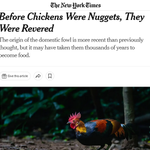
This brilliant piece just out nyti.ms/3xbZAfI draws together our exciting new research from PNAS (https://nitter.cf/t.co/SRdXMNFt5X) & Antiquity (https://nitter.cf/t.co/JESb1DqFkQ). With @ArchaeOphelie @Greger_Larson @ProfNaomiSykes Joris Peters, Mark Maltby & many more. Thread of 19 tweets:

And as for me? Well, this is the first time that radiocarbon dating has been used on this scale to determine the significance of chickens in early societies. Our results demonstrate the need to directly date proposed early specimens.
1
3
