

@ETHGasOfficial
Account based inUnited States!
About this account
- Account based in
- United States
- Connected via
- Web
X says this location may be affected by a proxy or VPN.
Account-level information from X, not a live location or the device used for a specific post.
The Realtime primitive that accelerates Ethereum over 100x
Ethereum
Joined August 2023
- Tweets2.3K
- Following95
- Followers305K
- Likes3K
Pinned Tweet
Ethereum has a 12-second blocktime. By slicing the block into sub-blocks, Realtime Ethereum moves in milliseconds ⚡️
No more waiting. No more uncertainty. Just 100x faster. The era of Realtime Ethereum starts now.
Go Realtime at : docs.ethgas.com/realtime/
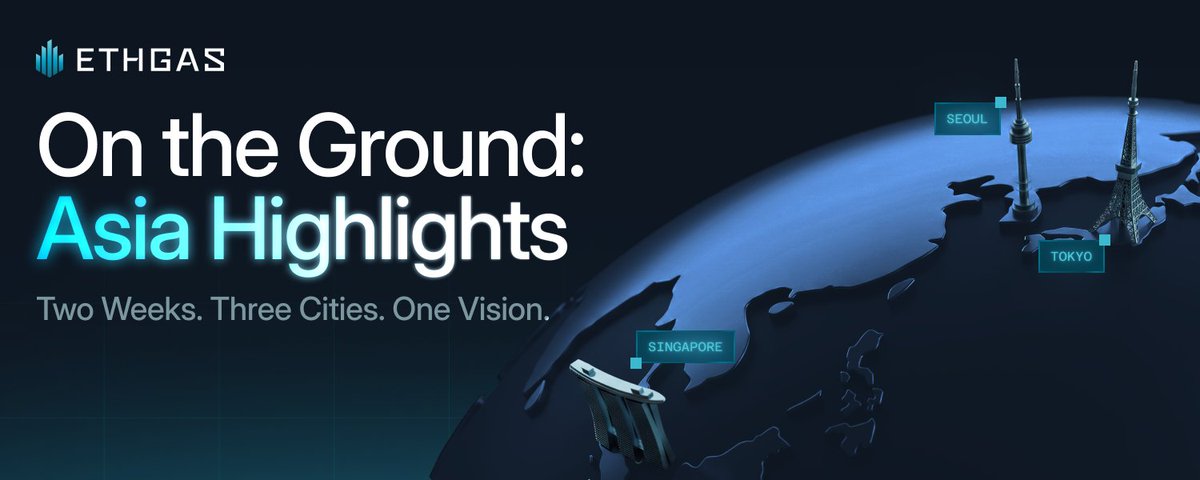
From the builder and institutional rooms in Tokyo, to three stages in Seoul, to TOKEN2049 in Singapore: institutions own ETH.
The question has moved from holding ETH to using ETH.
Read our APAC tour recap: nitter.cf/ETHGasOfficial/status/…

On the @token2049 stage last week, we were asked: what does “the next generation of ETH” actually mean?
After two weeks in Tokyo, Seoul and Singapore, my answer is simple 🧵

ETHGAS retweeted

Today's episode with @lepsoe, Founder of @ETHGasOfficial, dives into:
- Why ETH could become a strategic reserve asset for governments and corporations
- His case for $10,000 $ETH within the next two years
- Why asset managers are turning to tokenized assets for better execution and lower fees
TIMESTAMPS:
00:00 Intro
01:24 Ethereum's Institutional Shift
03:21 What's Still Missing From DeFi
05:43 Building Real-Time Ethereum
06:15 Why Blockspace Matters
07:21 What If Ethereum Were 100x Faster?
09:02 ETH as Strategic Infrastructure
11:51 Is Ethereum Having a Comeback?
13:19 ETHGas as Ethereum's “Supercharger”
14:40 Kevin's $10,000 ETH Thesis
16:43 Ethereum Treasury Companies
18:09 What Ethereum Needs Next
18:41 Bringing Institutional Capital Onchain
20:26 Why Institutions Want to Move Onchain
21:50 Can DeFi Cut Out Banking Middlemen?
23:54 What Institutions Want From Ethereum
25:40 AI Meets Onchain Finance
25:53 Why AI Agents Could Choose DeFi
27:15 Building Through Ethereum's Market Cycles
28:31 Ethereum's Decentralization Advantage
29:46 Where Ethereum Could Be in One Year
Watch below or on X:
ETHGAS retweeted

9월 28일 여의도 콘래드 서울에서 열린 Ethereum Korea One Day 1 기관 컨퍼런스의 기록을 공개합니다.
참여하지 못해 아쉬웠던 분들을 위해 세션별 발언을 현장 분위기까지 느끼실 수 있게 그대로 정리했습니다.
보고서가 정리한 7가지 인사이트:
1. 질문이 "쓸 것인가"에서 "어떻게 쓸 것인가"로 바뀌었다
2. 퍼블릭이냐 허가형이냐보다 연결과 통제를 어떻게 설계하느냐가 핵심이다
3. 기관이 먼저 묻는 것은 통제권이다
4. 토큰화의 가치는 디지털 래퍼가 아니라 유동성, 정산, 담보에 있다
5. 에이전틱 AI는 새로운 결제 수요이자 결제 레일 경쟁이다
6. 한국의 병목은 기술보다 제도, 회계, 사업성이다
7. 기술보다 먼저 정할 것은 수요와 "왜 온체인인가"다
[KR] docsend.com/view/q6drx4un89r…
[EN] docsend.com/view/n8nkynag3ry…

ETHGAS retweeted

A DAT Is Not a Megaphone Anymore. It Is a Distribution Channel.
Panelists Christopher Jensen (@jensane2001, @stablecoin_x), Hyunsu Jung (@hyperiondefi) and Kevin Lepsoe (@lepsoe, @ETHGasOfficial) discussed "Digital Asset Treasury: The New Frontier of Corporate Finance."
What is a DAT actually for?
Not promotion, and Jensen said it plainly. His StablecoinX holds roughly 20% of Ethena's total token supply.
"DAT companies are no longer simply businesses that promote or speak for a specific digital asset."
His reframe: the ecosystems behind these assets contain real products, and a DAT can push those products through distribution channels protocols cannot reach directly. Holding company to distribution platform is a different business, and he called the shift a significant one for the category.
Is accumulating the job?
No, and Jung of Hyperion DeFi treated that as an obligation rather than an option. What DATs need to do is go beyond continuing to accumulate and consistently contribute to the growth of those ecosystems, which means putting the balance sheet backed by those holdings to practical use. His own example: when new markets or products launch on Hyperliquid, Hyperion can supply capital and infrastructure and share in the resulting revenue, while building credit and trading infrastructure for participants entering the ecosystem.
So how should anyone value these companies?
This is the consequence nobody has priced yet. Jensen's read is that market cap to modified net asset value is the first metric comparing across DATs, but over time they get valued as a sum of their parts. Treasury assets on one side, operating businesses using those assets on the other, and the operating side judged on revenue, customers and ARR like any other company.
If DATs start trading on ARR instead of token beta, the whole category re-rates on operations.
Moderated by Jun Kim (@junkim), General Manager of Investor Relations at Hashed (@hashed_official).
#EastPoint #EastPointSeoul2026 #EPS2026

We're at @token2049 🇸🇬
The question we keep hearing: how do institutions go from holding ETH to actually using Ethereum?
Come say hi 👋

ETHGAS retweeted

Most banks started on permissioned networks, and that did real work for hedging the risk and building capability. @motypes 's EthConnect 2026 keynote was about what comes after, because the architecture chosen at step one sets the cost of step three, and the wall on the way to a public network is almost always confidentiality.
Confidential is not anonymous. It is control over who sees what, when and how: the counterparty sees the trade, everyone else sees only a proof that it is valid, the operator sees nothing, and the regulator holds a disclosure key.
The same question ran through both panels. Good conversations with @Sharplink , @LidoFinance , @ETHGasOfficial , @Offchain , @zama , @axelar and @FourPillarsFP , and our thanks to @0xundefined_ for hosting.
Coverage in threads 👇🏻

ETHGAS retweeted

Proud to see ETH CONNECT 2026 featured in the Korean press. We brought together leaders from Korea’s financial sector and the global Ethereum ecosystem for a meaningful conversation about what’s next for on-chain finance.
Huge thanks to everyone who made it happen! @Sharplink @eth_systems @zama @ETHGasOfficial


ETHGAS retweeted
Thank You for Joining Us at EastPoint:Seoul 2026
September 28, Westin Seoul Parnas
On Monday, 627 people came through the doors at the Westin Seoul Parnas, each there by invitation or approved application.
Central banks, regulators, legislators, traditional financial institutions, Korean enterprises, global protocols, infrastructure companies, investors, and builders spent the day in the same building, listening to each other and taking questions from the room.
That was the point of EastPoint.
Why EastPoint Exists
Korea did not arrive here with an obvious advantage. It built capital, technical depth, and consumer technology adoption over decades.
What has been harder to build is a single table where the people responsible for policy, institutions, enterprise, and technology can sit together long enough to test their assumptions.
Policy has often moved in one direction, institutions in another, and builders in a third. Each side has had its own constraints, its own language, and its own reasons to believe the others were not ready yet.
EastPoint was created to make that distance smaller.
It is not only a tech conference, and it is not only a finance conference. It is a room where finance, technology, policy, and enterprise are asked to meet each other seriously enough to disagree, clarify, and move the conversation forward.
A Room Built for Decision-Makers
EastPoint was intentionally narrow, but not small.
The day brought together 627 checked-in attendees from 385 companies and institutions, alongside 112 speakers, 22 sessions, and 40 roundtables across 4 public and 36 private discussions.
Among profiled attendees, 62% were senior decision-makers: 156 C-level leaders, founders, and CEOs, together with 231 executives, division heads, and directors.
That composition mattered. The goal was not simply to gather a large audience. It was to bring together people with the authority to allocate capital, set policy, manage risk, build infrastructure, and reach users, and to place them in the same working conversation.
The mix reflected that intent: AI and digital asset companies, traditional financial institutions, asset managers, conglomerates, fintech companies, PE and VC firms, government and regulators, academia, and media. Banks, securities firms, asset managers, custodians, exchanges, payment companies, public institutions, and global protocols were not adjacent to the conversation. They were inside it.
Institutions, Enterprises, and Builders in One Room
Who stood on stage is the clearest expression of what EastPoint is trying to become.
Central banks, regulators, and legislators joined the conversation not as distant observers, but as participants: the Bank of Korea’s Office of Digital Currency, the White House Crypto Council, Abu Dhabi Global Market’s regulatory authority, DAXA, four sitting members of the National Assembly, and the Majority Leader of the Utah State Senate.
Traditional finance showed up with institutional weight: Franklin Templeton, Mirae Asset Global Investments, KB Asset Management, Hanwha Asset Management, Korea Investment Management, NH-Amundi, Meritz Securities, and Eugene Investment & Securities.
Korean enterprise brought a question that matters beyond financial markets: how any of this reaches ordinary users. Kakao Pay, LG Electronics, LG CNS, SM Entertainment, and many others helped widen the frame beyond infrastructure alone.
And the builders who have spent years constructing the rails were there as well: @a16zcrypto, @hashed_official , @tether , @circle , @chainlink , @LayerZero_Core , @Anchorage, @BitGo , @FalconXGlobal , @Ondo, @Avax , and many others.
Many of these conversations continued beyond the stage, in roundtables where the more difficult and less polished questions had room to breathe.
What We Heard
The distance between institutions and builders felt shorter than many expected.
Institutions were not asking whether digital assets are real. They were asking who holds the keys, who carries the liability, what settlement finality means in practice, and what standards they can responsibly rely on.
Builders were not asking simply for permission. They were asking what rules are worth building toward, and what kind of infrastructure would still make sense when the market becomes more institutional, more regulated, and more widely used.
Those are not separate conversations. They are the same question approached from different responsibilities.
Getting that question asked out loud, in front of the people who can actually move it forward, may be the most useful thing one day can produce.
Thank You
Above all, thank you to the 627 people who came.
You gave up a Monday and stayed through sessions that did not always offer comfortable answers. You carried the discussion into the roundtables, the hallways, the 1:1 meetings, and the conversations that continued long after the panels closed.
Across the day, attendees exchanged opinions and built partnerships through over 90 business meetings matched. Those numbers matter because they point to something more important: people did not just attend EastPoint. They used it.
The quality of EastPoint came from the questions you were willing to ask in public, and from the seriousness with which you listened to answers that were still unfinished.
Thank you to the 112 speakers who prepared, travelled, and spoke with care.
Thank you to our sponsors and partners,
@kakaopay_kr, @lmtls_research, @circle, @Presto_Labs, Vooy, @ADI_Foundation, @Anchorage, @BitGo, @CantonFdn, @circle, @DCENTWALLETS, @ETHGasOfficial, @FourPillarsFP, @GoKiteAI, @googlecloud, @hadron_tether, @hyperiondefi, @injective, @KaiaChain, @LayerZero_Core, @monad, @moonpay, @Ondo, @Optimism, @PingCAP, @plumenetwork, @soohoio, @talostrading, @Tiger_Research_, @virtuals_io, @Xangle_official
whose support made it possible to bring this room together with the care, independence, and hospitality it deserved. EastPoint was not built around banners. It was built around the conversation those banners made possible.
And thank you to our co-hosts @hashed_official, @bloomingbit_io, and @hankyungmedia.
Korea’s next financial layer will not be built by institutions alone, or by builders alone. If it is built well, it will be built through repeated contact between the people who regulate, allocate, operate, and build.
For one day, that was not a thesis. It was a room.
What we keep coming back to is that EastPoint was not a conclusion. It was a starting line.
Everything said on Monday is now a position that can be tested against a year of evidence. By next September, some of those positions may look obvious. Some may look early. And some of the most important questions may be ones none of us knew how to ask this time.
That is the work.
This was not the end of the conversation. It was the first page of it.
See you at the next one.


ETHGAS retweeted

Ethereum Institutional Summit 2026
Sep 25, Tokyo. 11 sessions done.
Thank you to all who spoke, sponsored, supported and attended.
Japan's first Ethereum-focused, invitation-only summit for financial institutions & institutional investors
eis.fracton.ventures
#EIS2026

ETHGAS retweeted

Real people making a real impact. And it all comes from bottom-up connections.
Thank you so much, Rongxin, @WPReadingClub, @wecandaoit, @ETHGasOfficial, and everyone for making this happen together at @enXross! @wecandaoit has been pulling out their amazing network.
I appreciate @Sprpstn, @justindico, @thescoho, and @JMatsushiba for their strong, continued support on this journey. Excited to see where it all leads.

Thanks to @WPReadingClub for having us! 🙏
Two sessions back to back: crypto meeting rural Japan's population decline, and how @ethereum block-building is being rebuilt.
A quick recap 🧵


ETHGAS retweeted
[Sponsor Fireside]
ETHGas( @ETHGasOfficial ) & Bitmine( @BitMNR )
記念すべき第1回目となる「Ethereum Institutional Summit 2026」のPlatinum SponsorであるETHGasによるSponsor Firesideを実施しました。

Agents can already pay.
What they still lack is execution they can rely on.
In his latest piece for @YellowMedia_HQ, @lepsoe explains why Ethereum’s next challenge isn’t just more throughput. It’s turning blockspace into infrastructure that agents and institutions can actually schedule.
Read: yellow.com/opinion/agent-eco…

Everyone’s building agents. Giving them wallets is the easy part.
The harder question is whether their transactions land when they need them to.
Ethereum has already built credible settlement. Now access to that settlement needs to become programmable.
If agents are going to coordinate capital at machine speed, blockspace has to become something they can schedule.
My latest for @YellowMedia_HQ: yellow.com/opinion/agent-eco…
ETHGas is hitting the road across APAC. ✈️
Over the next two weeks, the ETHGas team will join institutions, investors, and builders in Tokyo, Seoul, and Singapore to discuss Ethereum’s next chapter, from institutional adoption and onchain capital markets to the execution infrastructure they require.
Here’s where to find us👇

🇸🇬 Oct 6 | Founder × VC Summit - Institutional Capital Era
backersstage.com/founder-x-v…
